

Key Takeaways
- The global gluten-free food market was valued at USD 6.8 billion in 2023, projected to reach USD 12.5 billion by 2030 (Grand View Research, 2023) — growing at roughly 9% per year, driven by both medical diagnosis and voluntary adoption.
- Celiac disease affects approximately 1% of the global population but is diagnosed in only about 1 in 5 cases, suggesting the affected population is significantly larger than diagnosed rates indicate (Rubio-Tapia et al., Gastroenterology, 2012).
- Non-celiac gluten sensitivity (NCGS), which causes real digestive and systemic symptoms without celiac's autoimmune damage, affects an estimated 6-10% of the population and has driven most of the voluntary gluten-free adoption globally.
- In North India, celiac prevalence is estimated at 1 in 96-270 based on serology screening studies — far higher than previously estimated from clinic data (Singh et al., Indian Journal of Gastroenterology, 2016).
The gluten-free food market has roughly doubled every 5-7 years since 2010. This growth isn't driven primarily by celiac disease — that condition's prevalence hasn't changed. It's driven by a large population of people who've noticed that eating less gluten makes them feel better and have reorganised their food choices accordingly, whether or not they've had a formal diagnosis. Understanding why is more interesting than the market size number.
The Medical Foundation: Celiac and NCGS
Two distinct conditions create medically-motivated gluten-free eating. Celiac disease is an autoimmune condition in which the immune system attacks the small intestinal lining when gluten is present, causing villous atrophy and progressive malabsorption. It affects approximately 1% of the global population, with significant regional variation. In North India, recent serology-based screening studies estimate prevalence at 1 in 96-270 people — considerably higher than estimated from clinic-based data, where low awareness and infrequent testing mean most cases are attributed to other causes.
Non-celiac gluten sensitivity was formally characterised as a distinct clinical entity in 2011. NCGS produces real, measurable symptoms — bloating, abdominal pain, brain fog, fatigue, joint pain — without the autoimmune intestinal damage of celiac disease. It's diagnosed by exclusion: symptoms resolve on a gluten-free diet and return on reintroduction, in the absence of celiac disease or wheat allergy. Estimates for its prevalence range from 6-10% of the population. Combined with celiac disease, this represents a minimum of 7-11% of adults with a clear medical rationale for gluten-free eating — at India's population, roughly 100-150 million people.
Why People Without Diagnoses Are Going Gluten-Free
The majority of gluten-free food purchasers in developed markets don't have a celiac or NCGS diagnosis. They're choosing gluten-free foods because of perceived digestive benefits, clean label preferences, or because they've tried eliminating gluten and noticed improvement in how they feel. The most plausible explanation for this: the foods typically high in gluten (white bread, pasta, biscuits, packaged snacks) are also high in refined carbohydrates and low in fibre. Eliminating these foods and replacing them with whole grain alternatives — including naturally gluten-free grains like millet, rice, and buckwheat — improves overall diet quality regardless of any specific gluten effect. The improvement attributed to going gluten-free may often be an improvement in overall food quality that gluten elimination facilitated as a practical framework.
What's Driving Growth in India Specifically
India's gluten-free market is growing for reasons partly distinct from global trends. Indian urban consumers are increasingly reading food labels and questioning ingredient quality — FSSAI's consistently high product failure rates have received media coverage, and consumers are responding by seeking products with shorter, cleaner ingredient lists. Gluten-free millet-based alternatives often have simpler ingredient lists than processed wheat-based equivalents.
India's heritage grain culture is also being rediscovered. Millets were the dietary backbone of most of India before wheat displaced them through the 1960s-80s. The Indian government's Year of Millets campaign in 2023 and ICMR's updated dietary guidelines recommending millets as a primary cereal have accelerated both supply (more millet-based products reaching retail) and demand (growing consumer awareness of millet's nutritional advantages).
And the rising rate of lifestyle diseases — 77 million Indian adults with type 2 diabetes, growing rates of PCOS among urban Indian women, rising obesity rates — has created a motivated consumer segment looking for lower-GI, higher-fibre alternatives to refined flour foods. Gluten-free millet products address this need far better than conventional gluten-free alternatives made with rice starch or potato flour, which often have GI profiles similar to or worse than refined wheat.
What to Look for in a Gluten-Free Product
Gluten-free is a starting point, not a guarantee of nutritional quality. A gluten-free biscuit made with rice flour, potato starch, refined sugar, and palm oil has no meaningful nutritional advantage over a maida biscuit. The GI may be similar, the fibre content negligible, and the ingredient list no shorter or cleaner.
Products worth seeking out replace gluten-containing grains with nutritionally superior alternatives: jowar, bajra, ragi, amaranth, or combinations of these. Check that the grain appears as the first ingredient, not "rice starch" or "modified tapioca starch." Check the fibre content — a genuinely improved gluten-free product should have at least 3-4g fibre per 100g. And check the sugar content, since many gluten-free products compensate for the lost texture and palatability of wheat by adding more sugar.
Frequently Asked Questions
Is gluten-free eating a fad, or will it continue to grow?
The medical foundation (celiac disease and NCGS) creates durable minimum demand that won't disappear. The broader voluntary adoption will fluctuate with health trends, but the underlying driver — consumers wanting cleaner, less-processed food with better nutritional profiles — is unlikely to reverse. Products that deliver genuine nutritional improvement will sustain growth; products that are merely wheat-free without being nutritionally better will not. Millet and amaranth-based alternatives have a clear structural advantage over "gluten-free" products made with refined starches.
How can I tell if I might benefit from reducing gluten?
A basic elimination trial is the most practical approach: remove gluten-containing foods for 3-4 weeks and note changes in energy, digestion, skin, and mood. If improvement is noticeable, reintroduce gluten and observe whether symptoms return. This is diagnostic for NCGS, for which there's no blood test. If you suspect celiac disease, get tested before eliminating gluten — the blood test (anti-tTG IgA) requires active gluten consumption to be accurate. Eliminating gluten before testing will produce a false negative.
Are gluten-free products always more expensive?
Not necessarily. Whole millets and millet flour are often cheaper than wheat flour at the farm and wholesale level, though processing and premium branding add cost at retail. Traditional Indian gluten-free staples — jowar roti, bajra khichdi, ragi porridge — are inexpensive because they're made from minimally processed ingredients. Packaged gluten-free products at health food stores are typically priced at a premium. The most cost-effective approach to gluten-free eating in India is to cook with traditional gluten-free grains rather than buying packaged gluten-free versions of processed foods.
Try This Product
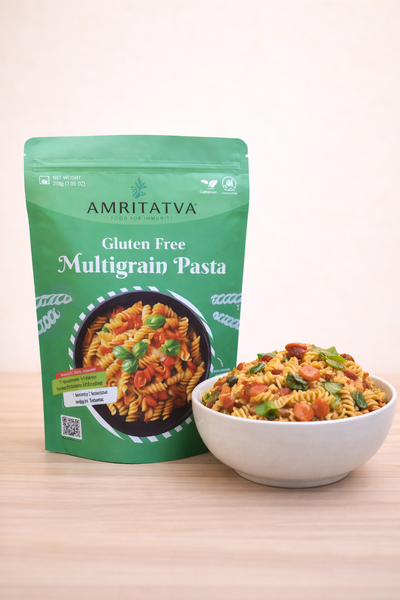
Amritatva Gluten-Free Millet Pasta
Millet pasta + mushroom seasoning. No maida, no MSG. Ready in 15 min.
Shop Now

0 comments