

Key Takeaways
- INS 621 (monosodium glutamate) appears in the ingredient lists of over 70% of India's top-selling masala blends, despite FSSAI permitting its use — it's a flavour amplifier that masks poor base ingredient quality (FSSAI additive database, 2023).
- INS 110 (Sunset Yellow FCF), an artificial colour in several commercial spice blends, is classified as a possible carcinogen by IARC and is banned for food use in Norway and Finland — it remains permitted in India below 100mg/kg.
- Amritatva's seasonings are produced under FSSAI licence 22222046000640 with full ingredient disclosure: oyster mushroom powder, whole dried herbs, whole spices, salt — no additive numbers on the label.
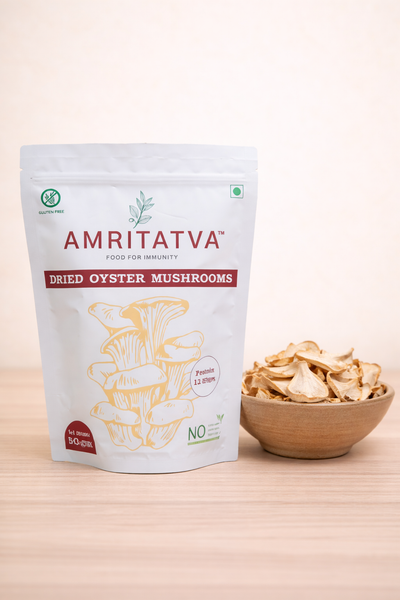
- Oyster mushroom powder in our seasoning blend contributes natural glutamates (not synthetic) for umami depth, plus beta-glucans and ergothioneine — functional compounds absent from any commercial masala blend.
Pick up almost any commercial masala blend and read the back. The first ingredient is often salt. The third or fourth is usually an additive number: INS 621, INS 110, INS 551. These aren't flavour — they're substitutes for flavour. We built our seasonings differently. Here's exactly what's in a commercial blend, what's in ours, and why each ingredient we use is there.
What's Actually in Commercial Masala Blends
A typical commercial all-purpose seasoning or masala blend sold in Indian supermarkets lists ingredients in this approximate order: refined salt (often first by weight, sometimes 40-55% of total product weight), maltodextrin (a refined starch filler with no flavour purpose except bulk), INS 621 (monosodium glutamate, a synthetic flavour enhancer), INS 635 (disodium ribonucleotides, a flavour enhancer that amplifies MSG), anticaking agents like INS 551 (silicon dioxide), INS 554 (sodium aluminosilicate), and — in products with visual appeal as a marketing hook — INS 110 (Sunset Yellow) or INS 102 (Tartrazine) for colour.
The actual herbs and spices appear later in the list, which means they're present in small quantities. The flavour you taste isn't primarily from turmeric, coriander, or cumin — it's from the MSG and flavour amplifiers. This matters because those spices have the functional benefits. Curcumin in turmeric is anti-inflammatory. Coriander seeds support digestion. Cumin contains thymoquinone with antimicrobial properties. When they're present in trace quantities masked by MSG, you get the flavour impression without the function.
What We Put In Our Seasonings and Why
Our Italian Seasoning and All-Purpose Seasoning list every ingredient in plain language: no INS codes, no additive numbers. The Italian Seasoning contains dried oregano, dried basil, dried thyme, dried rosemary, garlic powder, Amritatva Oyster Mushroom Powder, and sea salt. The All-Purpose Seasoning contains whole dried cumin, coriander, black pepper, dried ginger, garlic, Amritatva Oyster Mushroom Powder, and sea salt.
Every ingredient is there for a purpose. Oregano and thyme are not just flavour — both contain rosmarinic acid, an antioxidant compound with documented anti-inflammatory activity (Journal of Nutrition, 2019). Garlic powder contributes allicin precursors with antimicrobial properties. The herbs are dried, not extracted — which preserves the fibre matrix and secondary phytochemicals that extraction removes.
Why Oyster Mushroom Powder Is in Both Blends
Oyster mushroom powder solves the umami problem cleanly. Commercial blends use INS 621 (synthetic MSG) because umami is the flavour dimension that makes food taste complete and satisfying. Without it, many blends taste flat. Oyster mushrooms are naturally high in glutamic acid — the same compound that makes MSG work — but it's delivered in the matrix of a whole food with beta-glucans, ergothioneine, and Vitamin D2 precursors. One teaspoon of our seasoning provides functional mushroom compounds alongside the flavour benefit.
Ergothioneine is worth specific mention: it's a rare antioxidant amino acid that humans cannot synthesise themselves and must obtain from diet. Mushrooms are the primary dietary source (Journal of Nutrition, 2020). It's heat-stable — levels remain measurable after cooking at 200°C for 30 minutes. You get it in every seasoned meal.
The FSSAI Licence and What It Actually Means
We operate under FSSAI licence 22222046000640. This isn't just a compliance formality. FSSAI registration requires ingredient declaration in descending order of weight, which is why our full ingredient lists are on every pack. We can't hide what's in our products behind generic terms like "permitted class II preservatives" or "added flavour" — FSSAI's labelling regulations require disclosure, and we've built our formulations so that disclosure is something we want to make, not something we're minimising.
What FSSAI doesn't currently mandate is front-of-pack clean-label certification — that's a marketing claim, not a regulatory one. We use the term "clean label" to mean: every ingredient is named in plain language, no additive numbers, no synthetic flavour enhancers. It's a commitment that's verifiable by reading our label, not by trusting a logo.
How to Compare Any Seasoning Label
When you pick up a seasoning blend, check three things. First: where is salt in the ingredient order? If it's first, the product is majority salt by weight. Second: count the INS codes. Each one is an additive — INS 621 is MSG, INS 635 amplifies MSG, INS codes in the 100s are usually colours. Third: are the actual herbs and spices listed with quantities or at least with names recognisable as food? "Mixed spices" and "natural flavour" are not ingredient disclosures. Our labels show what's there. Read it and compare.
Try This Product
Amritatva All-Purpose Seasoning 100g
Real herbs, mushroom umami — zero INS codes or additives.
Shop Now →Frequently Asked Questions
Is MSG in commercial seasonings actually harmful?
The science on MSG is genuinely contested. Large population studies — including a 2008 American Journal of Clinical Nutrition study of 752 Chinese adults — found associations between MSG consumption and overweight status after controlling for calories. The mechanism proposed is MSG's effect on hypothalamic regulation of satiety. MSG is not acutely toxic at typical culinary doses for most people. Our concern with it is different: when INS 621 is the flavour mechanism, the herbs and spices present in tiny amounts can't deliver functional benefits. The flavour is fake; the beneficial compounds are absent.
Can I use Amritatva Italian Seasoning as a direct substitute in any recipe calling for commercial seasoning?
Yes, with one calibration note. Because our seasoning contains no flavour amplifiers like MSG, the initial intensity may seem lower than commercial blends when you taste it dry. This reverses during cooking: the heat-released aromatic compounds from real dried herbs build in depth over 5-10 minutes of cooking. Start with the quantity the recipe calls for, cook the dish, then adjust at the end. Don't add extra at the start to compensate for the absent MSG hit — the cooked result is more layered than commercial blends, not less.
Are there any allergens in Amritatva seasonings?
Our seasonings contain no gluten, no dairy, no nuts, no soy. Oyster mushroom powder is a tree fungus, not a nut — mushroom allergy exists but is distinct from nut allergy. People with confirmed mushroom allergy should check with a healthcare provider before using any product containing mushroom powder. All ingredients are declared on the label under FSSAI licence 22222046000640. If you have a specific allergen query, the ingredient list on pack is the definitive reference.

0 comments