

Key Takeaways
- FSSAI tested 1.7 lakh food samples in 2024 and found over 33,000 non-compliant or adulterated — roughly 1 in 5 products. Clean-label eating is a rational response to documented system failure, not a wellness trend.
- A clean-label product has a short, recognisable ingredient list where every item is something a consumer could identify as a real food — no INS codes, no "permitted additives" catch-alls, no "nature-identical flavouring."
- India's clean-label food market is growing at 8–12% CAGR through 2030 (IMARC Group, 2024), driven by urban consumers who are checking ingredient lists at higher rates than ever before.
- The strongest indicator of clean-label authenticity in India is a verifiable 14-digit FSSAI licence number, not marketing claims on the front of the pack.
The idea of "clean label" sounds simple: food that's honest about what it contains. In practice it's a response to a specific problem. FSSAI found over 33,000 non-compliant food samples in 2024 from 1.7 lakh tested. One in five products failed on safety, composition, or labelling accuracy. In that context, choosing a product with a short, verifiable ingredient list isn't a wellness preference — it's due diligence. Clean eating is the rational response to a food system that has documented compliance failures at scale.
What Clean Label Actually Means
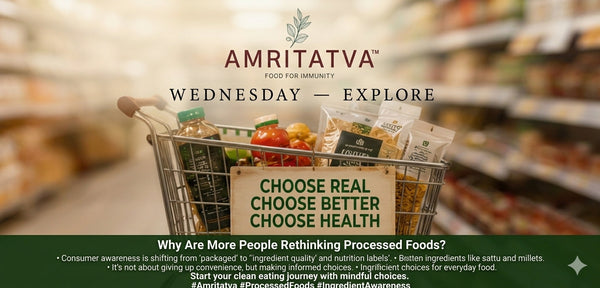
Clean label has no legal definition in India. It's a consumer-led movement, not a regulatory category. In practice, it means: an ingredient list short enough to read in one breath, where every item is recognisable as a real food or spice rather than a chemical compound. The test is simple — read the ingredient list and ask whether you could buy every item on it in a grocery store or market. If you encounter INS codes, "modified starch," "nature-identical flavouring," or "antioxidant (permitted)," the product has opted for processing convenience over ingredient transparency. That's not illegal. But it's not what clean-label means. A product like Amritatva's All-Purpose Seasoning shows what this standard actually looks like — every ingredient named in plain language.
Why Clean Label Is Growing in India Right Now
India's clean-label food market is growing at 8–12% CAGR through 2030, according to IMARC Group (2024). The growth is driven by a generational shift in purchasing behaviour: millennials and Gen Z consumers in urban India are reading ingredient labels at significantly higher rates than their parents did. A 2024 Nielsen India report found 63% of urban consumers checking ingredient lists before purchase — up from 41% in 2020. The driver isn't just health consciousness. It's the information environment: food adulteration incidents, FSSAI recall notices, and viral social media investigations have made consumers aware that what's marketed and what's in the pack can be very different things.
The Four Hidden Ingredients Most People Miss
Even motivated label readers miss some common forms of hidden additives. Four that appear most frequently in Indian packaged foods:
- Modified starch (often listed as "edible starch"): Usually modified maida, used as a cheap bulking agent. Provides no nutritional value and raises glycaemic load.
- Nature-identical flavouring: Chemically synthesised in a laboratory to mimic a natural flavour compound. Legal, but not what most consumers imagine when they see "natural" on the front of the pack.
- Anti-caking agents (INS 551, 552, 553): Silicon dioxide and silicates added to prevent clumping in powdered products. Not dangerous at permitted levels, but unnecessary in products that don't need extended shelf life.
- "Added flavours": A catch-all that can include MSG, disodium inosinate, and disodium guanylate — flavour enhancers that don't need to be named individually under Indian labelling law.
How to Read a Label in 60 Seconds
Step one: count the ingredients. Under 5 is clean; over 15 warrants scrutiny. Step two: look for the FSSAI licence number — a 14-digit number, verifiable at fssai.gov.in. Absent means unlicensed. Step three: read the first three ingredients (listed by weight — they make up the majority of the product). Step four: scan for INS codes, "modified," "nature-identical," and "permitted" — these signal processing complexity. Step five: check the serving size against what you'd actually eat, and multiply the nutritional values accordingly. This takes 60 seconds and tells you more about a product than any front-of-pack claim.
Amritatva's Standard
Every Amritatva product carries a full ingredient list in plain language: millet flour, mushroom powder, spices, salt. No INS codes. No catch-alls. FSSAI Licence 22222046000640 appears on every pack, verifiable on the FSSAI portal. The ingredient list is short by design — not because products are simple, but because the ingredients themselves are doing the nutritional work. That's what clean label actually means: food that doesn't need additives to function, because the base ingredients are chosen to be genuinely nutritious. Our All-Purpose Seasoning is the clearest example of this in our range.
Try This Product
Amritatva All-Purpose Seasoning
No INS codes. No additives. Just real ingredients.
Shop Now →Frequently Asked Questions
Is clean-label food always more expensive?
Not necessarily. The most affordable clean-label diet in India is built on whole foods: rice, dal, millets, vegetables, and sattu — all inexpensive and inherently clean-label. Packaged clean-label products do tend to cost more than conventional equivalents because they use more expensive ingredient sourcing and fewer cheap additives. But the foundation of clean eating doesn't require premium packaged products — it requires choosing whole ingredients over heavily processed alternatives.
Does FSSAI certification guarantee clean-label?
No — FSSAI certification confirms the product meets minimum food safety standards, not that it's clean-label by consumer standards. A product can be FSSAI-certified and still contain 25 ingredients including synthetic additives that are permitted under FSSAI regulations. FSSAI licence is a necessary baseline (absence is a red flag), but ingredient list transparency is the actual clean-label indicator.
Are preservatives always bad?
Not all preservatives are equal. Natural preservatives — salt, sugar, vinegar, lemon juice — have been used safely for centuries and carry no known health risks at food amounts. Synthetic preservatives (sodium benzoate, potassium sorbate, TBHQ) are permitted by FSSAI at low levels and are generally considered safe, but some have been flagged for concerns at high exposure. The clean-label position isn't that all preservatives are dangerous — it's that products with short shelf lives and whole ingredients shouldn't need them.
What's the difference between "natural" and "clean-label"?
"Natural" has no regulatory definition in India and can appear on any product regardless of what it contains. "Clean-label" is a consumer expectation, not a legal claim, and it means short, recognisable ingredient lists. A product can claim "natural" while containing nature-identical flavourings (synthetic), and it would be legally compliant. Clean-label is the stricter, consumer-defined standard.

0 comments