

Key Takeaways
- WHO recommends 25g dietary fibre per day for adults; the average urban Indian consumes 12-15g — roughly half that amount (ICMR National Nutrition Survey, 2019).
- After just one week of low fibre intake, butyrate-producing bacteria like Faecalibacterium prausnitzii measurably decline, reducing the short-chain fatty acids that directly fuel colon wall cells (BMJ, 2019).
- After six months on a consistently low-fibre diet, intestinal microbiome diversity drops by up to 40% compared to high-fibre diet controls, with some bacterial species going locally extinct (Nature, 2022 — Sonnenburg Lab, Stanford).
- Low dietary fibre is independently associated with a 35% increased risk of type 2 diabetes over 10 years (Lancet, 2019, PURE study cohort of 135,335 participants across 18 countries).
Fibre deficiency doesn't announce itself. It accumulates quietly over weeks and months, degrading gut function, immune competence, and metabolic stability by degrees — until a visit to a physician or a blood test makes the damage visible. Understanding the timeline makes it possible to intervene before that point.
What Happens in the First Week
The gut microbiome responds to dietary fibre changes faster than almost any other dietary variable. Within 48 hours of dropping fibre intake, fermentation activity in the colon measurably decreases — less gas production, which people often mistake for a digestive improvement (BMJ, 2019). It isn't. That reduced fermentation means butyrate output is falling. Butyrate feeds colonocytes, the cells lining your colon wall. By day 5-7 of low fibre intake, stool transit time begins slowing — the earliest measurable sign of reduced gut motility.
A 2021 study published in Frontiers in Nutrition tracked 28 healthy adults through a 7-day low-fibre intervention (under 10g/day). By day 7, stool frequency decreased by an average of 1.4 bowel movements per week, and self-reported bloating increased in 71% of participants despite less fermentation. The mechanism: slower transit means stool remains in the colon longer, where water absorption continues — producing drier, harder stools that require more pressure to pass.
What Happens Over the First Month
By week 2-3, the structural changes in the microbiome become significant. A landmark 2019 BMJ study using 16S rRNA sequencing found measurable declines in Bifidobacterium and Lactobacillus species within 14 days of low-fibre diet. These species produce both butyrate and lactic acid, compounds that maintain the tight junctions between gut epithelial cells. When tight junctions loosen — a state called increased intestinal permeability, colloquially leaky gut — bacterial lipopolysaccharides (LPS) begin crossing the gut wall into systemic circulation.
Systemic LPS triggers low-grade chronic inflammation. C-reactive protein (CRP), a standard inflammation marker, rises measurably within 3-4 weeks of consistently low-fibre intake in previously healthy adults (Journal of Nutrition, 2020). This inflammation is subclinical — it doesn't feel like illness. It feels like fatigue, mood flatness, and slightly more frequent minor infections. By week 4, immune competence begins declining. The gut-associated lymphoid tissue (GALT), which handles 70% of the body's immune responses according to WHO, depends on the same short-chain fatty acids that fibre produces to maintain its defensive function.
What Happens Over Six Months
The long-duration data is stark. Justin Sonnenburg's research group at Stanford, published in Nature (2022), found that six months on a consistently low-fibre, high-processed-food diet reduced gut microbiome diversity by an average of 40% in human subjects — and that some bacterial species did not recover even after fibre was reintroduced. This is the most alarming finding in recent gut microbiome research: the damage is not always fully reversible on a human-relevant timescale.
At six months, metabolic consequences become measurable in blood work. Fasting insulin rises, triglycerides increase, and LDL cholesterol tends to climb — all consistent with the loss of butyrate's regulatory effect on hepatic lipid metabolism. The Lancet's 2019 PURE study (135,335 participants, 18 countries) found that individuals in the lowest fibre quintile had a 35% increased risk of type 2 diabetes over 10 years compared to those in the highest quintile. That risk accrual begins in month one and compounds with each subsequent month of deficiency.
The Immune Suppression Mechanism
The immune consequence of low fibre is specific and mechanistic, not vague. Gut-associated lymphoid tissue (GALT) includes Peyer's patches, mesenteric lymph nodes, and intraepithelial lymphocytes — together they constitute the largest immune tissue mass in the human body. GALT requires a healthy epithelial barrier and active microbiome signalling to function. Short-chain fatty acids produced by fibre fermentation, particularly butyrate and propionate, regulate regulatory T-cell (Treg) differentiation in the GALT (Frontiers in Nutrition, 2023 meta-analysis of 31 studies).
When fibre drops, SCFA production drops, Treg differentiation decreases, and the immune system shifts toward a more pro-inflammatory baseline. This explains why low-fibre eaters tend to experience more frequent upper respiratory infections, slower wound healing, and heightened allergic responses — all documented in the same Frontiers in Nutrition meta-analysis.
How Much Fibre, and From What Sources
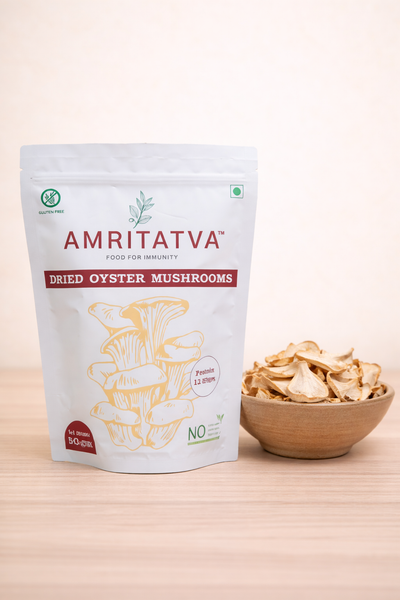
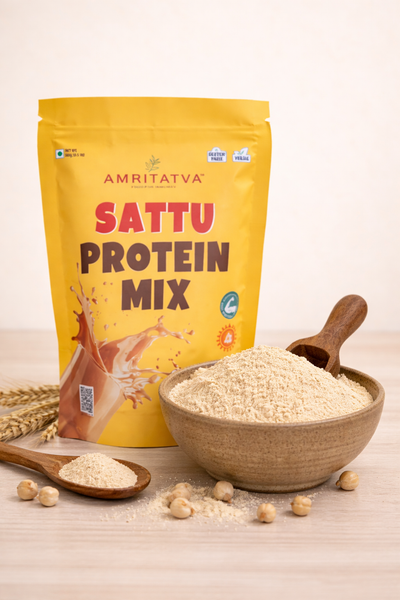
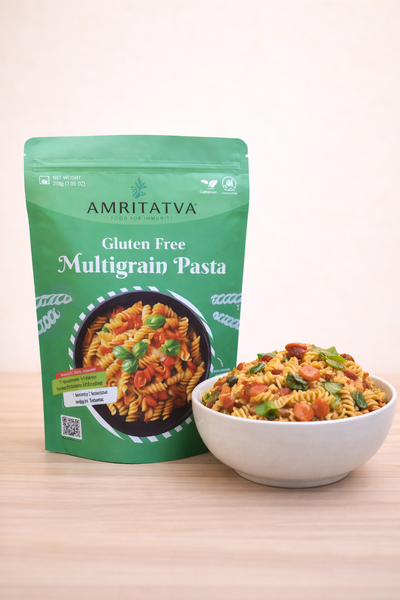
WHO's 25g/day target is a minimum, not an optimal. The populations with the highest gut microbiome diversity — the Hadza hunter-gatherers in Tanzania, studied by the Sonnenburg lab — consume 100-150g fibre daily from seasonal plant foods. That's not a realistic target for modern urban life, but it contextualises 25g as a floor. ICMR's IFCTs (2017) data on Indian foods shows the best fibre sources per 100g as: sattu at 7.6g, rajma (kidney beans) at 6.4g, oats at 5.5g, millet-based pasta at approximately 4g (depending on preparation), sun-dried oyster mushrooms at approximately 4-5g (USDA FoodData Central). The key is not a single superfood addition but consistent daily variety across soluble and insoluble fibre sources.
Try This Product
Amritatva Sattu Protein Mix 500g
High-fibre roasted chana flour. Feeds your gut microbiome daily.
Shop Now →Frequently Asked Questions
Can you reverse the gut microbiome damage from years of low fibre intake?
Partially, and the speed depends on how long the deficiency lasted. The Sonnenburg lab's Nature (2022) paper found that short-term interventions (under 6 months) showed near-complete microbiome recovery within 2-4 weeks of returning to high-fibre eating. Longer-term deficiency showed partial recovery — diversity improved but some extinct species did not return. The practical implication: start increasing fibre now rather than later, because the longer the deprivation period, the less complete the recovery. Fermented foods alongside fibre accelerate the reintroduction of lost bacterial species.
Is 25g fibre per day actually achievable on a typical Indian diet?
Yes, easily — on a traditional Indian diet. Dal, sabzi, whole grains, and seasonal fruits together deliver 25-35g without supplementation. The problem is that the modern urban Indian diet has shifted heavily toward refined-flour staples: white bread, instant noodles, maida rotis. ICMR's 2019 survey found that urban households now get 40-50% of calories from refined grains versus 15-20% in 1975. Replacing one refined-grain meal with a millet or whole-legume alternative adds 5-8g fibre daily with no other dietary change required.
What is the difference between soluble and insoluble fibre, and does the type matter?
Yes, the type matters significantly for different outcomes. Soluble fibre (beta-glucans in oats and mushrooms, pectin in fruits) dissolves in water and forms a gel in the digestive tract — it feeds butyrate-producing bacteria and slows glucose absorption. Insoluble fibre (cellulose in vegetables, husk of whole grains) adds bulk and accelerates colon transit time. Both are required: soluble for microbiome feeding and metabolic effects, insoluble for regularity and colon health. Most whole plant foods contain both. Fibre supplements (psyllium, inulin) typically provide one type only, which is why whole-food fibre sources are consistently superior in clinical outcomes (Journal of Nutrition, 2021).



0 comments