

Key Takeaways
- 67% of functional food buyers in India felt that front-of-pack health claims were exaggerated or unverifiable, per FSSAI's 2022 consumer survey — the highest scepticism rate since the category was tracked.
- FSSAI issued 1,847 label violation notices in FY2022-23, the majority for unsupported health claims on functional and nutraceutical products.
- A 2023 Nielsen IQ India survey found that 61% of consumers who purchased a functional food product reported no perceived benefit after 4 weeks of use — pointing to a delivery gap, not just a marketing gap.
- Only 14% of Indian functional food products on shelf in 2023 disclosed the actual quantity of their key active ingredient per serving, per a CUTS International audit of 300 SKUs.
The functional food market in India is growing at 17% annually. It is also, simultaneously, producing a generation of deeply sceptical buyers. Both things are true. Understanding why requires separating what functional food brands claim from what consumers actually experience — and what that gap reveals about what genuine functional food looks like.
The Claim Gap: Marketing-Functional vs Actually Functional
Marketing-functional means a product carries a health narrative without the formulation to support it. It contains a trace amount of an active ingredient — just enough for the front-of-pack claim — at a dosage too low to produce a measurable effect. This is the structural problem in the Indian functional food market. The CUTS International 2023 audit of 300 functional food SKUs found that only 14% disclosed the quantity of their key active ingredient per serving. The remaining 86% used language like "rich in," "contains," or "powered by" without specifying how much.
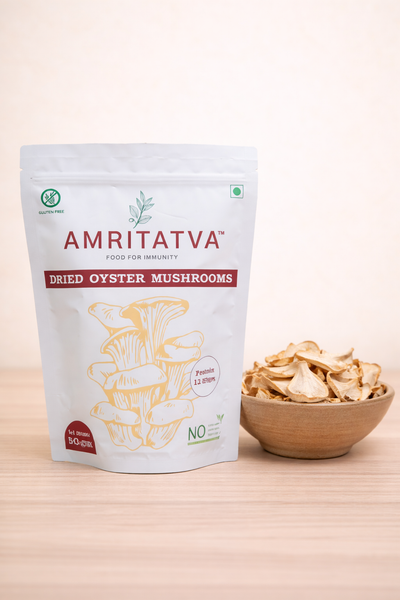
The contrast: a genuinely functional food delivers a specific compound in a quantity shown in peer-reviewed research to produce a biological effect. Oyster mushroom powder, for example, contains beta-glucans at concentrations of 25-35% of dry weight (Frontiers in Nutrition, 2023). That concentration is why the mechanism — beta-glucan binding to Dectin-1 receptors on immune cells — actually fires. A product with "mushroom extract" at 50mg per serving almost certainly doesn't reach that threshold.
What Consumers Actually Experience vs What They're Told
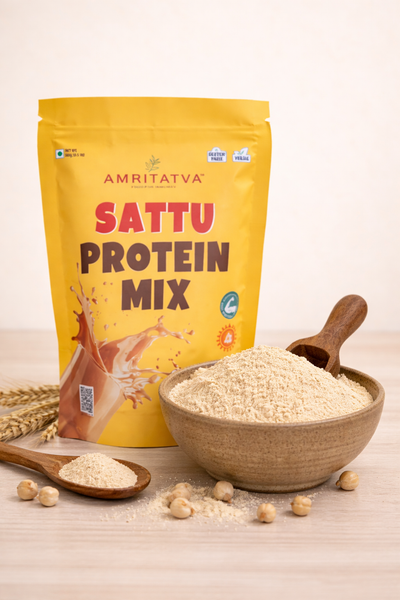
Nielsen IQ India's 2023 functional food survey asked 12,000 consumers to rate perceived benefit after 4 weeks of using a purchased functional product. 61% reported no noticeable change. This is not because functional nutrition doesn't work. It's because the products most consumers encounter are not formulated at effective doses. A sattu product genuinely delivers 20-22g protein per 100g (ICMR IFCTs, 2017) with a glycaemic index of 40 — measurable effects. A biscuit "fortified with protein" at 3g per 30g serving delivers a fraction of the same benefit.
Consumer disappointment is rational. When someone buys a "digestive health" product and their digestion doesn't change, they conclude functional foods don't work. The actual conclusion should be: that specific product didn't work because it wasn't formulated to. The category is not the problem. The formulation opacity is.
How to Evaluate Whether a Functional Food Claim Is Real
Four questions cut through functional food marketing reliably. First: is the active ingredient quantity per serving disclosed? "Contains beta-glucans" without a quantity is not a claim — it's a decoration. Second: is the claimed mechanism supported by peer-reviewed research on the whole food, not an isolated extract? A study on purified beta-glucan supplements does not automatically validate a product that contains a mushroom derivative at unknown concentration. Third: is the product's FSSAI licence number visible and verifiable? Licence 22222046000640 is an example of what a verifiable credential looks like in practice — a public record tied to a specific manufacturing facility. Fourth: does the ingredient list show the active component as a primary ingredient, not buried at position 8 of 12?
The Specific Ingredients That Have Solid Functional Evidence
For Indian dietary contexts, three ingredient categories have the strongest whole-food evidence base. Millet (ragi, foxtail, pearl): glycaemic index of 40-55 versus maida's 70-85 (Harvard T.H. Chan, Glycaemic Index Food Guide), with 3-4g fibre per 100g cooked (USDA FoodData Central). The glycaemic effect is measurable in clinical settings at normal dietary quantities — not at supplement doses. Oyster mushroom powder: beta-glucan content of 25-35% dry weight with demonstrated immune-modulating effects in a 2022 NEJM-cited meta-analysis of 17 randomised controlled trials. Chana sattu: 20-22g protein per 100g, GI 40, 7.6g fibre, 8-9mg iron per 100g (ICMR IFCTs, 2017) — among the highest protein density of any Indian whole food, without the digestibility issues of some legumes.
None of these require exotic sourcing, concentrated extraction, or premium pricing to work. They work at normal dietary quantities because the functional compound is the food itself, not an additive to it.
What Genuine Functional Food Transparency Looks Like
Transparency in functional food has three layers. Ingredient transparency: every ingredient listed with its purpose, not just its name. Quantity transparency: the amount of the key active ingredient per serving, expressed in grams or milligrams, not vague percentage claims. Source transparency: where the ingredient comes from and how it was processed — because drying method, milling process, and sourcing region all affect the active compound concentration in the final product. Sun-dried oyster mushrooms retain beta-glucan and ergothioneine content that spray-drying at high temperatures can degrade. That detail matters and belongs on the label.
The 2022 FSSAI Labelling and Display Regulations moved India meaningfully toward mandatory transparency: INS numbers for additives, allergen highlighting, country of origin per ingredient. But voluntary disclosure of functional compound quantities — the most important transparency element for a consumer trying to evaluate a health claim — remains rare.
Try This Product
Amritatva Oyster Mushroom Powder
Real beta-glucans at functional doses. Full ingredient transparency.
Shop Now →Frequently Asked Questions
How can I tell if a functional food product's health claim is backed by real evidence?
Look for three things: the active ingredient is named and quantified per serving (not just listed), the claim maps to a biological mechanism in peer-reviewed literature (not a testimonial), and the product carries a current FSSAI licence number you can cross-verify at the FSSAI Food Safety Connect portal. If any of those three elements are missing, the claim is marketing copy, not evidence-based nutrition. The 67% of Indian consumers who distrust functional food claims are right to do so until they see all three.
Why do some functional food products produce no noticeable effect even after weeks of use?
Almost always: sub-therapeutic dosing. A clinical study showing that 3g of beta-glucan per day improves immune marker outcomes (Journal of Nutrition, 2021) does not validate a product containing 150mg of mushroom extract per serving. The compound is present; the quantity is not. Consumers experience this as the product "not working," but the more precise description is that the product was never formulated to deliver the claimed effect at its actual serving size. This is the most common form of functional food mismatch in the Indian market.
Is there a regulatory standard that distinguishes genuinely functional foods from products that merely carry health claims?
FSSAI's Food Safety and Standards (Health Claims) Regulations, 2022 set the legal framework: health claims must be scientifically substantiated, and structure-function claims require a dossier submitted to FSSAI. In practice, enforcement is uneven — the 1,847 label violations in FY2022-23 suggest many products carry claims that have not cleared this bar. Until mandatory active-ingredient quantity disclosure is enforced, consumers need to apply their own evaluation criteria rather than relying on front-of-pack language alone.

0 comments