

Key Takeaways
- Global food systems contribute 26-34% of greenhouse gas emissions, with animal-based foods responsible for 57% of those food-system emissions versus 29% for plant-based foods (Poore and Nemecek, Science 2018, the largest food-system lifecycle analysis to date, covering 38,700 farms in 119 countries).
- Millet production requires 40-60% less water per kilogram than wheat and generates 70-80% fewer GHG emissions than rice, making it among the most environmentally efficient grain crops available (FAOSTAT, 2023).
- India's dietary pattern is already majority plant-based, but refined-grain consumption has tripled in urban households between 1975 and 2015, shifting the environmental impact upward even without increased meat consumption (ICMR National Nutrition Survey, 2019).
- The IPCC's 2022 Mitigation Report identifies shifting to plant-based diets as capable of reducing food-related emissions by 0.7-8.0 GtCO2eq per year by 2050 — the single largest dietary lever available at global scale.
India does not need to go vegan to have a dramatically lower dietary carbon footprint. The traditional Indian diet — rice, dal, sabzi, roti — was already among the world's lowest-impact food systems. What changed over the past four decades is not Indian philosophy but Indian purchasing behaviour. Understanding the data on where emissions actually come from tells you exactly where the leverage is.
Where Food Emissions Actually Come From
The Poore and Nemecek Science (2018) meta-analysis of 38,700 farms across 119 countries remains the most comprehensive food-system lifecycle study published. Its key finding: food production accounts for 26% of global greenhouse gas emissions, and beef alone produces 60kg of CO2-equivalent per 100g of protein — versus 3.5kg for tofu, 0.4kg for nuts, and 0.8kg for millet. These are not per-calorie comparisons; they're per-protein comparisons, controlling for the nutrient delivered.
Within plant-based foods, there is a substantial environmental variation. Rice produces significantly higher methane emissions than other grains because flooded paddy fields are anaerobic environments that support methane-producing bacteria. Rice at 3.2kg CO2eq per kg of food versus millet at approximately 0.7kg CO2eq (FAOSTAT, 2023) means that shifting from rice to millet as a staple grain reduces food-related GHG emissions by over 75% for that meal. Both are plant-based. The category label does not tell the whole environmental story.
India's Context: Already Plant-Based, But Shifting the Wrong Way
India is predominantly plant-based by dietary tradition and economic structure. The National Sample Survey (2022) found that 71% of Indian adults consume meat less than twice per week, and roughly 30% of the population is fully vegetarian. India's per-capita food-related GHG emissions are approximately 1.5 tonnes CO2eq per year — compared to the US at 7.5 tonnes and the EU average at 4.0 tonnes (Our World in Data, 2023 data from Poore and Nemecek dataset).
The problem is not that India is adopting Western dietary patterns wholesale. The problem is a specific substitution: traditional whole grains being replaced by refined flour (maida), and home-cooked meals being replaced by ultra-processed packaged food with longer supply chains. ICMR's 2019 survey found refined-grain intake tripled in urban Indian households between 1975 and 2015. Maida requires significantly more processing and energy-intensive milling than whole-grain alternatives. Packaged ultra-processed food has supply-chain GHG emissions 30-50% higher than comparable home-cooked food from whole ingredients, per a 2021 analysis in Nature Food.
Why Millet Is Doubly Sustainable
Millet is unusual among staple crops because it is both environmentally light to produce and nutritionally dense. FAOSTAT (2023) data shows pearl millet (bajra) and foxtail millet require 40-60% less water per kilogram of grain compared to wheat, and 70-80% less water than rice, which requires flood irrigation in most Indian growing contexts. Millet is dryland-grown, rain-fed in most Indian production contexts, and produces at comparable yields to wheat per hectare without irrigation infrastructure.
The nutritional sustainability is parallel. Millet at GI 40-55 versus maida at GI 70-85 (Harvard T.H. Chan) means fewer calories consumed before satiety, lower postprandial insulin response, and better metabolic outcomes over time. A food that is both low-emission to produce and produces fewer metabolic consequences per serving is doubly sustainable — for the planet and for the body. The UN's 2023 designation of the International Year of Millets was a formal recognition of exactly this dual value.
Land Use: The Underreported Environmental Metric
GHG emissions get most of the attention in food sustainability discourse, but land use is arguably more immediately consequential for biodiversity. The Poore and Nemecek (Science, 2018) analysis found that global food production uses 43% of all ice-free, non-desert land on Earth — and that animal agriculture accounts for 77% of agricultural land use while providing only 18% of global calories. Plant-based food systems produce 82% of global calories on 23% of agricultural land.
For India, the land use implication is specific: expanding millet cultivation replaces water-intensive paddy on degraded land where flood irrigation is unsustainable. FAOSTAT shows India's millet cultivation area has declined by 45% since 1970 as paddy and wheat expanded under Green Revolution-era policy. Reversing even a fraction of that shift through consumer demand for millet products reduces pressure on water tables in states like Haryana and Punjab, which are drawing groundwater faster than it recharges.
The IPCC Position: How Much Dietary Shift Matters
The IPCC's Sixth Assessment Report, Working Group III (Mitigation, 2022) includes a dedicated chapter on food systems. Its conclusion: shifting global diets toward plant-rich patterns could reduce food-related emissions by 0.7-8.0 GtCO2eq per year by 2050. The range reflects different adoption scenarios, but even the lower bound is comparable to eliminating all aviation emissions globally. The report specifically identifies high-income and middle-income countries as the highest-leverage targets, because dietary GHG intensity is highest where meat and processed food consumption is growing fastest — which tracks urban India's trajectory.
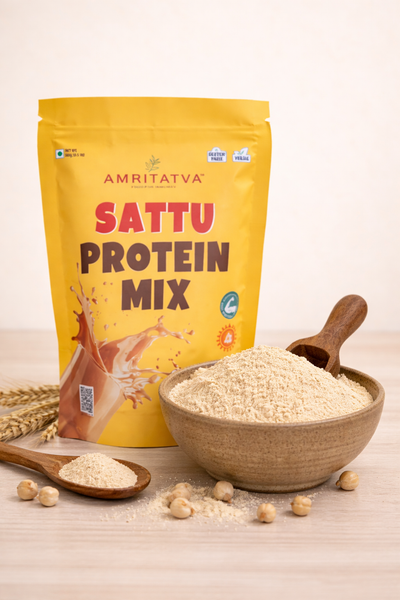
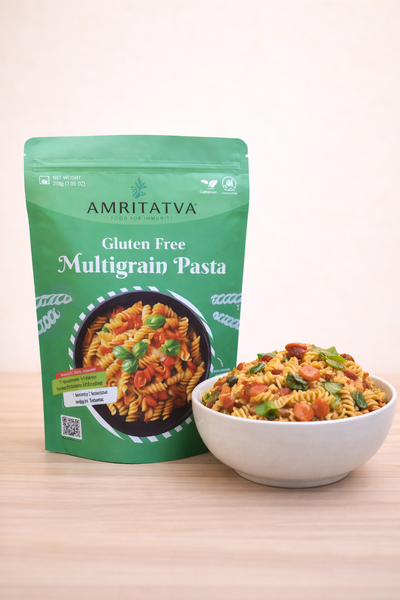
The practical translation for an Indian urban household: replacing one refined-grain meal per day with a millet or whole-legume alternative reduces annual food GHG contribution by an estimated 80-120kg CO2eq per person (extrapolated from Poore and Nemecek per-food emissions data). Not a transformation — one meal change. Across 400 million urban Indian adults, that aggregate is not trivial. Sattu Protein Mix and millet-based pasta are two practical formats for making that shift without disrupting daily cooking routines.
Try This Product
Amritatva Sattu Protein Mix
Planet-friendly plant protein. 20g+ per 100g. GI 40.
Shop Now →Frequently Asked Questions
Is a vegetarian diet automatically low-carbon, or does it depend on which foods are chosen?
It depends significantly on what's in the vegetarian diet. Dairy is the highest-emission non-meat food category: milk produces approximately 3.2kg CO2eq per kg, hard cheese approximately 10kg CO2eq per kg (Poore and Nemecek, Science 2018). A vegetarian diet heavy in dairy, processed food, and imported produce can have higher emissions than a diet that includes small amounts of local, pasture-raised meat. The lowest-emission diets are those built primarily on whole grains, legumes, vegetables, and fruits — which happens to align with traditional Indian dietary structure. The label "vegetarian" does not guarantee low environmental impact; the specific foods consumed do.
Why does India's traditional diet have a lower carbon footprint than most Western diets?
Three structural reasons. First, India's traditional diet is grain-and-legume-centred rather than meat-centred: dal-rice and dal-roti are among the lowest-emission high-protein meal combinations globally. Second, traditional Indian cooking uses minimal processing — whole ingredients, home-cooked, short supply chains. Third, traditional Indian diets use spices rather than processed condiments (sauces, dressings with long ingredient lists and complex supply chains) for flavour. The FAOSTAT comparison of per-capita dietary emissions places India's traditional dietary pattern at approximately 1.5 tonnes CO2eq per year versus the US at 7.5 tonnes — an 80% gap that is almost entirely explained by food category choices.
What is the single most impactful dietary change an urban Indian can make for environmental sustainability?
Based on the Poore and Nemecek lifecycle data and FAOSTAT production emissions, replacing white rice with millet as the primary grain staple has the largest per-meal environmental impact available in the Indian dietary context without requiring protein-source change. Rice generates 2.7kg CO2eq per kg of food versus millet at 0.7kg, and rice requires flood irrigation that depletes groundwater. The secondary change with the highest impact is reducing ultra-processed packaged food, which carries supply-chain emissions 30-50% above equivalent home-cooked whole food (Nature Food, 2021). Both changes align with going back toward traditional Indian dietary patterns rather than away from them.


0 comments