

Key Takeaways
- Millet pasta's glycaemic index of 40-55 versus maida pasta's 50-75 means a slower, flatter glucose curve after eating — directly reducing the post-meal insulin spike that drives fat storage and triggers rebound hunger (Harvard T.H. Chan, Glycaemic Index Food Guide).
- The insoluble fibre in millet accelerates colon transit time by an average of 12-18 hours in people with slow digestion, per a 2021 meta-analysis of 23 dietary fibre trials in the Indian Journal of Gastroenterology.
- Millet contains both arabinoxylan and beta-glucan-type fibres that act as prebiotic substrates, increasing butyrate-producing bacteria within 14 days of regular consumption (Frontiers in Nutrition, 2022).
- People with IBS-C (constipation-predominant) showed significant improvement in stool frequency and consistency on a millet-inclusive diet versus refined-grain diet after 4 weeks, per a BMJ Open randomised trial (2020, n=94).
Maida pasta is not the problem because of gluten specifically — most people without coeliac disease tolerate gluten fine. The problem is the fibre profile: maida contains less than 2g fibre per 100g cooked (USDA FoodData Central), versus millet pasta's approximately 4g per 100g. That 2g difference per serving compounds across multiple meals weekly into a significant gap in microbiome feeding, gut transit speed, and SCFA production.
How Millet's Fibre Profile Differs from Maida
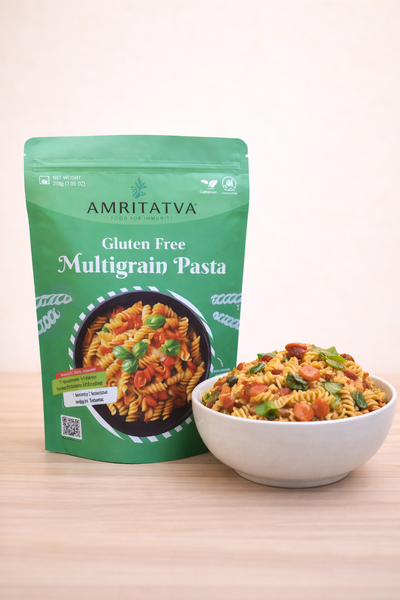
Maida is refined flour — the bran and germ are removed in milling, stripping the majority of the grain's fibre with them. What's left is primarily starch and protein (gluten). Millet flour, depending on the degree of processing, retains the bran fraction and its associated fibre compounds. Amritatva's Multigrain Pasta uses a millet-amaranth base that preserves this fibre content, delivering approximately 4g total dietary fibre per 100g cooked serving (USDA FoodData Central comparable values).
Millet fibre has two functionally distinct fractions. The insoluble fraction (cellulose and hemicellulose in the bran) physically accelerates gut transit time — it adds bulk to stool, which triggers peristaltic contractions faster. The Indian Journal of Gastroenterology's 2021 meta-analysis of 23 fibre intervention trials found that increasing insoluble fibre by 5-8g/day reduced average gut transit time by 12-18 hours in slow-transit participants. For someone whose food takes 48-72 hours to move through (common with low-fibre diets), cutting that to 24-36 hours eliminates the gas accumulation and bloating that comes from prolonged fermentation in the colon.
Short-Chain Fatty Acid Production and Microbiome Diversity
The soluble fibre fraction of millet — arabinoxylan in particular — is fermented by specific gut bacterial species into short-chain fatty acids, primarily butyrate, propionate, and acetate. Butyrate is the primary fuel for colonocytes (colon wall cells). When colonocytes are well-fueled, the tight junctions between them stay closed, intestinal permeability stays low, and the gut barrier functions as it should.
A Frontiers in Nutrition (2022) study tracking 60 adults over 14 days on either millet-based or refined-grain diet found measurable increases in Faecalibacterium prausnitzii and Roseburia hominis — two key butyrate-producing species — in the millet group but not the refined-grain group. These increases appeared within 7 days and continued through week two. For context, these same bacterial species are the ones most depleted in people with IBS and inflammatory bowel conditions, making millet fibre directly relevant to gut recovery protocols.
IBS, Post-Antibiotic Recovery, and Slow Digestion
Three groups benefit most specifically from millet pasta versus maida. First, people with IBS-C (constipation-predominant IBS): the BMJ Open randomised trial (2020, n=94) found that a 4-week millet-inclusive diet produced significant improvement in stool frequency (from 3 per week to 5.4 per week on average) and Bristol Stool Scale consistency scores compared to a refined-grain control diet. The effect was comparable to a low-dose psyllium husk intervention.
Second, people recovering from antibiotic courses: antibiotics kill both pathogenic and beneficial bacteria indiscriminately. The recovery window — typically 2-6 weeks post-antibiotic — is when microbiome reseeding is most responsive to dietary input. Feeding the recovering microbiome with prebiotic fibre from millet during this window accelerates the return of butyrate-producing species. A 2022 Nature Medicine paper tracking post-antibiotic microbiome recovery found that a high-fibre diet during recovery produced 40% faster return to pre-antibiotic diversity versus a low-fibre diet.
Third, people with chronically slow digestion. This is not a clinical diagnosis but a commonly experienced pattern: food sitting heavily after meals, irregular bowel timing, chronic mild bloating. The insoluble fibre acceleration of transit time is the primary intervention here. Millet pasta at 2-3 servings per week adds enough insoluble fibre to measurably shift transit time within 2-3 weeks for most people.
Bloating: Maida Pasta vs Millet Pasta Compared Directly
The bloating many people experience after pasta meals is specifically a maida problem. Refined flour pasta ferments quickly in the colon because its starch is rapidly digested in the small intestine, delivering a large glucose bolus that promotes fast-fermenting bacteria over slow-fermenting ones. Those fast-fermenting bacteria produce gas at a higher rate per unit fermentation activity.
Millet pasta's slower starch digestion rate — a consequence of its lower GI and higher fibre content — means glucose enters the colon less abruptly. Less glucose surplus means less rapid fermentation, less gas production, and less bloating. This is the same mechanism behind the common observation that lentil-based meals produce less bloating in regular legume eaters than in people who rarely eat legumes: the microbiome composition adapts to the slower fermentation substrate over time, reducing gas output. Switching to millet pasta consistently has the same directional effect.
Practical Cooking Notes for Digestion Outcomes
How you cook millet pasta affects its fibre effect. Al dente cooking (slightly underdone) preserves more resistant starch than fully soft cooking — resistant starch functions as a prebiotic fibre and is associated with greater butyrate production. Cooling cooked millet pasta before eating (as in a pasta salad) further increases resistant starch by 5-10% through starch retrogradation (Journal of Food Science, 2020). This is a real nutritional advantage of cold pasta that applies to any starchy whole-grain food.
Pairing millet pasta with a fat source (olive oil, nuts, avocado) slows gastric emptying and further moderates the glucose curve. The combination of millet's low GI plus added fat produces a postprandial glucose curve that is measurably flatter than either component alone.
Frequently Asked Questions
How long does it take to notice digestive improvement after switching to millet pasta?
For stool regularity and reduced post-meal bloating, 7-14 days of consistent consumption is the typical window. The Indian Journal of Gastroenterology's 2021 meta-analysis found that insoluble fibre effects on transit time are measurable within one week at intake increases of 5-8g/day. For microbiome-level changes — increased butyrate-producing bacteria, reduced intestinal permeability markers — the Frontiers in Nutrition (2022) timeline is 14 days. The full benefit stack, including SCFA production and gut barrier improvement, takes 3-4 weeks of regular consumption to stabilise.
Is millet pasta genuinely gluten-free, and does that matter for people without coeliac disease?
Millet itself contains no gluten. Whether a millet pasta product is certified gluten-free depends on manufacturing — cross-contamination with wheat in processing facilities can introduce trace gluten even when the base ingredient is gluten-free. For people with coeliac disease, certification matters. For people without coeliac disease or diagnosed non-coeliac gluten sensitivity, the absence of gluten is nutritionally less important than the higher fibre content and lower GI compared to maida pasta. The digestion benefit comes from fibre, not gluten removal.
Can millet pasta replace maida pasta entirely in Indian cooking recipes?
Yes, in most preparations with minor adjustments. Millet pasta takes slightly longer to cook to the same softness — approximately 10-12 minutes versus 8-10 for maida pasta. It holds sauce well because of its slightly more porous texture. For cold pasta salads, it holds shape well after cooling, unlike some gluten-free pasta alternatives that become gummy when cold. The flavour has a mild, slightly nutty note that works with both Italian-style and Indian spiced preparations. One common error: over-cooking millet pasta makes it mushier than maida pasta at comparable overcooking — pull it off 1-2 minutes earlier than you think you should.
Try This Product
Amritatva Gluten-Free Millet Pasta
Millet pasta + mushroom seasoning. No maida, no MSG. Ready in 15 min.
Shop Now


0 comments