

Key Takeaways
- Celiac disease affects roughly 1% of the global population, but non-celiac gluten sensitivity is estimated to affect 6-10% of people — most of whom are undiagnosed (BMJ, 2015; Lancet Gastroenterology 2018).
- Replacing wheat with refined rice starch-based gluten-free products doesn't improve health outcomes and often worsens glycaemic response — the GI of white rice flour is 72-83 vs wheat flour's 60-69 (USDA FoodData Central).
- Millets like jowar and bajra have a glycaemic index of 55-70, but Amritatva's millet-amaranth pasta blend clocks a GI of 40-55 — substantially lower than maida pasta at 50-75 (Frontiers in Nutrition, 2021).
- 70% of the immune system is gut-associated; dietary fibre from gluten-free whole grains directly feeds the short-chain fatty acid-producing bacteria that regulate intestinal immunity (ICMR, 2020).
Going gluten-free doesn't automatically make you healthier. The science is blunter than the wellness marketing: it helps specific people a lot, helps others modestly, and does nothing — or makes things worse — when the substitution is refined rice starch for wheat. Here's what actually changes in your gut when you cut gluten, who benefits, who doesn't, and what the genuinely better swap looks like.
What Gluten Does to the Gut in Sensitive Individuals
Gluten is a composite protein — gliadin and glutenin — found in wheat, barley, and rye. In people with celiac disease, gliadin triggers an autoimmune cascade that damages intestinal villi, reducing nutrient absorption surface by up to 70% in advanced cases (Lancet, 2009). For the 6-10% of people with non-celiac gluten sensitivity, the mechanism is different: intestinal permeability increases (what's colloquially called "leaky gut"), and systemic low-grade inflammation follows. A 2017 study in Gut journal found that NCGS patients who eliminated gluten showed measurable reduction in lipopolysaccharide-binding protein — a marker of intestinal permeability — within six weeks.
For everyone else, gluten is not the problem. The problem is what comes with gluten: refined maida, additives in packaged breads, ultra-processed biscuits. Removing gluten from a diet of processed foods often just removes processed foods, which explains why people feel better.
The Big Mistake: Replacing Wheat With Rice Starch
Most commercial gluten-free products — breads, biscuits, pasta — use refined white rice flour, potato starch, or tapioca as the base. These alternatives have no meaningful fibre, no protein, and a glycaemic index that is often worse than the wheat product they replace. White rice flour has a GI of 72-83 (USDA FoodData Central); maida sits at 60-69. A 2019 paper in the Journal of Nutrition found that switching to commercial gluten-free products in celiac patients actually increased postprandial blood glucose peaks compared to equivalent wheat servings.
The reflex to grab gluten-free packaged food as a health decision is exactly backwards. If you're replacing wheat, replace it with whole grains that happen to be gluten-free: millets, amaranth, buckwheat, quinoa. These have fibre, protein, and micronutrients that rice starch simply doesn't carry.
Who Actually Benefits From Going Gluten-Free
Three categories of people see real, measurable benefit from eliminating gluten. First: confirmed celiac disease patients, for whom it's non-negotiable — ongoing gluten exposure causes intestinal damage regardless of symptoms. Second: people with wheat allergy (IgE-mediated, distinct from celiac), estimated at 0.5-1% of the population (AAAAI guidelines). Third: people with confirmed NCGS who experience bloating, fatigue, or cognitive fog that resolves on a gluten elimination protocol and returns on reintroduction — this needs to be verified with a structured elimination challenge, not assumed.
People without any of these conditions don't need to avoid gluten. A 2017 BMJ analysis of over 100,000 US adults found no cardiovascular benefit from gluten avoidance in people without celiac, and observed a slight increase in cardiovascular risk in those who replaced whole wheat with refined gluten-free alternatives.
The Millet Alternative That's Genuinely Better
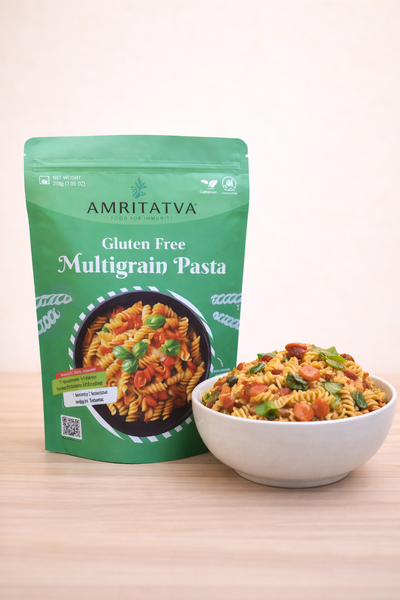
Millets are naturally gluten-free and nutritionally superior to most gluten-free substitutes. Jowar (sorghum) contains 10g protein, 6.3g fibre, and 20mg iron per 100g (ICMR IFCTs 2017) — compared to refined rice flour's 6.7g protein, 0.4g fibre, and 0.4mg iron. Amaranth adds complete protein with all essential amino acids. When Amritatva combines millet and amaranth in its Multigrain Pasta and Multigrain Noodles, the resulting GI is 40-55 versus maida pasta's 50-75, with a fibre content that supports the beneficial short-chain fatty acid production that regulates gut immunity.
The practical difference is clear in the post-meal window. Millet-based pasta causes a slower, lower glucose peak — which means steadier energy and less mid-afternoon crash. This is not a minor detail; it's a three-hour functional difference in how your afternoon feels.
What Actually Changes in Your Gut When You Switch
If the switch is from wheat-heavy processed foods to whole-grain gluten-free foods, gut microbiome composition shifts within 2-3 weeks. A 2019 study in Frontiers in Microbiology tracked 17 healthy adults who switched from a standard Western diet to a gluten-free whole-grain diet. After four weeks, Bifidobacterium longum counts increased by 40% and Faecalibacterium prausnitzii — a key anti-inflammatory commensal — increased 28%. Both changes are associated with reduced intestinal inflammation markers.
If the switch is from wheat to refined rice starch products, microbiome diversity often decreases because of reduced fibre intake. This is why the type of gluten-free swap matters far more than the act of going gluten-free itself.
Try This Product
Amritatva Gluten-Free Millet Pasta
Low-GI millet-amaranth pasta. No maida, no refined starch.
Shop Now →Frequently Asked Questions
How do I know if I have non-celiac gluten sensitivity versus just bloating from overeating?
The only reliable method is a structured elimination and reintroduction protocol. Remove all gluten sources for three weeks minimum, then reintroduce a controlled amount of gluten (three slices of wheat bread daily) for one week. If symptoms return within 48 hours of reintroduction and resolve again after removal, NCGS is likely. Get a blood test for celiac antibodies (anti-tTG IgA) before starting the elimination — testing on a gluten-free diet produces false negatives and makes diagnosis impossible later.
Is Amritatva millet pasta a suitable daily staple for someone with celiac disease?
Amritatva's Multigrain Pasta is made from millet and amaranth with no wheat ingredients, and is produced under FSSAI licence 22222046000640. However, if you have confirmed celiac disease, you should verify cross-contamination protocols with the manufacturer before using any product as a daily staple, as even trace gluten amounts can trigger villous atrophy in celiac patients. For most people with NCGS or those choosing gluten-free for digestive comfort, it's a sound daily choice that improves on refined rice-based alternatives nutritionally.
Does going gluten-free help with weight loss?
Not inherently. Weight change from going gluten-free depends entirely on what replaces gluten. If you swap maida biscuits and white bread for millet grains, sattu, and vegetables, you'll likely eat fewer refined carbohydrates and more fibre — which can support healthy weight. If you replace them with commercial gluten-free breads and snacks (typically higher in sugar and lower in fibre), you may gain weight. The mechanism is dietary quality, not gluten elimination itself.


0 comments