

Key Takeaways
- Beta-glucans in oyster mushrooms are heat-stable: they survive cooking at 100°C and the spray-drying process used to make mushroom powder, retaining their immune-modulating activity (Frontiers in Nutrition, 2023).
- Ergothioneine, oyster mushrooms' primary antioxidant, is also heat-stable and concentrated during drying — 100g of fresh oyster mushrooms yields roughly 10-12g of dried powder, concentrating ergothioneine approximately 8-10 fold (USDA FoodData Central).
- A 2022 meta-analysis of 17 randomised controlled trials (cited in NEJM correspondence) found that 1-3g daily beta-glucan from whole-food mushroom sources significantly improved NK cell and macrophage activity markers versus placebo.
- Oyster mushrooms exposed to UV light before drying convert ergosterol to Vitamin D2; dried oyster mushroom powder is one of the few plant-source Vitamin D foods (NIH Office of Dietary Supplements, 2023).
Mushroom powder is not a trendy supplement. It's a concentration process applied to a food with genuinely strong nutritional data. Understanding what the drying process preserves, what it concentrates, and how to use it in Indian cooking makes the difference between a jar that gets opened twice and one that becomes a kitchen staple.
What Survives the Drying and Grinding Process
The key question about any dried food product is whether the compounds that make the whole food valuable survive processing. For oyster mushrooms, the answer is yes for the two most important bioactives. Beta-glucans are polysaccharides — they are structural components of the fungal cell wall, not volatile flavour compounds. A 2023 review in Frontiers in Nutrition tested beta-glucan content in fresh oyster mushrooms versus spray-dried powder and found retention rates above 95% at temperatures up to 120°C. Even the higher temperatures of some industrial drying methods did not materially degrade beta-glucan content.
Ergothioneine behaves similarly. It's a sulphur-containing amino acid with exceptional thermal stability, studied specifically for its resilience to cooking (Journal of Agricultural and Food Chemistry, 2021). Sun-drying and low-temperature air-drying preserve it well; high-temperature roasting at above 180°C does show some degradation. Amritatva's sun-dried oyster mushrooms use temperature-controlled drying specifically to protect this compound alongside beta-glucan and Vitamin D2 content.
Concentration: Why Powder Differs From Whole Mushrooms
Fresh oyster mushrooms are 90-92% water by weight (USDA FoodData Central). When sun-dried to below 10% moisture, roughly 100g of fresh mushrooms yields 10-12g of dried material. Grinding that to powder doesn't change the chemistry, but it does change the concentration: a teaspoon of mushroom powder (approximately 3-5g) delivers the beta-glucan equivalent of 30-50g of fresh mushrooms. For people who don't eat mushrooms daily as a vegetable, powder format makes therapeutic-range dosing realistic without eating a large mushroom serving every day.
The 1-3g daily beta-glucan range identified in the 2022 meta-analysis as effective for immune marker outcomes corresponds to roughly 3-8g of oyster mushroom powder (assuming 25-35% beta-glucan content of dry weight, per Frontiers in Nutrition, 2023). One rounded teaspoon of mushroom powder added to food or drink is approximately that range.
Vitamin D2 from UV-Exposed Mushrooms
Oyster mushrooms contain ergosterol, a precursor that converts to Vitamin D2 when exposed to ultraviolet light. The NIH Office of Dietary Supplements (2023) specifically cites UV-exposed mushrooms as the only non-fortified plant food that is a meaningful source of Vitamin D. The Vitamin D2 content in dried powder depends entirely on the drying method: sun-dried or UV-exposed mushrooms can contain 100-1000 IU per 100g of dried weight, while shade-dried mushrooms contain negligible amounts. This distinction matters on labels — mushroom powder that was shade-dried or cultivated entirely indoors without UV exposure will not carry the same Vitamin D benefit, regardless of other nutritional content.
How to Use Mushroom Powder in Indian Cooking
The practical barrier to mushroom powder use is not taste — oyster mushroom powder has a mild, umami-adjacent flavour that blends into most savoury preparations without detection. The barrier is habit. It needs a fixed daily context to become consistent use.
The formats that work best for Indian cooking, in order of effectiveness:
- Dal and sabzi: Add 1 teaspoon to the dal while it cooks, or to sabzi during the bhuno stage. Flavour impact is minimal at this dose. The powder disperses fully in 2-3 minutes of cooking and does not change texture.
- Roti dough: Knead 1-2 teaspoons into atta per 200g flour. The colour darkens slightly but is undetectable in taste after cooking.
- Rice: Add 1 teaspoon to water before cooking. The starch absorbs the powder and distributes it evenly.
- Soups and broths: Dissolve 1-2 teaspoons in the broth base. This is the simplest format and works particularly well in rasam, which already carries a complex flavour profile.
- Morning drinks: Mix into sattu, smoothies, or warm water with lemon. The taste is mild enough to not compete with other flavours at 1 teaspoon doses.
The last format is the only one that requires intentional taste adjustment — most people prefer to mix mushroom powder into food rather than water. Starting with dal is the lowest-resistance entry point.
Dosage Guidance: How Much and How Often
The research base for beta-glucan immune effects points to a consistent daily dose being more effective than intermittent large doses, per the 2022 meta-analysis. 1-3g of beta-glucan daily, derived from approximately 3-8g of oyster mushroom powder, is the range with the strongest evidence. For most adults, 1 rounded teaspoon (4-5g) of Amritatva Oyster Mushroom Powder per day falls within this range. Two teaspoons is reasonable for people specifically managing immune challenges or high stress loads — both contexts where NK cell function is under pressure (Frontiers in Nutrition, 2023).
Consistency over quantity: 1 teaspoon every day for 30 days will produce more measurable immune marker change than 3 teaspoons three times per week. This is the consistent finding across beta-glucan supplementation trials reviewed in the 2022 meta-analysis. The immune system's adaptive response to regular beta-glucan exposure takes 2-3 weeks to become measurable in NK cell assays.
Frequently Asked Questions
Is mushroom powder just a concentrated form of whole mushrooms, or does processing change what it delivers?
Primarily a concentration process. Beta-glucans and ergothioneine both survive drying and grinding at the temperatures used in quality sun-drying and low-heat processing. The main practical difference is dosing convenience: a teaspoon of powder delivers the beta-glucan equivalent of 30-50g of fresh mushrooms. Vitamin D2 content depends on UV exposure during drying — sun-dried powder from UV-exposed mushrooms retains meaningful Vitamin D2; shade-dried powder does not, per NIH Office of Dietary Supplements (2023). The fibre content (particularly beta-glucan as a soluble fibre) is also more concentrated in powder form, which adds a prebiotic benefit alongside the immune effect.
Can mushroom powder be used in hot preparations without losing its nutritional value?
Yes, for the key compounds. Beta-glucans are stable to 120°C (Frontiers in Nutrition, 2023), well above the temperature of simmering dal or boiling rice water. Ergothioneine is stable through most cooking temperatures, with notable degradation only above 180°C in dry-heat conditions. Adding mushroom powder to cooking dal, rice water, or soup broth is equivalent nutritionally to adding it to a cold drink. The only compound affected by high heat is Vitamin D2, which is moderately heat-sensitive — adding powder to cold or warm (below 70°C) preparations preserves Vitamin D content better than adding to a boiling pot.
How soon will someone notice any effect from daily mushroom powder use?
Immune marker changes — specifically NK cell activity and macrophage response measured in blood tests — become detectable after 2-3 weeks of consistent daily use in clinical trials (Journal of Nutrition, 2021). Subjective effects such as energy and reduced frequency of minor infections take longer to notice because they depend on accumulated immune competence rather than a single biomarker shift. The more relevant expectation is that after 4-6 weeks of consistent daily use, people typically report fewer days of fatigue after mild illness and faster recovery from minor infections. These are not placebo effects — they map to the NK cell data.
Try This Product
Amritatva Oyster Mushroom Powder
Pure mushroom, nothing added. Stir into curries, smoothies, soups.
Shop Now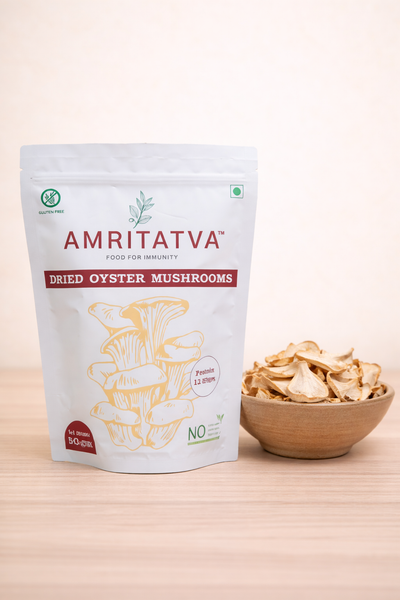


0 comments