

Short answer: it depends entirely on what the pasta is made from, not on whether the label says "gluten-free" or "high protein." These are two separate claims. Gluten-free pasta made mostly from rice or corn flour rarely beats regular wheat pasta's roughly 13 to 14g protein per 100g (PMC, 2016). Gluten-free pasta built on chickpea, lentil, or pea protein can run 2 to 3 times higher, because legumes are simply richer in protein than grains (same source). For the detailed chickpea-versus-rice-versus-semolina nutrition breakdown, see Amritatva's pasta nutrition guide. Amritatva's own Gluten-Free Multigrain Pasta, FSSAI-tested like every product we sell, carries 6.99g protein per 100g on its nutrition panel, a number we're stating plainly here rather than dressing up. The real skill isn't spotting marketing words. It's reading the ingredient list and the per-100g protein figure on any pack before you buy.

Key Takeaways
- "Gluten-free" and "high protein" are separate, unrelated claims. Only the ingredient base determines protein content.
- Legume-forward gluten-free pasta (like Mille Supergrain's chickpea and pea protein blend) delivers 21g protein per 100g, versus roughly 6.8 to 6.99g for rice or corn-based options.
- Amritatva's own pasta carries 6.99g protein per 100g. We say this plainly, because that's what our own label shows.
- A 100g serving of wheat pasta (~13g protein) closes about 26% of a sedentary adult's daily 50g protein target (ICMR-NIN, 2020).
New to gluten-free eating in India altogether? Our complete gluten-free diet guide covers the basics. If you haven't read our full guide to gluten-free pasta nutrition, including the detailed chickpea-versus-rice-versus-semolina breakdown, that's a useful companion to this article too.
What Actually Makes a Gluten-Free Pasta "High Protein"?
Protein content in gluten-free pasta comes down almost entirely to one variable: how much legume flour is in the recipe. Pure pulse-based pasta runs 23 to 30% protein on a dry-weight basis, roughly 2 to 3 times wheat pasta's 13 to 14%, according to peer-reviewed food science research (PMC, 2016). Rice, corn, and potato starch, the default gluten-free substitutes for wheat, simply don't carry that protein density.
There's also a quality dimension most shoppers never see. Protein quality is measured using a score called PDCAAS, which accounts for digestibility and amino acid completeness, not just gram count. Pulse Canada, a pulse-industry research body, reports that adding just 25% lentil flour to wheat pasta raises its PDCAAS from 0.43 to 0.71, crossing the threshold used in the US to qualify as a "good source of protein" under labeling standards (Pulse Canada). Independent peer-reviewed research on wheat-legume pasta blends supports the same underlying direction, that legume flour measurably improves protein digestibility over wheat pasta alone, even if the exact 0.43-to-0.71 figure is industry-reported rather than from a peer-reviewed journal. In plain terms: legumes don't just add more protein, they likely add better-absorbed protein too.
Citation capsule: Legume-based gluten-free pasta contains 23 to 30% protein on a dry-weight basis, roughly double to triple wheat pasta's 13 to 14% (PMC, 2016). Blending in just 25% lentil flour raises a pasta's PDCAAS protein-quality score from 0.43 to 0.71, the threshold for a "good source of protein" claim under US labeling rules (Pulse Canada). This is why the words "gluten-free" tell you nothing about protein: the ingredient list, specifically whether chickpea, lentil, or pea protein appears near the top, does. A rice or corn-only gluten-free pasta can be just as legitimately FSSAI-approved and third-party lab-tested for gluten compliance as a chickpea-based one, and still carry a third of the protein, simply because rice and corn are starch-forward grains, not protein-forward legumes. Amritatva's own Gluten-Free Multigrain Pasta is a case in point: it meets the same FSSAI testing standard, but its multigrain, rice-forward formulation was never built to maximize protein, which is exactly why its own label shows a modest, not inflated, number.
Most shoppers assume "gluten-free" and "protein-rich" travel together, likely because both terms show up on premium-looking packaging. In our experience, they rarely do. A gluten-free label only confirms the absence of wheat, barley, and rye proteins, verified through FSSAI testing in India. It says nothing about how much protein replaced them, or what replaced them with.
How Much Protein Do Real Gluten-Free Pasta Brands in India Actually Have?
Across real gluten-free pasta products sold in India today, protein per 100g ranges from under 7g to 21g, and the gap tracks almost exactly with ingredient base. Legume-and-pea-protein blends sit at the top; rice and corn-based pastas sit near the wheat-free baseline. No brand in this comparison makes a false claim. The differences are simply a function of what's in the bag.
| Product | Protein per 100g | Fiber per 100g | Primary Ingredient Base |
|---|---|---|---|
| Wheat/semolina pasta (baseline) | ~13g | varies | Durum wheat semolina |
| Mille Supergrain Protein Pasta | 21g | 9g | Bengal gram flour, pea protein, tapioca starch, brown rice flour |
| Amritatva Gluten-Free Multigrain Pasta | 6.99g | see product label | Multigrain flour blend (rice, millet-forward), FSSAI-tested gluten-free |
| Anmara Gluten-Free Spaghetti | 6.8g | not specified | White corn flour, yellow corn flour, rice flour, water |

Worth noting: Anmara doesn't market its pasta as "high protein," which lines up honestly with its corn-and-rice ingredient base. That's a good example of front-of-pack language matching the actual nutrition panel, exactly what this article is asking every shopper to check for themselves before buying, on any brand, including ours.
Citation capsule: Among gluten-free pasta products available in India, protein per 100g ranges from 6.8g (Anmara's corn-and-rice spaghetti) to 21g (Mille Supergrain's chickpea and pea protein blend), against a wheat pasta baseline of roughly 13g. Amritatva's own pasta carries 6.99g protein per 100g, in the same range as other rice-and-grain-based options, not the legume-fortified category, a figure taken directly from its own FSSAI-approved, third-party lab-tested nutrition panel rather than rounded up for effect. Fiber content follows a similar pattern: Mille Supergrain's legume-forward blend lists 9g fiber per 100g, well above a typical rice-based option. None of the four products compared here makes a false or unverifiable claim; the differences simply reflect what flour is actually in the bag. The honest way to shop for protein is the same across every brand, including Amritatva's: read the per-100g number on the pack, not the marketing language on the front, before assuming a gluten-free pasta is automatically protein-rich.
How Much of Your Daily Protein Target Does One Serving Actually Close?
A single 100g serving of a legume-forward gluten-free pasta can close roughly 40% of a sedentary adult's daily protein need, while a rice or corn-based option closes closer to 13 to 14%. ICMR-NIN's 2020 nutrient requirements report sets the RDA at 0.83g protein per kg bodyweight per day for a sedentary adult, about 50g/day for someone weighing 60kg, rising to 1.2 to 1.6g/kg, or 72 to 96g/day, for active and fitness-focused individuals (ICMR-NIN, 2020).
Run the numbers and the gap becomes concrete. A 100g serving of Mille Supergrain's 21g-protein pasta covers about 42% of a sedentary 60kg adult's 50g target, but only about 25% of an active person's 84g midpoint target. A 100g serving of wheat-baseline pasta at ~13g covers about 26% of the sedentary target and roughly 15% of the active target. Neither number is a full meal's protein on its own. Pasta is a carbohydrate-forward food first, protein second, regardless of type.
It's easy to expect a single pasta serving to function like a protein shake, but the numbers don't support that, even for the highest-protein options on the market today. Pasta protein is a supporting contribution to a day's total, not the main event. What you pair it with, dal, paneer, eggs, or chicken, usually matters more than which pasta brand you pick.
India's broader protein gap is well documented separately. For background on why so many Indian diets fall short of even the sedentary RDA, see Amritatva's article on protein deficiency in India and how to address it through everyday food choices.
Is "Gluten-Free" and "High Protein" the Same Claim?
No, and this is the single most important thing to understand before buying any gluten-free pasta for protein reasons. "Gluten-free" is a compliance claim, verified in India through FSSAI testing and labeling rules (Amritatva's FSSAI label-verification guide, 2026). "High protein" is a nutrition claim, and it depends entirely on what flour replaced the wheat, not on the absence of gluten itself.
A pasta can be perfectly, verifiably gluten-free and still carry less protein than the wheat pasta it replaced, simply because rice and corn flour aren't protein-dense ingredients. Conversely, a pasta can be both gluten-free and genuinely high in protein, but only when legumes such as chickpea, lentil, or pea protein isolate are the primary flour, not a minor addition. Neither fact makes one product better or worse. They're just different formulations built for different goals.
Citation capsule: "Gluten-free" and "high protein" are independent claims that happen to appear on the same packaging. FSSAI-based gluten-free certification confirms the absence of wheat, barley, and rye protein, while protein content depends solely on whether legume flour or pea protein replaces the wheat, a fact confirmed by comparing real per-100g figures across Indian gluten-free pasta brands rather than trusting front-of-pack wording. A pasta can meet every FSSAI gluten-free requirement and still carry a fraction of wheat pasta's protein, or it can be gluten-free and genuinely high in protein, but only when a legume flour is the primary ingredient, not an afterthought further down the list. Amritatva's own pasta illustrates the first case honestly: FSSAI-approved and third-party lab-tested for gluten compliance, built around a multigrain rather than a legume-maximizing recipe, and positioned accordingly rather than marketed as something it isn't.
The practical takeaway: read the ingredient list before the marketing copy. If chickpea flour, lentil flour, or pea protein isolate isn't listed near the top, the pasta likely sits closer to the 6 to 8g range regardless of how the front of the pack is worded. This isn't a flaw in any specific product. It's simply how flour composition works.
What Does Amritatva's Own Pasta Actually Deliver?
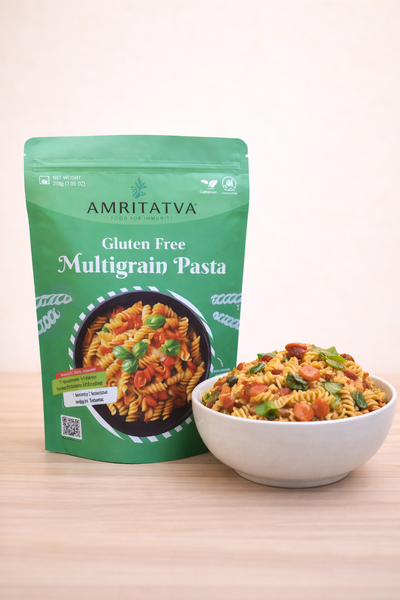
Amritatva's Gluten-Free Multigrain Pasta carries 6.99g protein per 100g on its published nutrition facts panel, tested under FSSAI-approved third-party lab protocols. We're stating that number as-is, without rounding up or hedging, because that's the same standard we're asking readers to hold every brand to in this article.
Our pasta wasn't formulated to maximize protein. It's built around a multigrain, fiber-forward flour blend, engineered first for verified gluten-free compliance and eating experience, not as a legume-based protein product. That's a legitimate, honest design choice, but it does mean the protein number sits closer to Anmara's corn-and-rice-based 6.8g than to Mille Supergrain's chickpea and pea protein 21g.
Citation capsule: Amritatva's Gluten-Free Multigrain Pasta carries 6.99g protein per 100g, per its own FSSAI-approved, third-party lab-tested nutrition facts panel ("Typical Value per 100gm, Approximate Values"). This places it in the same protein range as other rice and grain-based gluten-free pastas, not the legume-fortified category exemplified by chickpea or pea-protein blends, a distinction Amritatva discloses plainly rather than obscures. The pasta was formulated around a multigrain, fiber-forward flour blend engineered for verified gluten-free compliance and everyday eating experience, not to chase a protein-per-serving number for marketing purposes. For a fitness-focused shopper, that means treating this pasta as a lab-tested, gluten-free carbohydrate base to pair with a separate protein source, rather than as a standalone protein food, exactly the same standard this article asks readers to apply to any brand's claim before buying. Amritatva's FSSAI approval speaks to gluten safety, not to protein density, and the two should never be assumed to travel together on any pack, including this one.
If maximizing protein per serving is your primary goal, our honest recommendation is to check the exact per-100g number on any pack, ours included, and look for chickpea, lentil, or pea protein as a leading ingredient. That's the same verify-don't-assume standard we've built our FSSAI label-reading guide around, and it applies to us just as much as to anyone else on the shelf.
Frequently Asked Questions
Is gluten-free pasta automatically higher in protein than wheat pasta?
No. Most gluten-free pasta made from rice or corn flour carries less protein than wheat pasta's roughly 13g per 100g baseline. Only legume-forward formulations, using chickpea, lentil, or pea protein, reliably exceed the wheat baseline, sometimes reaching 21g per 100g (Mille Supergrain, 2026).
Why does Amritatva's pasta have only 6.99g protein per 100g?
Amritatva's Gluten-Free Multigrain Pasta is formulated around a fiber-forward multigrain blend and FSSAI-tested gluten-free compliance, not a legume-protein-maximizing recipe. Its 6.99g per 100g figure is stated directly on its nutrition facts panel and sits in the same range as other rice and grain-based gluten-free pastas on the market.
How do I know if a "high protein" claim on a gluten-free pasta pack is real?
Check two things: the per-100g protein figure on the nutrition panel, and whether chickpea, lentil, or pea protein appears near the top of the ingredient list. Genuine high-protein gluten-free pasta typically shows 18g or more per 100g and lists a legume flour first (PMC, 2016).
How much protein do I actually need in a day?
ICMR-NIN sets the RDA at 0.83g protein per kg bodyweight per day for a sedentary adult, about 50g/day for a 60kg person, rising to 1.2 to 1.6g/kg (72 to 96g/day) for active individuals (ICMR-NIN, 2020). A single pasta serving, even a high-protein one, covers only part of that target; see Amritatva's protein deficiency article for the fuller picture.
Should I avoid rice or corn-based gluten-free pasta if I'm trying to hit a protein goal?
Not necessarily. Rice and corn-based gluten-free pasta is still a valid gluten-free carbohydrate choice; it just won't meaningfully raise your protein intake on its own. Pair it with a protein source like dal, paneer, eggs, or chicken, and check the label rather than assuming from the words "gluten-free" alone.
The Amritatva Difference
We're not going to claim our Gluten-Free Multigrain Pasta is high protein, because at 6.99g per 100g, it isn't, not compared to legume-forward options. What we can stand behind is that every number on our label, protein included, is verified through FSSAI-approved third-party lab testing, and we'd rather state an unremarkable figure honestly than dress it up with vague wellness language. That transparency, not a protein number, is what we're asking you to trust.
If your goal is a verified gluten-free carbohydrate base that you pair with your own protein sources, and you want a label that reflects independent lab testing rather than marketing copy, that's exactly what our pasta is built for.
Where to Buy
Amritatva's Gluten-Free Multigrain Pasta is available directly through our site, with its full FSSAI-tested nutrition panel listed on each product page.
- Gluten-Free Pasta with All-Purpose Seasoning
- Gluten-Free Pasta with Italian Seasoning
- Browse the full range: Gluten-Free Pasta Collection
Every Amritatva product is independently tested by FSSAI-approved third-party laboratories. View our lab reports →
Preeti Rathore is the founder of Amritatva, an IIM Ahmedabad-trained entrepreneur (SAP Regional Entrepreneurship Bootcamp, 2021) building India's first lab-certified functional mushroom food brand. This article is for general education and does not replace professional dietary or fitness advice. Please consult a nutritionist for individual guidance.

0 comments