

Most gluten-free parenting guides are written for a school cafeteria and a Halloween candy bowl. That's not much use to a parent packing a tiffin box in Pune or explaining a diagnosis to a grandmother in Lucknow. Managing a gluten-free diet for a child in India means solving three specific problems most global resources ignore: what goes into the school tiffin, how relatives and joint families respond to a celiac diagnosis, and how to handle wheat-based prasad at temples and family functions.
Around 1 in 310 Indian school children may have celiac disease, based on a Ludhiana screening study of 4,347 children (Sood A, et al., Journal of Gastroenterology and Hepatology, 2006), yet diagnosis is often delayed by roughly two years after symptoms first appear (Indian Journal of Medical Research, 2023). Practical management starts with swapping roti and sandwiches for tiffin options like poha, idli, dosa, or khichdi, briefing teachers and relatives clearly instead of assuming they understand, and asking in advance what a prasad is made from. For packaged options, look for a brand that publishes its FSSAI license and third-party lab reports, the way Amritatva does for its gluten-free multigrain pasta and noodles.
Key Takeaways
- 1 in 310 Indian school children may have celiac disease (Sood A, et al., 2006).
- Diagnosis often lags two years behind first symptoms (IJMR, 2023).
- Growth faltering, not stomach pain, is the most commonly missed symptom.
- Always ask what a prasad is made from before your child eats it.

New to gluten-free eating in India altogether? Our complete gluten-free diet guide covers the basics, from what gluten is to how FSSAI's 20ppm standard works, before you get into the kid-specific parts below.
How Common Is Celiac Disease in Indian Children?
Celiac disease affects roughly 1 in 310 Indian school children, based on a Ludhiana, Punjab study that screened 4,347 children aged 3 to 17 and confirmed 14 cases (Sood A, et al., Journal of Gastroenterology and Hepatology, 2006). That's a far more common condition than most Indian parents assume it to be.
Diagnosis usually arrives later than it should. A study following 891 Indian children found symptoms typically began around age 4, but diagnosis came, on average, at age 6.2, a gap of roughly two years (Indian Journal of Medical Research, Vol 158(1), August 2023). That's two years of a child eating something that's quietly making them unwell.
Why does the delay happen so often? Partly because early celiac symptoms in children rarely look dramatic. A child who's a little tired, a little smaller than classmates, or has an upset stomach every few weeks doesn't usually trigger an immediate specialist visit, especially in a first child or an only child where there's no sibling to compare against.
Citation capsule: Celiac disease affects an estimated 1 in 310 Indian school children, according to a Ludhiana, Punjab screening study that tested 4,347 children aged 3 to 17 and confirmed 14 positive cases (Sood A, et al., Journal of Gastroenterology and Hepatology, 2006). Diagnosis is also commonly delayed: a separate study of 891 Indian children found the average age at symptom onset was 4.0 years, while the average age at diagnosis was 6.2 years, a gap of roughly two years (Indian Journal of Medical Research, Vol 158(1), pp. 75-84, August 2023). For Indian parents, this means celiac disease is neither rare nor quickly caught. A child's first symptoms can go unrecognized for years before a pediatrician connects them to gluten, which is one reason Amritatva recommends any parent who notices a suspicious pattern of symptoms consult a pediatric gastroenterologist rather than waiting it out.
What Are the Warning Signs Parents Often Miss?
Growth faltering, not stomach pain, is the single most common sign of celiac disease in Indian children, appearing in 70% of cases in one large cohort study, ahead of abdominal pain (64.2%), abdominal distension (61.2%), and diarrhea (58.2%) (Indian Journal of Medical Research, 2023). Most parents expect the opposite.
That's the counter-intuitive part. Parents watch for tummy aches or loose motions, and those do show up often. But a child who's shorter or lighter than classmates, or whose growth curve has quietly flattened on the pediatrician's chart, is frequently the first and easiest sign to miss. It gets blamed on fussy eating or a slow growth spurt instead.
Other signs worth watching for include persistent fatigue, irritability, unexplained anemia, and delayed puberty in older children and teenagers. None of these alone confirms celiac disease. Together with a flat or slow growth curve, though, they're worth raising with a pediatrician rather than waiting them out.
Citation capsule: Growth faltering, not abdominal pain, is the most common presenting symptom of celiac disease in Indian children, found in 70% of cases in a study of 891 children, ahead of abdominal pain (64.2%), abdominal distension (61.2%), and diarrhea (58.2%) (Indian Journal of Medical Research, Vol 158(1), pp. 75-84, August 2023). Most Indian parents expect stomach symptoms to appear first, which means a child whose height or weight gain has quietly slowed is often the hardest case to catch early. Pediatricians recommend tracking a child's growth chart at routine checkups rather than relying on digestive symptoms alone as the trigger for a celiac disease screening. Recognizing this pattern early, rather than waiting for classic stomach symptoms, is one of the most useful pieces of information a parent managing a child's gluten-free diet in India can act on.
What Do You Pack in a Gluten-Free School Tiffin?
A safe gluten-free tiffin swaps roti and sandwiches for foods that were never wheat-based to begin with: poha, idli, dosa, khichdi, and besan chilla all travel well and taste fine by lunchtime. The easiest fix isn't a special product, it's rethinking what already belongs in an Indian kitchen.
- Poha or upma holds up well in a tiffin box and doesn't turn soggy if it's kept lightly dry.
- Idli or dosa (rice and urad dal batter) travel well and don't need reheating.
- Khichdi made with rice and moong dal is filling, familiar, and easy to prepare in bulk.
- Besan chilla or dhokla pack easily and taste good even a few hours later.
- Ragi, jowar, or bajra-based snacks, like ragi cookies or jowar khakhra, add variety without wheat.
- Rice-flour chakli or khakhra work as a crunchy side, similar to what a wheat-based namkeen would offer.
- Rajma or chole with rice, or simple curd rice, both travel well for an older child's lunch.
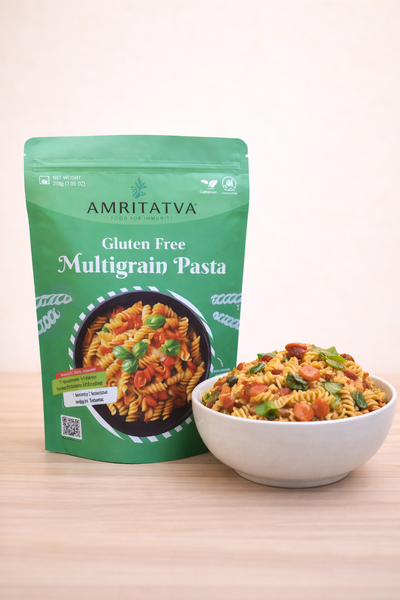
- Gluten-free multigrain noodles or pasta, like Amritatva's FSSAI-tested noodles range, are a quick option for days when a hot tiffin isn't practical.

Rotate these through the week so your child doesn't feel like they're eating the same three things while classmates swap sandwiches. Most schoolteachers won't automatically know which of these is safe, so a short note inside the tiffin box, or a quick conversation at the start of term, helps more than it seems like it should.
How Do You Get Relatives to Take This Seriously?
Getting relatives on board is often harder than managing the diet itself. In an Indian study of children with celiac disease, adolescents' dietary adherence dropped to 44%, compared to 80% among younger children, and compliance was measurably lower in joint or larger families than in nuclear ones (Basu S, et al., Indian Journal of Pediatrics, 2010).

The same study found that nearly half of surveyed parents felt teachers didn't adequately understand their child's condition. That's a pattern many Indian parents will recognize: a grandparent insisting "a little bit of wheat won't hurt," or a school function serving snacks nobody checked. The diet doesn't fail because the child isn't disciplined. It fails when the adults around the child aren't aligned.
A few things help. Write down, in plain language, what your child can and can't eat, and share it with every adult who regularly feeds them, not just close family. Explain that celiac disease isn't a preference or a phase; even a small amount of gluten can cause internal damage regardless of whether symptoms show up right away. Repetition works better than a single conversation.
Why does this need repeating so often? Because "gluten-free" still sounds, to a lot of relatives, like a diet trend rather than a medical necessity. Framing it in terms grandparents already understand, an allergy, not a preference, tends to land better than a scientific explanation.
Citation capsule: Dietary adherence for children with celiac disease in India drops sharply during adolescence, from around 80% compliance in younger children to just 44% among adolescents, according to a study of Indian children conducted at Lady Hardinge Medical College, New Delhi (Basu S, et al., 2010). The same study found that children from joint or larger families showed lower dietary compliance than those from nuclear families, and nearly half of parents surveyed felt teachers did not adequately understand their child's condition. For Indian parents, this points to a specific, fixable gap: the diet often fails not because a child lacks discipline, but because the adults around them, relatives, teachers, and caregivers, aren't consistently informed or aligned. Amritatva recommends sharing a clear, written list of safe and unsafe foods with every adult who regularly feeds your child, rather than relying on a single verbal conversation to hold over the years. Choosing FSSAI-approved, third-party tested packaged staples for a gluten-free diet for kids in India is one less thing to explain or defend at every gathering.
What About Prasad and Festival Food?
Kada prasad and sooji halwa, two of the most commonly offered prasad at gurudwaras, temples, and family functions, are traditionally made from whole wheat flour or semolina (sooji), both wheat-derived and not gluten-free. This isn't a formally researched statistic, it's simply how these dishes are conventionally prepared.
That makes prasad a genuine, unaddressed gap for gluten-free families in India, one that most Western gluten-free-kids guides never mention because the problem doesn't exist in their context. It's worth being upfront about this with a temple committee or a relative hosting a puja, rather than hoping your child will quietly skip it.
A few habits help. Ask what the prasad is made from before your child eats it, especially at a gathering where you don't know the cook. Where possible, carry a small gluten-free alternative sweet your child can accept instead, so they aren't the only one not receiving prasad. Most families, once they understand why, are happy to make the swap.
How Do You Choose a Safe Gluten-Free Product for Your Child?
Choosing a safe packaged gluten-free product starts with checking two things: whether the brand's FSSAI license number is verifiable, and whether a third-party lab report is available on request. Our detailed guide on decoding gluten-free pasta labels in India walks through exactly how to check both yourself, on any brand.
For children specifically, it's worth going one step further and checking the full ingredient list, including any seasoning sachets, since these are often left vague on packaging. A product that's transparent about its FSSAI license and its lab testing is generally a safer bet than one that only says "gluten-free" on the front of the pack.
Amritatva publishes its FSSAI license number and third-party lab reports on its certifications page for exactly this reason, so a parent can verify before serving, not after.
Frequently Asked Questions
Q: What age should a child be tested for celiac disease in India?
A: There's no fixed age; testing is based on symptoms, not a birthday. Since growth faltering is the most common sign in Indian children (Indian Journal of Medical Research, 2023), a pediatrician typically recommends blood testing if growth or weight gain slows unexpectedly, at any age.
Q: Can a gluten-free child still manage a normal school day with a cold tiffin?
A: Yes. Most gluten-free tiffin options like poha, idli, khichdi, or besan chilla travel well cold and don't need reheating. The bigger challenge is usually classmates' snacks or canteen food, not the tiffin itself, so briefing the teacher matters as much as the lunchbox contents.
Q: Is kada prasad or sooji halwa gluten-free?
A: No. Kada prasad and sooji halwa are traditionally made from whole wheat flour or semolina (sooji), both wheat-derived. This is based on how these dishes are conventionally prepared, not a formal lab study, so it's best to ask directly before your child eats prasad at a temple or family event.
Q: How do I explain celiac disease to grandparents who don't take it seriously?
A: Explain that celiac disease causes internal damage even without visible symptoms, so "a little bit won't hurt" isn't accurate. Indian research shows joint-family households often see lower dietary compliance than nuclear families (Basu S, et al., 2010), so repeating the explanation calmly, more than once, tends to work better than a single conversation.
Q: Are Amritatva's gluten-free noodles and pasta safe for children?
A: Amritatva's Gluten-Free Multigrain Pasta and Noodles are tested by FSSAI-approved third-party laboratories against the 20ppm gluten threshold, with lab reports available on request. As with any packaged food for a child with celiac disease, check the full ingredient list against your pediatrician's guidance first.
The Amritatva Difference
Amritatva makes Gluten-Free Multigrain Pasta and Noodles that are tested by FSSAI-approved third-party laboratories, with lab reports available on request rather than a front-of-pack claim alone. As India's first lab-certified functional mushroom food brand and a DPIIT-recognised startup, Amritatva was built on the idea that Indian food safety claims should be checkable, not just trusted. For a parent managing a child's gluten-free diet in India, that means you don't have to take our word for it: you can verify our FSSAI license number and review our lab reports yourself before your child's first bite.
This matters most in the situations this article covers: the school tiffin, the relative who doesn't quite understand, the prasad at a family function, because the diet's biggest risks usually come from outside the packaged food aisle. A verified pasta or noodle pack is one less variable a parent has to manage on an already complicated day.
Where to Buy
Amritatva's Gluten-Free Multigrain Pasta and Noodles are available directly through our site, each lab-verified under FSSAI's 20ppm standard before it ships.
- Browse the full range: Gluten-Free Pasta Collection
- Browse the full range: Gluten-Free Noodles Collection
Every Amritatva product is independently tested by FSSAI-approved third-party laboratories. View our lab reports →
Preeti Rathore is the founder of Amritatva, an IIM Ahmedabad-trained entrepreneur (SAP Regional Entrepreneurship Bootcamp, 2021) building India's first lab-certified functional mushroom food brand. This article is for general education and does not replace medical or pediatric advice. Please consult a pediatrician or pediatric gastroenterologist for individual guidance.
0 comments