

Most shoppers read the front of a gluten-free pasta pack and stop there. Almost nobody checks the one number on the back that actually means something: the FSSAI license. That small, unglamorous check is the whole point of this article.
Most "best gluten-free pasta in India" roundups rank brands by taste and price and stop there. Nobody explains what the FSSAI label is actually promising, or how a shopper can check it themselves. Here's the short answer: FSSAI's gluten-free standard sets a legal 20ppm gluten limit, but it issues no separate gluten-free certificate, and compliance is self-declared by the brand, not independently confirmed before sale (our noodles article breaks this down in full).
What you can verify yourself is the brand's FSSAI license number, its ingredient base, and whether a lab report exists on request. Amritatva publishes all three; this article shows you how to check any brand's, not just ours, using the FSSAI's own FoSCoS portal. (New to gluten-free eating in India? Our complete gluten-free diet guide covers the basics first.)
Key Takeaways
- FSSAI issues no separate gluten-free certification; a brand's 20ppm compliance is self-declared, not pre-checked before sale.
- You can verify any brand's 14-digit FSSAI license number yourself via the FoSCoS "FBO Search" tool at foscos.fssai.gov.in.
- Chickpea and multigrain bases generally out-nutrition rice-only gluten-free pasta on protein and fibre.
- India's gluten-free products market is projected to grow from USD 201.8 million (2025) to USD 513.8 million by 2033, and gluten-free products typically carry a 20-40% price premium.

What Does "FSSAI Approved" Actually Mean on a Gluten-Free Pasta Pack?
"FSSAI approved" on a pasta pack means the brand holds a valid food business license, not that FSSAI has separately tested and certified the gluten-free claim. FSSAI issues no distinct gluten-free certification or license, and no rapid test-kit is validated for market checks, so compliance with the 20ppm threshold is effectively self-declared by the manufacturer, a point we've covered in more depth in our noodles buying guide.
We covered the full mechanics of this, including FSSAI's Sub-Regulation 2.14 and the 20ppm number itself, in our gluten-free pasta guide, so we won't re-derive it here. What matters for this article is the practical consequence: a license number on the back of a pack tells you a business is registered with FSSAI, and nothing more, unless the brand also chooses to publish independent lab results.
That gap between "licensed" and "lab-tested" is exactly where a shopper's own checking has to start. A license number is a floor, not a guarantee. The rest of this article is about raising that floor yourself, one check at a time.
Citation capsule: An "FSSAI approved" claim on a gluten-free pasta pack in India confirms only that the manufacturer holds a valid food business license under the Food Safety and Standards Authority of India. It does not mean FSSAI separately tested or certified the gluten-free claim itself: the agency issues no distinct gluten-free certification, and no rapid test-kit is validated for routine market checks, so 20ppm compliance is effectively self-declared by the brand. That 20ppm threshold itself matches the international Codex Alimentarius, EU, and US FDA standards, but a legal number with no routine independent re-checking is only as trustworthy as the brand publishing it. For a shopper managing celiac disease or wheat sensitivity, the practical takeaway is to treat a license number as a starting point, and check separately whether the brand publishes a third-party, FSSAI-approved lab report behind its claim, the way Amritatva does for its own gluten-free pasta and noodles.
How Do You Actually Verify an FSSAI License Number Yourself?
FSSAI runs a public verification tool called FoSCoS (Food Safety Compliance System) at foscos.fssai.gov.in, where anyone can enter a brand's 14-digit license number and a captcha to pull up its registered business name, address, license type, and validity status (Corpbiz, 2024; Surepass, 2024). This is the single most useful, and most overlooked, check in this whole article.
Here's how to actually do it, step by step:
- Find the 14-digit FSSAI number printed on the pack, usually near the ingredient list or on the back panel.
- Go to foscos.fssai.gov.in and look for the "FBO Search" function under license verification.
- Enter the number and the captcha. FoSCoS is a JS-heavy government portal, so expect a captcha and a page or two of clicking rather than an instant result.
- Check three things once it loads: does the registered business name match the brand on the pack, is the license status "Active," and does the registered product category plausibly cover pasta or noodle manufacturing.
There's a second, faster sense-check worth knowing even before the portal loads. A genuine FSSAI number isn't a random string, it's decodable. Per FSSAI's own advisory on its uniform numbering system, a 14-digit License number starts with "1" and a Registration number starts with "2," with the second and third digits state-dependent for licenses (FSSAI, Uniform Numbering System Advisory, 2018); compliance-explainer sources describe this as splitting into five practical segments: registration type, state code, year of issue, designated officer code, and serial number (Corpbiz, 2024). Practically, that means the state-linked digits should roughly line up with the state on the pack's registered address. It won't replace the FoSCoS lookup, but it's a five-second red flag check while you're standing in a store aisle with patchy signal.

A genuine FSSAI license number isn't a random string, it decodes into five parts. Source: FSSAI's Uniform Numbering System Advisory, 2018.
It's genuinely faster to check a license number than to read a full ingredient panel end to end, and it's a step most gluten-free buying guides skip entirely. That's the gap this section is meant to close.
Citation capsule: FSSAI operates a free public tool, FoSCoS (Food Safety Compliance System), at foscos.fssai.gov.in, where any shopper can enter a brand's 14-digit license number plus a captcha under the "FBO Search" function to see the registered business name, address, license type, and validity status. The 14 digits themselves decode into five parts, registration type, state code, year of issue, designated officer code, and serial number, so a real license number should logically match the brand's state and a plausible year even before the lookup finishes loading. This single check, run before a pack goes in your cart, verifies the business behind a gluten-free claim rather than just the words printed on it, which is more than most label-reading habits ever cover. Amritatva publishes its own FSSAI license number and third-party, FSSAI-approved lab reports on its certifications page specifically so customers can run this exact check themselves, rather than trusting a logo on the pack.
Why Does the Ingredient Base Matter More Than the Gluten-Free Label?
The gluten-free label tells you nothing about nutrition, only about wheat absence, and that's where the ingredient base becomes the more useful check. Peer-reviewed nutrition comparisons show chickpea-based and rice-quinoa-chickpea-blend pasta generally deliver more protein and fibre per serving than rice-only formulations, a full breakdown we've already published in our gluten-free pasta guide.
We won't repeat that nutrition table here since it's already there in detail. The practical version for this article: when you flip a pack over, look past "gluten-free" on the front and read what the flour blend actually is. Rice flour alone, multigrain (rice plus millet, chickpea, or lentil), or a single legume base each behave differently in both nutrition and cooking texture.
This is also the check most shoppers skip entirely. They'll verify the gluten-free claim, then never ask what the pasta is actually made of. Ingredient-base literacy is arguably the more consequential habit of the two, especially for anyone managing weight, blood sugar, or protein intake alongside a gluten-free diet.
What Should You Check Before Buying Any Gluten-Free Pasta Brand in India?

A published FSSAI license and a lab report on request are the two checks that matter most, since an independent 2021 AIIMS Delhi study found 10.8% of labeled gluten-free products in Delhi NCR still failed lab testing (Mehtab et al., European Journal of Clinical Nutrition, 2021). A workable buyer's checklist has four items: license published, lab report available, ingredients fully disclosed, and price per pack.
Citation capsule: Before buying any gluten-free pasta or noodle brand in India, a shopper can apply a simple four-item checklist: is the brand's FSSAI license number published and verifiable, is a third-party, FSSAI-approved lab report available on request, are all ingredients including seasoning sachets disclosed, and how does the price compare per 100g. This checklist matters because compliance with FSSAI's 20ppm gluten threshold is self-declared, not independently re-checked once a product is already on a shelf: an independent 2021 study by AIIMS Delhi researchers found that 10.8% (38 of 360) of labeled gluten-free products tested in Delhi NCR exceeded the legal limit (Mehtab et al., European Journal of Clinical Nutrition, 2021). Amritatva publishes all four checklist items for its own Gluten-Free Multigrain Pasta and Noodles, including a verifiable FSSAI license number and third-party lab reports on request, so a shopper does not have to take the front-of-pack claim on faith.
Below is a neutral, fact-only look at four brands actually sold in India as of this research, based only on what each brand publishes. Where something wasn't published or independently verified this session, we've said so rather than guessing.
| Brand | FSSAI license published? | Lab report available on request? | Ingredient/sachet transparency | Approx. price |
|---|---|---|---|---|
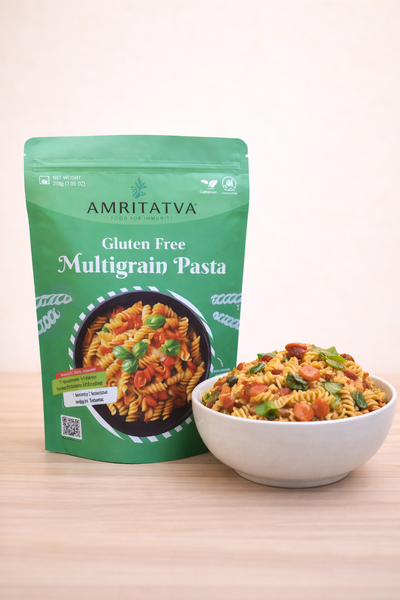
| Amritatva Gluten-Free Multigrain Pasta | Yes, on pack and certifications page | Yes, third-party lab reports published on request | Full ingredient list published, seasoning sachets itemised separately | See current pricing on our pasta collection |
| Wheafree (macaroni, spaghetti, penne, fusilli, rice noodles) | Not independently verified this session | Not independently verified this session | Ingredient lists published; sold direct at wheafree.com | ₹85-225 per pack (wheafree.com) |
| Slurrp Farm (multigrain GF macaroni, fusilli) | Not independently verified this session | Not independently verified this session | Ingredient lists published on retail listing | ~₹280/400g (via BigBasket) |
| Nutrahi (multigrain GF pasta) | Not independently verified this session | Not independently verified this session | Ingredient lists published on retail listing | ₹180-400 (via BigBasket/IndiaMart) |
None of this is a claim that any brand above is non-compliant. It's simply what each brand's own public pages did and didn't show us this session, which is exactly the exercise this article is trying to teach you to run yourself, on any brand, any time you're standing in front of a shelf or a product page. If you're comparing noodles too, our noodles buyer's checklist covers the same four checks for that category.
Is Gluten-Free Pasta Worth the Price Premium in India?
Gluten-free pasta in India typically costs 20-40% more than a comparable wheat pasta pack, a directional premium rather than a fixed number (Market Research Future), while the category itself is growing fast: India's gluten-free products market is projected to expand from USD 201.8 million in 2025 to USD 513.8 million by 2033, a 12.4% CAGR (Grand View Research).
For someone with confirmed celiac disease, the premium isn't really optional, it's the cost of a diet that doesn't make you sick. For a wheat-sensitive shopper without a formal diagnosis, it's more of a value call: does the ingredient base (protein, fibre) and the verification trail (license, lab report) justify paying more than plain wheat pasta.
Our own view, and it's a genuinely contrarian one against most "just buy the cheapest option" advice: price alone tells you almost nothing about whether a gluten-free claim is trustworthy. A cheaper pack with a published lab report is a safer bet than a pricier one with none. Verification, not price, should be the first filter, and price the second.
How Do You Use This Checklist Whether You're Buying Pasta or Noodles?
The same four-item checklist works across both pasta and noodles, since India's gluten-free packaged foods market is growing fast enough that more multigrain options are now sturdy enough for everyday Indian cooking, not just a standalone bowl.
In our own kitchen, gluten-free multigrain pasta holds up well in a simple sabzi-style toss with sautéed vegetables and mustard oil tempering, in a baked pasta with paneer and tomato gravy, or in a chaat-masala pasta salad for a quick lunchbox option. Gluten-free noodles work the same way in a khichdi-adjacent one-pot format: boiled, then finished in the same pan as a light vegetable and dal-based sauce, rather than treated as a separate Western-style dish.
The checklist doesn't change based on what you're cooking. Check the license number, check for a published lab report, check the ingredient base, and only then compare price. Do that once per brand, and you won't need to redo it every time you restock your pantry.
Frequently Asked Questions
Q: What is the best gluten-free pasta brand in India?
A: There's no single "best" brand independent of your own checking. The stronger question is whether a brand publishes its FSSAI license number and a lab report on request. Amritatva publishes both; run the same check on any brand before buying.
Q: How do I verify if a gluten-free pasta brand's FSSAI license is real?
A: Enter the 14-digit license number from the pack into FSSAI's FoSCoS "FBO Search" tool at foscos.fssai.gov.in along with the captcha, then confirm the business name, license status, and registered product category match.
Q: Is chickpea-based gluten-free pasta more nutritious than rice-only pasta?
A: Generally, yes. Peer-reviewed comparisons show chickpea and multigrain blends deliver more protein and fibre per serving than rice-only bases; see our full gluten-free pasta guide, linked earlier in this article, for the exact figures.
Q: How much more expensive is gluten-free pasta than regular wheat pasta in India?
A: Roughly 20-40% more, directionally, though this varies by brand and ingredient base (Market Research Future). India's gluten-free market is growing fast enough that this gap is likely to narrow over time.
Q: Can gluten-free pasta be used in everyday Indian recipes like sabzi or khichdi?
A: Yes. Multigrain gluten-free pasta holds up well in a sabzi-style sauté, a baked paneer-tomato bake, or a chaat-masala salad, and gluten-free noodles work well finished khichdi-style in a one-pot vegetable and dal base.
The Amritatva Difference
Amritatva's Gluten-Free Multigrain Pasta and Noodles publish exactly what this article asks you to check for any brand: a verifiable FSSAI license number, third-party lab reports on request confirming compliance with the 20ppm threshold, and a full ingredient list, seasoning sachets included, rather than a vague "seasoning mix" line. As a DPIIT-recognised startup, we built our own transparency trail before writing an article telling readers to demand one.
This matters because FSSAI approval alone doesn't guarantee a gluten-free claim was independently tested; it only confirms a valid food business license, since no separate gluten-free certification exists and compliance is otherwise self-declared. Every batch of Amritatva pasta and noodles carries a verifiable, FSSAI-approved third-party test result behind the claim on the pack, so you don't have to take our word, or any brand's word, for it.
Where to Buy
Amritatva's Gluten-Free Multigrain Pasta and Noodles are available directly through our site, each lab-verified under FSSAI's 20ppm standard before it ships.
- Browse the full range: Gluten-Free Pasta Collection
- Browse the full range: Gluten-Free Noodles Collection
Every Amritatva product is independently tested by FSSAI-approved third-party laboratories. View our lab reports →
Preeti Rathore is the founder of Amritatva, an IIM Ahmedabad-trained entrepreneur (SAP Regional Entrepreneurship Bootcamp, 2021) building India's first lab-certified functional mushroom food brand. This article reflects her own research process and is for general education; it does not replace professional dietary advice.

0 comments