

Three months ago I was standing in my own kitchen holding a pack of "gluten-free" instant noodles, turning it over for the third time, reading the same line on the front: certified gluten-free. I wasn't buying it for myself. My cousin's daughter had just been diagnosed with celiac disease, and I'd promised her mother I'd help stock a pantry that wouldn't make her sick.
Running my thumb over that little seal on the pack, I realized I couldn't actually answer a basic question: who checks this, after it leaves the factory? I'd spent two years building a food brand that puts "gluten-free" on our own noodle packs, and I still didn't know the honest answer. So I went looking for it, and what I found changed how I read every label since. (If you're newer to this, our complete gluten-free diet guide for India covers the basics first.)
Key Takeaways
- 10.8% (38 of 360) of labeled gluten-free products tested in Delhi NCR exceeded India's legal gluten threshold (Mehtab et al., 2021).
- FSSAI has never validated a rapid test-kit for checking this claim in the market and issues no separate gluten-free certification; compliance is effectively self-declared (NuFFooDS Spectrum, 2019).
- Seasoning sachets, not just the noodle strand, are a common hidden-gluten risk worth checking separately.
- Treat the front-of-pack claim as a starting point, not a guarantee, and check the ingredient list and lab report before you buy.
What Made Me Stop Trusting the Front of the Pack?
The turning point wasn't a scare story, it was a line buried in FSSAI's own guidance note. FSSAI has never validated a rapid test-kit method for checking gluten-free claims once a product is already on a shelf, and it does not issue a separate gluten-free certification or license (FSSAI Guidance Note, 2019/2020; NuFFooDS Spectrum, 2019). In practice, "gluten-free" compliance in India runs on the honour system.
I already knew the number that supposedly defines the category: under 20mg/kg, or 20ppm, set by FSSAI's Sub-Regulation 2.14 (NuFFooDS Spectrum, 2019). What I hadn't clocked was the gap between having a legal number and someone actually checking it. A rule nobody routinely verifies is really just a promise with a number attached.
So who does check? Almost nobody, at scale, and only one study has really tried to find out.
Citation capsule: FSSAI's Guidance Note for gluten-free foods sets a legal threshold of under 20mg/kg (20ppm) of gluten under Sub-Regulation 2.14 of the Food Products Standards and Food Additives Regulations, 2011, the only standard a packaged food can legally use to claim "gluten-free" in India (FSSAI Guidance Note, 2019/2020). Crucially, the same note confirms FSSAI has never validated a rapid test-kit method for verifying this claim once a product is already on a store shelf, and the agency does not operate a separate gluten-free certification or license scheme (NuFFooDS Spectrum, 2019). In practical terms, compliance with the 20ppm standard is effectively self-declared by the manufacturer, not independently confirmed before sale. For anyone managing celiac disease, that is the detail worth knowing: a legal number exists, but no routine government testing enforces it at the point of purchase.
How Many "Gluten-Free" Noodles in India Actually Fail Lab Testing?
One study answered this properly, and the answer was uncomfortable: 10.8% (38 of 360) of labeled gluten-free products sold in Delhi NCR exceeded the 20ppm gluten threshold when independently tested, alongside 11.8% of unlabeled products and 0% of imported gluten-free items (Mehtab et al., European Journal of Clinical Nutrition, 2021).
Researchers led by Wajiha Mehtab and Govind Makharia at AIIMS Delhi tested 794 packaged foods across Delhi NCR: 360 carried a gluten-free label, 354 were unlabeled or naturally gluten-free, and 80 were imported gluten-free products. It remains the largest India-specific check of its kind published to date.

10.8% of labeled gluten-free products, 11.8% of unlabeled products, and 0% of imported gluten-free products exceeded India's legal gluten threshold in a 2021 Delhi NCR lab study. Source: Mehtab et al., European Journal of Clinical Nutrition, 2021.
That 10.8% failure rate is the headline, but the detail beside it matters more. Unlabeled, naturally gluten-free products failed at a slightly higher 11.8%, likely from processing-line cross-contamination rather than a false claim. Imported gluten-free products, sold in markets with routine pre-export testing, cleared entirely, not because imported wheat is magically gluten-free, but because someone actually checked before it shipped.
Citation capsule: A 2021 study led by researchers at AIIMS Delhi, published in the European Journal of Clinical Nutrition, tested 794 packaged foods across Delhi NCR to check whether gluten-free claims held up under lab analysis. Of 360 products carrying a labeled gluten-free claim, 10.8% (38 products) exceeded India's legal 20ppm gluten threshold. Among 354 unlabeled or naturally gluten-free products, 11.8% also exceeded the threshold, likely from processing-line cross-contamination rather than a false claim. None of the 80 imported gluten-free products tested exceeded the limit, a 0% failure rate that points to stricter pre-export testing regimes rather than anything inherent about imported wheat. It remains the largest independent, India-specific check of gluten-free label accuracy published to date (Mehtab et al., European Journal of Clinical Nutrition, 2021). For a buyer managing celiac disease, that's a wide enough margin to matter: roughly one in nine labeled products failed to meet their own claim.
Why Are Noodle Seasoning Packets a Hidden Source of Gluten?
The noodle strand isn't usually where the risk hides, the seasoning sachet is. Instant noodle tastemaker packets are commonly built on a soy-sauce-based flavoring, and hydrolyzed wheat protein is a standard ingredient in that kind of base. This is a well-documented formulation pattern in the food industry generally, not a stat with an India-specific number attached, which is exactly why it's worth checking on its own.
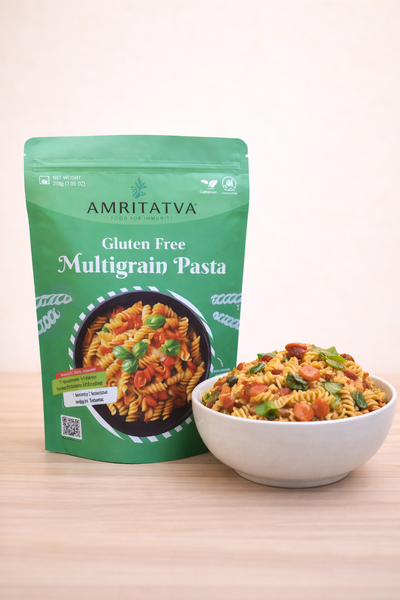
I'll admit this one stung a little, because it's personal to what we make. Our own Amritatva Gluten-Free Multigrain Noodles ship with a seasoning sachet too, either an Italian seasoning or an all-purpose seasoning. Going through this research is exactly why we list what's in ours on the pack, ingredient by ingredient, rather than folding it into a vague "seasoning mix" line.
Here's the practical habit worth building: when you check a noodle pack, check the noodle ingredients and the seasoning packet's ingredients as two separate lines, not one. A brand can be genuinely gluten-free in its noodle strand and still slip on the sachet, and most people never think to look at both.
Citation capsule: FSSAI's under-20ppm gluten-free standard, set by Sub-Regulation 2.14 of the Food Products Standards and Food Additives Regulations, 2011, legally applies to a packaged food as sold in its entirety, not only to its primary grain ingredient (NuFFooDS Spectrum, 2019). For instant noodles, that means the standard covers the seasoning sachet as much as the noodle strand. Seasoning sachets commonly use a soy-sauce-based flavoring, and hydrolyzed wheat protein is a standard ingredient in that type of base, a well-documented pattern in packaged food generally, though not one with a published India-specific failure rate. Checking only the noodle strand and skipping the sachet leaves a real gap, one Amritatva's own noodles close by listing every sachet ingredient, not a vague "seasoning mix" line. The practical fix is straightforward: read the noodle strand's ingredient list and the seasoning sachet's ingredient list as two separate checks, since a product can be genuinely gluten-free in one and still fall short on the other, and most shoppers only ever check the first.
What Should You Check Before Buying Gluten-Free Noodles in India?
Short version: check the ingredient list on the noodles and the seasoning sachet separately, look for a specific lab report rather than a logo, and treat the front-of-pack claim as a starting point, not proof. Here's why that's the right standard to hold every pack to.
FSSAI's own guidance note is honest about its limits: because there's no routine market surveillance re-testing products already on shelves, the front-of-pack "gluten-free" claim is a starting point for a celiac patient, not a guarantee on its own (NuFFooDS Spectrum, 2019). That's the single most useful reframe I took from all of this.
Here's the checklist I actually use now, standing in a store aisle or scrolling a product page:
- Read the full ingredient list, not just the front claim. Look specifically for wheat, barley, rye, malt, and any derivative of them, not just the word "gluten" itself.
- Check the seasoning sachet's ingredients separately. Look for "hydrolyzed wheat protein" or "hydrolyzed vegetable protein" without a named source grain.
- Look for a referenced lab report, not just a badge. A logo or seal means little without a batch-level test result a brand is willing to show you.
- Ask the brand directly if nothing is published. A legitimate gluten-free brand should be able to produce a recent lab report on request, ours included.
- Treat the label as a first filter, not a final answer, especially if you or a family member has a confirmed celiac diagnosis.

None of this means avoiding packaged noodles altogether. It means spending thirty extra seconds on the ingredient panel before the pack goes in your cart, the same thirty seconds I now spend on every pack I recommend to family.
Citation capsule: FSSAI's own guidance note for gluten-free foods is candid about a structural limitation: there is no routine market surveillance program that re-tests gluten-free-labeled products once they are already sitting on store shelves (NuFFooDS Spectrum, 2019). Because of that gap, the agency's practical guidance, and the most useful takeaway for anyone managing celiac disease or a gluten sensitivity, is to treat a front-of-pack "gluten-free" claim as a starting point for further checking, not a guarantee on its own. In practice, that means reading the full ingredient list on both the main product and any seasoning sachet, looking for a specific batch-level lab report rather than a generic logo, and asking the brand directly if no report is published. A label alone is a claim; a lab report is evidence. None of this is a reason to avoid packaged noodles altogether: it's a reason to check the panel, and ask whether the claim is third-party tested, the way Amritatva's noodles are.
Amritatva Gluten-Free Noodles vs. Uncertified "Gluten-Free" Claims: What's the Real Difference?
| Factor | Amritatva Gluten-Free Multigrain Noodles | Generic/Uncertified "Gluten-Free" Claims |
|---|---|---|
| Gluten testing | Independently tested by FSSAI-approved third-party labs, verified under 20ppm | Often self-declared, no public lab report |
| Seasoning sachet disclosure | Full ingredient list published for the seasoning packet, not just the noodles | Varies; seasoning ingredients often summarized as "seasoning mix" |
| Legal standard met | Meets FSSAI Sub-Regulation 2.14 (under 20ppm) | Unclear; label claim not independently verifiable at point of sale |
| Certification trail | DPIIT-recognised startup, lab reports available on request | Rarely published |
| Market context | Independently verifiable testing trail | Part of the 10.8% of labeled gluten-free products that failed lab testing in an independent 2021 review (PubMed) |
This isn't about naming any one competitor as unsafe. It's about a pattern the data shows across the market: independent testing found that roughly 1 in 10 labeled gluten-free products in Delhi NCR exceeded the threshold they claimed to meet (Mehtab et al., 2021). If you're also comparing gluten-free pasta brands, our pasta buyer's guide walks through the same checklist for that category, or see our guide to verifying any brand's FSSAI claim yourself for a full brand-by-brand comparison.
Browse the full gluten-free noodles collection, each variant lab-verified under FSSAI's 20ppm standard before it ships.
Frequently Asked Questions
Q: Is "gluten-free" on an Indian noodle pack independently verified before it's sold?
A: Not automatically. FSSAI sets the under-20ppm legal threshold but has never validated a market test-kit and issues no separate gluten-free license, so compliance is largely self-declared by the brand (FSSAI Guidance Note, 2019/2020; NuFFooDS Spectrum, 2019).
Q: How many gluten-free-labeled products in India actually fail lab testing?
A: In the largest India-specific study to date, 10.8% (38 of 360) of labeled gluten-free products tested in Delhi NCR exceeded the legal 20ppm threshold (Mehtab et al., 2021). Imported gluten-free products in the same study failed at 0%.
Q: Should I worry about the seasoning packet in instant noodles, not just the noodles themselves?
A: Yes. Sachets often use soy-sauce-based flavoring, and hydrolyzed wheat protein is a common ingredient in that base. Check the seasoning packet's ingredients separately from the noodle strand's.
Q: What's the single most useful check before buying gluten-free noodles?
A: Read the full ingredient list on both the noodles and the seasoning sachet, and ask for a lab report if one isn't published. Treat the label as a starting point, not proof on its own.
Q: Are imported gluten-free noodles automatically safer than Indian ones?
A: Not automatically, but the data leans that way for now. In the Mehtab et al. (2021) study, 0% of imported gluten-free products exceeded the threshold, likely reflecting stricter pre-export testing.
The Amritatva Difference
Amritatva's Gluten-Free Multigrain Noodles are independently tested by FSSAI-approved third-party laboratories to verify they stay under the legal 20ppm gluten threshold, seasoning sachet included, not just labeled and assumed safe. As a DPIIT-recognised startup, we publish this testing trail rather than asking customers to take a claim at face value.
This matters because an independent study found that 10.8% of products labeled gluten-free in India failed to meet the 20ppm standard when actually tested (Mehtab et al., 2021). A label is a claim; a lab report is proof, and every batch of Amritatva noodles carries a verifiable third-party test result behind the claim on the pack, seasoning sachet and all.
Where to Buy
Amritatva's Gluten-Free Multigrain Noodles are available directly through our site, each variant lab-verified under FSSAI's 20ppm standard before it ships.
- Gluten-Free Noodles with Italian Seasoning
- Gluten-Free Noodles with All Purpose Seasoning
- Browse the full range: Noodles Collection
Every Amritatva product is independently tested by FSSAI-approved third-party laboratories. View our lab reports →
Preeti Rathore is the founder of Amritatva, an IIM Ahmedabad-trained entrepreneur (SAP Regional Entrepreneurship Bootcamp, 2021) building India's first lab-certified functional mushroom food brand. This article reflects her own process for checking gluten-free labels and is for general education; it does not replace medical advice. Please consult a qualified professional for individual dietary guidance.

0 comments