

A gluten-free diet in India means removing wheat, barley, rye, and their derivatives (maida, suji, atta) while building meals around rice, millets, and dals that are naturally free of gluten. It is entirely possible to eat well this way in India. Roughly 1.04% of the north Indian population tests positive for celiac disease on door-to-door screening (Makharia et al., Journal of Gastroenterology and Hepatology, 2011), and millions more manage non-celiac wheat sensitivity. This guide walks through what gluten intolerance looks like in India, how it gets diagnosed, which everyday foods are already safe, where gluten hides without warning, and how to read a label the way a lab would.
Key Takeaways
- Celiac disease affects about 1.04% of north Indians, roughly ten times higher than the south (0.10%), largely tracking wheat intake (Ramakrishna et al., American Journal of Gastroenterology, 2016).
- Rice, jowar, bajra, ragi, and most dals are naturally gluten-free and already central to Indian cooking.
- FSSAI's gluten-free standard requires verified gluten content under 20 ppm, a single binary threshold with no intermediate tier (Sub-Regulation 2.14, FSSAI Guidance Note, 2019/2020).
- Compounded hing (asafoetida) is a common, India-specific hidden-gluten trap that most generic gluten-free guides never mention.
What Is Gluten Intolerance in India?
Gluten intolerance in India ranges from diagnosed celiac disease, an autoimmune reaction to gluten, to non-celiac wheat sensitivity, where symptoms appear without the same immune markers. Celiac prevalence hits 1.04% in north India based on a door-to-door screening of 10,488 people (Makharia et al., 2011), a number that surprises most doctors here.
For years, celiac disease was treated as a Western condition, rarely tested for and rarely discussed at Indian dinner tables. That's changing, slowly. Talk to anyone recently diagnosed and you'll hear the same story: years of "just IBS" or "just weak digestion" before someone finally ordered the right blood test.
Celiac Disease vs. Wheat Sensitivity: What's the Difference?
Celiac disease is an autoimmune condition. Eating gluten damages the small intestine's lining, even in small amounts, and the damage shows up on biopsy. Non-celiac wheat sensitivity causes similar symptoms, bloating, fatigue, brain fog, but without that same intestinal damage or the specific antibodies.
Both need a gluten-free diet to manage. The difference matters mainly for diagnosis and how strict the avoidance needs to be. Celiac disease requires lifelong, zero-tolerance avoidance. Wheat sensitivity sometimes allows more flexibility, though many people still choose to avoid gluten completely once they've felt the difference.
How Is Celiac Disease Actually Diagnosed?
Diagnosis starts with a blood test, not an elimination diet, and that order matters more than most people realize. The standard first step is a tTG-IgA (tissue transglutaminase antibody) blood test, which checks for the immune markers celiac disease produces while a person is still eating gluten normally.
If that test comes back positive, or borderline with strong symptoms, the next step is an endoscopy with a small intestine biopsy. A gastroenterologist takes tiny tissue samples to check for the villous damage that confirms celiac disease under a microscope. This biopsy step is what separates a confirmed diagnosis from a suspected one.
The single biggest mistake we hear about, over and over, is someone going gluten-free before getting tested, because they feel better and assume that confirms the diagnosis. It doesn't, and it actively works against getting one.
Here's why the order matters so much: once gluten is removed from the diet, the antibody levels drop and the intestinal lining can start healing. Test after that point, even a few weeks later, and results often come back falsely negative. That's a real problem for someone who genuinely has celiac disease but now can't get it confirmed on paper, which matters for long-term monitoring, family screening, and even insurance documentation in some cases.
The practical takeaway: if celiac disease is suspected, get the blood test and, if needed, the biopsy, while still eating a normal gluten-containing diet. Only start the gluten-free diet after diagnosis is confirmed, unless a doctor advises otherwise for urgent symptom relief. For a closer look at symptoms, testing costs, and what daily life looks like after diagnosis, see our guide to gluten intolerance signs and diagnosis in India.
Why Does Celiac Disease Vary So Much Across Indian Regions?
Celiac disease is far more common in north India than in the south, and the gap tracks almost exactly with how much wheat people eat. This is one of the more striking patterns in Indian gastroenterology research, and it changes how doctors think about risk by region.
A large multi-center study of 23,331 people found age-adjusted celiac autoantibody prevalence of 1.23% in north India, 0.87% in the northeast, and just 0.10% in the south (Ramakrishna et al., American Journal of Gastroenterology, 2016). The same study measured average daily wheat intake at 455 grams in the north, compared to 37 grams in the northeast and 25 grams in the south.
| Region | Age-adjusted celiac autoantibody prevalence | Average daily wheat intake |
|---|---|---|
| North India | 1.23% | 455 g/day |
| Northeast India | 0.87% | 37 g/day |
| South India | 0.10% | 25 g/day |
Source: Ramakrishna et al., American Journal of Gastroenterology, 2016, n=23,331
That's not a small gap. It suggests genetics alone don't explain the difference, dietary exposure plays a very real role too. A Punjabi household eating wheat rotis at every meal faces a fundamentally different exposure pattern than a Kerala household built around rice and coconut.
Public health researchers have started calling this a possible "impending epidemic," since wheat consumption is rising across India even as diagnosis lags far behind actual prevalence (Ramakrishna B.S., Indian Journal of Medical Research, ICMR, 2011). Most people with celiac disease in India are likely still undiagnosed, particularly outside the metro hospitals where testing is routine.
Citation capsule: Celiac disease prevalence in India follows a strong north-south gradient tied to wheat intake, not just genetics. North India shows 1.23% age-adjusted prevalence with average wheat intake of 455g/day, versus 0.10% in the south with only 25g/day (Ramakrishna et al., American Journal of Gastroenterology, 2016). Researchers have described this as a possible "impending epidemic," since wheat consumption is rising nationally even as diagnosis infrastructure lags well behind actual prevalence, especially outside major metro hospitals (Ramakrishna, Indian Journal of Medical Research, ICMR, 2011). Most affected Indians likely remain undiagnosed today, particularly in regions with lower medical awareness of celiac disease as an Indian, not just Western, condition.
Which Indian Foods Are Naturally Gluten-Free?
Most of India's everyday staples are naturally gluten-free, which makes the diet far easier here than in wheat-centric Western kitchens. Rice, millets like jowar, bajra, and ragi, all dals, and besan (gram flour) contain zero gluten by nature, no substitution required. For the full categorized list, including which pulses, dairy, nuts, and snacks are safe, and where hidden gluten actually hides in hing, namkeen, and packaged spice blends, see our complete list of naturally gluten-free Indian foods.
This is where Indian gluten-free eating actually has an advantage over Western gluten-free diets. A Western gluten-free shopper often reaches for expensive substitute breads and pastas built to imitate wheat. An Indian gluten-free eater can build an entire week of meals from foods that were never wheat-based to begin with, no substitute product required at all.
Millets: Jowar, Bajra, and Ragi
Jowar (sorghum), bajra (pearl millet), and ragi (finger millet) have been dietary staples in India for centuries, long before wheat rotis became common in urban kitchens. All three are naturally gluten-free and can replace wheat atta in rotis, bhakri, and porridge.
Ragi in particular carries meaningful calcium content and is a traditional first food for babies in many south Indian households. Bajra rotis are a winter staple in Rajasthan and Gujarat, usually served with generous ghee. None of this needs reinvention, it just needs rediscovery.
Rice in All Its Forms
Rice is inherently gluten-free, whether it's plain steamed rice, idli and dosa batter, poha, or puffed rice (murmura). This single grain covers breakfast, lunch, dinner, and snacks across nearly every Indian region without a single substitution needed.
Fermented rice-and-dal batters for idli and dosa are naturally gluten-free and already a celiac-friendly breakfast in most South Indian homes. Poha and murmura make quick, safe snacks that need no special "gluten-free" labeling at all.
Dals and Besan
Every dal, toor, moong, chana, urad, masoor, is naturally free of gluten and forms the protein backbone of a gluten-free Indian diet. Besan (gram flour) made from chana dal is equally safe and works for chillas, pakoras, and thickening curries.
Dal-rice or dal-chawal, arguably India's most common meal, is automatically gluten-free without any adjustment. That's a real comfort for someone newly diagnosed and worried they've lost access to familiar comfort food.
Comparing Gluten-Free Flours for Wheat Atta
Choosing which gluten-free flour to reach for depends on the dish, since each one behaves differently on the tawa. This table breaks down texture and best use for the five most common substitutes in an Indian kitchen.
| Flour | Texture | Best used for | Notes |
|---|---|---|---|
| Jowar (sorghum) flour | Slightly coarse, crumbly | Rotis, bhakri | Best rolled while dough is still warm; cracks if it cools too much |
| Bajra (pearl millet) flour | Dense, hearty | Winter rotis, bhakri | Pairs well with ghee and jaggery; common in Rajasthan and Gujarat |
| Ragi (finger millet) flour | Fine, slightly nutty | Rotis, dosa, porridge, baby food | High in calcium; blends well with rice flour for softer rotis |
| Rice flour | Smooth, light | Dosa, idiyappam, some rotis | Neutral taste; good base for blending with millet flours |
| Besan (gram flour) | Fine, slightly grainy | Chillas, pakoras, thickening curries | High in protein; best cooked on low-medium heat to avoid a raw taste |
Citation capsule: India's everyday staples make gluten-free indian recipes far simpler to build than Western gluten-free diets suggest, since rice, jowar, bajra, ragi, and every variety of dal are naturally free of gluten by default. This covers breakfast (idli, dosa, poha), lunch, and dinner without any substitution or specialty product. Dal-chawal, one of India's most common meals, requires zero adjustment for someone avoiding gluten intolerant food in india. Unlike Western gluten-free diets, which often depend on expensive imitation breads and pastas engineered to mimic wheat, an Indian gluten-free diet can be built almost entirely from staples that were never wheat-based in the first place, a structural advantage most guides overlook. Ragi alone carries meaningful calcium content and is already a traditional first food for babies in many south Indian households, which means the naturally gluten-free staple list doubles as a nutritionally sound foundation, not just a safe one.
Quick Gluten-Free Meal Ideas for Every Meal of the Day
Building a full day of meals is easier than it looks once the naturally gluten-free staples above are in place. These combinations use only what's already been discussed, no specialty products required.
Breakfast: Plain idli with sambar and coconut chutney, or a rice-batter dosa with a simple potato filling. Poha with peanuts and curry leaves works well for a quicker option on busy mornings.
Lunch: Dal-chawal with a vegetable sabzi and a side of curd is the simplest safe combination. A jowar or ragi roti with a dal and sabzi thali covers the same ground with more variety.
Dinner: Khichdi made from rice and moong dal, topped with ghee, is easy to digest and entirely gluten-free. Bajra roti with baingan bharta is a traditional winter dinner in several north Indian states.
Snacks: Besan chilla with chopped vegetables, roasted makhana (fox nuts), or plain murmura tossed with peanuts and spices all work as safe, familiar snacks without any label-checking required.
Hidden Gluten Traps in Indian Cooking
Hidden gluten in Indian food shows up in places generic gluten-free guides never mention, most notably in commercial hing (asafoetida), which is commonly cut with wheat flour as a carrier. This is a distinctly Indian risk, different from the soy sauce and malt vinegar warnings that Western checklists default to.
Pure asafoetida resin is naturally gluten-free. The compounded, commercial hing sold in most Indian kitchens, however, is a different product entirely, and that's where the risk lives.
The Hing (Asafoetida) Problem
Compounded hing, the kind sold in most Indian grocery stores, is typically bulked up with a carrier starch, and wheat flour is a very common choice for that carrier. One widely-cited test by a travel blogger checking a commercial hing brand found it contained 55% wheat content, a striking number, though it's worth being clear this was a single product test, not a systematic industry survey.
Still, the pattern is well known enough among Indian celiac communities that it's treated as a serious risk. Hing goes into tadka for dal, sambar, and countless vegetable dishes, often just a pinch, but even a pinch matters for someone with celiac disease.
Most Western gluten-free checklists focus on soy sauce or malt vinegar, ingredients that barely feature in Indian cooking, while missing hing entirely. That's a real gap in most international gluten-free resources, and one that generic, non-India-specific guides consistently get wrong.
The safer path is buying hing explicitly labeled gluten-free, or pure asafoetida resin without added starch, and checking the ingredient list every single time, even for a brand you've bought before. For a deeper look at the pure-versus-compounded asafoetida distinction under FSSAI rules, see our practical kitchen guide to gluten-free cooking in India.
Hidden Gluten Sources to Watch in Indian Kitchens
Beyond hing, several everyday sources of hidden gluten don't carry any obvious warning on the front of the pack. This table lists the most common ones and where they typically appear.
| Hidden gluten source | Where it shows up | Why it's easy to miss |
|---|---|---|
| Compounded hing (asafoetida) | Tadka for dal, sambar, vegetable dishes | Often cut with wheat flour as a carrier starch; pure resin is gluten-free |
| Restaurant gravies and curries | North Indian and Punjabi-style restaurant dishes | Maida is a common thickener, rarely disclosed on the menu |
| Packaged spice mixes and premixes | Instant dosa/idli premixes, ready-to-cook masalas | Wheat starch sometimes used as an anti-caking or bulking agent |
| Fried snacks with batter coating | Bhajiyas, some pakoras at restaurants | Batter may be blended with maida for crispness, not just besan |
| Papad (select regional varieties) | Some commercially made papads | A small number of varieties use wheat flour blends instead of pure urad or rice |
Where Does Maida Hide in Everyday Indian Food?
Maida (refined wheat flour) shows up far beyond the obvious naan and paratha. It's a common thickener in restaurant gravies, a coating agent in some fried snacks, and an ingredient in packaged spice mixes and instant premixes that don't always disclose it clearly on the front of the pack.
Anyone managing celiac disease in India learns quickly that "vegetarian" and "gluten-free" are not the same thing, and that restaurant staff often don't know their own gravies contain maida as a thickener. Asking directly, every time, becomes a habit.
For a deeper look at what maida actually does inside the body and why it's worth limiting even for people without celiac disease, see Amritatva's article on what happens to your body when you eat maida every day.
How Do You Read a Gluten-Free Label in India?
Reading a gluten-free label in India comes down to one number: 20 parts per million. FSSAI requires verified gluten content below 20 mg/kg for any product labeled gluten-free, under Sub-Regulation 2.14 of the Food Safety and Standards (Food Products Standards and Food Additives) Regulations, 2011, detailed further in FSSAI's Guidance Note on Gluten Free Foods (v2, October 2019, revised February 2020).
That threshold isn't arbitrary. It's the same benchmark used internationally (Codex Alimentarius) for gluten-free certification, and it exists because even trace gluten can trigger an immune reaction in someone with celiac disease. A product can carry a "gluten-free" claim on the front of the pack and still fail to meet it, unless someone actually tests the batch.
Citation capsule: FSSAI's gluten-free standard requires verified gluten content below 20 mg/kg (20 ppm), set out in Sub-Regulation 2.14 of the Food Safety and Standards Regulations, 2011, and detailed in FSSAI's Guidance Note on Gluten Free Foods (v2, October 2019, revised February 2020). Notably, the current guidance removed the earlier "low gluten" intermediate category (previously 20 to 100 mg/kg), meaning India now applies a single binary pass/fail threshold rather than a tiered system. This aligns India's standard directly with Codex Alimentarius, the international food standard used for gluten-free certification. A front-of-pack "gluten-free" claim means little without batch-level lab verification against this exact number, since the regulation gives no room for a partial or "mostly gluten-free" classification.
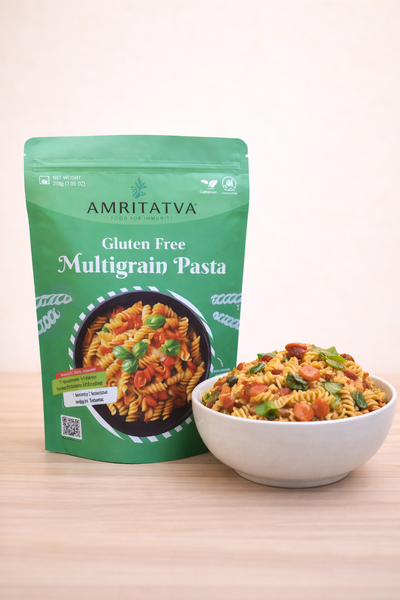
At Amritatva, every batch of Gluten-Free Multigrain Pasta and Gluten-Free Multigrain Noodles is third-party tested by an FSSAI-approved lab against this exact 20 ppm threshold, not just checked once at launch. We share the certificate, we don't just print a claim on the pouch.


Why "Gluten-Free" on the Front Isn't Enough
A front-of-pack claim tells you what a brand intends. It doesn't tell you what a lab confirmed. The only way to know a product genuinely sits under 20 ppm is batch-level testing, and that testing should be repeatable, not a one-time certificate from years ago.
Ask any brand, gluten-free or otherwise, whether they can show you a current lab report. Honest brands will have one ready. That single question tells you more than any marketing claim on the packaging.
Practical Kitchen Tips for Going Gluten-Free in India
Preventing cross-contamination in a shared Indian kitchen means separating utensils, storage, and prep surfaces for gluten-free cooking, not just swapping ingredients. Even trace wheat flour dust settling on a rolling board can matter for someone with celiac disease.
Most Indian kitchens weren't built with a gluten-free member in mind. Getting this right takes a few deliberate habits, not a full kitchen renovation.
Separate Utensils and Storage
Keep a dedicated rolling pin (belan) and board for gluten-free rotis, since wheat flour dust lingers in wood grain even after washing. Store gluten-free atta, rice flour, and jowar flour in sealed containers, away from shelves where wheat atta gets scooped daily.
Toasters, in particular, are a common oversight. Wheat crumbs from regular bread easily transfer to the next slice toasted, so a separate toaster or toaster bags helps.
Cooking Order and Shared Pots
If a shared kitchen still uses wheat regularly, cook the gluten-free dish first, before any wheat-based prep starts that day. Wash pots and pans thoroughly between dishes, and wipe down counters before rolling out gluten-free dough.
Families managing this often find labeling containers clearly, "GF flour only", helps everyone in the house remember, especially when relatives or domestic help aren't fully briefed on why it matters.
For a full walkthrough of which shared equipment actually carries cross-contamination risk (shared fryers and pasta water matter far more than shared spoons or tawas) and safe flour substitutes for daily rotis and parathas, see our practical kitchen guide to gluten-free cooking in India.
Gluten-Free Pasta and Noodles in an Indian Diet
Gluten-free pasta and noodles fill a real gap for Indian households managing celiac disease or wheat sensitivity, offering a familiar format (pasta night, Hakka-style noodles) without the wheat. The key is choosing versions actually tested against the FSSAI 20 ppm threshold, not just labeled gluten-free by assumption.
Multigrain gluten-free options built from rice, jowar, and other gluten-free grains can slot into weekly meal planning the same way regular pasta or noodles would, tossed with sautéed vegetables, a simple tomato base, or a quick Indo-Chinese style stir-fry.
Amritatva's Gluten-Free Multigrain Pasta and Gluten-Free Multigrain Noodles are both third-party tested by an FSSAI-approved lab against the 20 ppm standard for every batch, with the certificate available to check, not just claimed on the pouch. This matters most for families who've been burned before by a "gluten-free" label that turned out to be untested.
For a full breakdown of what "gluten-free" actually means on a pasta label, the real cost premium over regular wheat pasta, and how to cook it without it turning mushy, see our complete guide to gluten-free pasta in India.
For the same breakdown on noodles, including why an independent 2021 lab study found roughly 1 in 10 labeled gluten-free products in India didn't actually meet the claim on the pack, see our buyer's guide to gluten-free noodles in India. If you're comparing specific brands, our guide to verifying any gluten-free pasta brand's FSSAI claim walks through exactly how to check. If protein content is your main concern, our honest breakdown of real protein numbers across gluten-free pasta brands, including our own, is worth reading before you shop.
Brands like Nuvedo and SomaShrooms also operate in India's growing functional and gluten-free food space, part of a market where consumer awareness around gluten-free eating is rising steadily, even if exact market-size figures vary too widely across research firms to cite reliably here. What matters more than any market number is whether a specific product on your shelf has actually been tested.
Frequently Asked Questions
Is a gluten-free diet the same as a low-carb diet?
No. A gluten-free diet removes wheat, barley, and rye, but rice, potatoes, and millets, all carbohydrate-rich foods, remain fully allowed. Celiac disease management is about avoiding a specific protein, gluten, not reducing carbohydrate intake overall.
Can someone with celiac disease eat idli and dosa safely?
Yes, plain idli and dosa batter made from rice and urad dal is naturally gluten-free. The only risk is cross-contamination in restaurant kitchens that also handle wheat-based items on the same tawa or utensils.
Does going gluten-free help without a celiac or sensitivity diagnosis?
There's limited evidence that a gluten-free diet benefits people without celiac disease or diagnosed wheat sensitivity. Removing wheat unnecessarily can mean missing out on fiber and B-vitamins, so testing before eliminating gluten is the more evidence-backed approach.
How is celiac disease actually diagnosed in India?
Diagnosis typically starts with a blood test for specific antibodies (tTG-IgA), followed by an intestinal biopsy to confirm damage while the person is still eating gluten. Testing gluten-free before diagnosis can produce a false negative, so see a gastroenterologist first.
Are all Indian sweets automatically gluten-free?
No. Many Indian sweets use maida as a base, including some varieties of barfi coatings, certain biscuits sold alongside sweets, and bakery-style items. Traditional sweets made from besan, rice flour, or khoya (like besan laddoo or rice kheer) are typically safer choices.
Key Takeaways for Starting a Gluten-Free Diet in India
Going gluten-free in India is less about deprivation and more about rediscovering what was already on the plate: rice, millets, dals, and besan built entire regional cuisines long before wheat became a daily staple in most households. The real work lies in catching hidden gluten, in hing, restaurant gravies, and packaged premixes, and in insisting on lab-verified labels rather than front-of-pack promises.
Celiac disease in India is likely far more common than diagnosis rates suggest, with north India showing prevalence around 1.04 to 1.23% (Makharia et al., 2011; Ramakrishna et al., 2016). If persistent bloating, fatigue, or digestive issues sound familiar, a conversation with a gastroenterologist is worth having, with a blood test done before eliminating gluten, rather than self-diagnosing through diet elimination.
For packaged staples like pasta and noodles, check whether a brand actually tests against FSSAI's 20 ppm threshold rather than assuming a label is accurate. Amritatva shares its lab certificates for exactly this reason, transparency should be checkable, not just claimed.
Managing this for a child in India comes with its own challenges, school tiffins, relatives, and festival prasad among them; see our guide to raising a gluten-free kid in India for the specifics.
View certifications and lab reports →
Every Amritatva product is independently tested by FSSAI-approved third-party laboratories. View our lab reports →
Preeti Rathore is the founder of Amritatva, an IIM Ahmedabad-trained entrepreneur (SAP Regional Entrepreneurship Bootcamp, 2021) building India's first lab-certified functional mushroom food brand. This article is for general education and does not replace medical advice. Please consult a gastroenterologist for diagnosis.
0 comments