

Last reviewed: July 2026, by the Amritatva team.
If you've stood in front of a supermarket shelf reading pasta labels twice because "gluten-free" didn't used to mean much in India, you're not alone. As of January 2022, it legally does. Under FSSAI's Regulation 2.14, a product can only carry a "gluten-free" label in India if it contains less than 20 mg/kg (20 ppm) of gluten, the same threshold used by Codex Alimentarius, the EU, and the US FDA (FSSAI Compendium on Labelling and Display, Regulation 2.14). This guide covers what that number actually means, how gluten-free pasta is made, what it costs in India, how to cook it without turning it to mush, and whether it's actually better for blood sugar than regular wheat pasta.
Key Takeaways
- FSSAI mandates gluten-free labels contain under 20 ppm gluten, enforced since 1 Jan 2022
- India's gluten-free food market is growing roughly 7-13% a year (Grand View Research, IMARC Group, 2025-2026)
- Chickpea-based gluten-free pasta has a glycemic index of ~58 vs. wheat pasta's ~73 (PMC, 2024)
- Gluten-free pasta costs roughly 50-85% more than regular wheat pasta in Indian retail
- "Gluten-free" doesn't automatically mean low-GI; ingredient base decides that, not the label
Looking for the full picture on eating gluten-free in India first? Our complete gluten-free diet guide for India covers diagnosis, daily meals, and kitchen practicalities in one place.
What Actually Makes Pasta "Gluten-Free" in India?
A pasta can only be labeled gluten-free in India if lab testing confirms it holds less than 20 mg/kg of gluten, per FSSAI's Regulation 2.14 amendment that took effect 1 January 2022 (FSSAI Compendium, 2021). That's not a marketing claim. It's a specific, testable number.
Before this amendment, Indian food law had a strange middle category: a "low gluten" tier covering 20-100 mg/kg under the old Regulation 2.15. That tier is gone now. The 2021 amendment removed it entirely, leaving one clear line: under 20 ppm is gluten-free, anything above it isn't, full stop. This brought India's standard in line with Codex Alimentarius, the EU, and the US FDA, all of which use the same 20 ppm cutoff.

Why this matters for you as a buyer: most Indian gluten-free content online (including from established brands) mentions "FSSAI approved" without explaining what that actually certifies. It's not a vague quality stamp. It's a specific gluten concentration limit backed by lab testing. When you see the claim on a pasta pack, that's the number behind it.
You can review FSSAI's official gazette notifications directly at fssai.gov.in; the regulation number, 20 ppm threshold, and 1 January 2022 compliance date above are consistent across FSSAI's own notification records and independent legal summaries of the amendment.
What Ingredients Replace Wheat in Gluten-Free Pasta?
Indian gluten-free pasta is typically made from rice flour, corn flour, millet flour, chickpea (besan) flour, or a multigrain blend of these, since none of them contain the gluten protein found in wheat, barley, or rye. The base you choose changes the nutrition profile more than most shoppers realize.
Rice and corn-only pasta tend to be the closest in texture to regular wheat pasta, which is why many mainstream brands default to them. But they're also the least nutritionally different from plain white pasta. Chickpea and multigrain blends are where the real upgrade happens, and we cover the actual numbers in the next section.
Is Gluten-Free Pasta Actually More Nutritious Than Wheat Pasta?
It depends entirely on the ingredient base, not the gluten-free label itself. A peer-reviewed 2025 study compared semolina (regular wheat pasta's base) against chickpea flour and an optimized gluten-free blend of 80% brown rice, 10% quinoa, and 10% chickpea, and found the chickpea-forward option meaningfully ahead on every nutrition metric measured (Scientific Reports, June 2025):
| Metric | Semolina (wheat pasta) | Chickpea flour | 80/10/10 rice-quinoa-chickpea blend |
|---|---|---|---|
| Protein | 10.90% | 23.19% | 10.70% |
| Fiber | 0.83% | — | 1.80% |
| Protein biological value | 77.26% | 97% | — |
Chickpea flour's 97% biological value means the body actually uses nearly all the protein it takes in, versus 77.26% for semolina. In plain terms: not all gluten-free pasta is created equal, and rice-only versions don't automatically carry this advantage. The nutrition upgrade comes specifically from legume and multigrain content, which, in our experience researching this category, is exactly why Amritatva's own pasta blends use a multigrain formulation rather than a single rice or corn base.
If you're shopping by nutrition rather than just by the gluten-free label, check the ingredient list before the front-of-pack claim. A pack that says "gluten-free" and lists rice flour as the only ingredient is a different product, nutritionally, from one built on chickpea or multigrain flour, even though both are legally allowed to carry the same label.
What About Millet-Based Gluten-Free Pasta?
There isn't reliable pasta-specific glycemic index or protein data for millet-based gluten-free pasta yet. Millets (jowar, bajra, ragi) are well documented as nutritious whole grains on their own, rich in fiber and micronutrients, but that doesn't automatically transfer to pasta made from them, and we couldn't locate peer-reviewed, pasta-specific studies to cite a number. We'd rather tell you that honestly than repeat an invented figure, so treat millet-pasta health claims you see elsewhere with some caution until better data exists.
Does Gluten-Free Pasta Help With Blood Sugar and Weight Management?
Not automatically, and this is the most commonly misunderstood part of gluten-free shopping. Wheat pasta averages a glycemic index around 73±5, while chickpea-flour pasta comes in around 58±6, a meaningfully lower blood sugar response (PMC, 2024). But that drop is about the chickpea content, not the absence of gluten.
Rice-only gluten-free pasta can carry a glycemic index similar to or even higher than wheat pasta, because refined rice flour digests quickly too. Here's the nuance most Indian gluten-free marketing skips entirely: if your goal is managing blood sugar or feeling fuller for longer, the ingredient base matters far more than the "gluten-free" badge on the front of the pack.
There's a second lever worth knowing about: how you cook and serve it. When chickpea-flour pasta is cooked, cooled, and reheated rather than eaten fresh off the boil, its glycemic index can drop further to roughly 33-39, and resistant starch rises from 1.83g to 3.65g per 100g (MDPI, 2021). Resistant starch behaves more like fiber in digestion, feeding gut bacteria instead of spiking blood sugar.
| Pasta type | Glycemic index |
|---|---|
| Wheat pasta | ~73 |
| Chickpea-flour pasta, fresh | ~58 |
| Chickpea-flour pasta, cooled and reheated | ~33-39 |
Practical takeaway: if you're diabetic or watching your weight, a next-day pasta salad made from chickpea or multigrain gluten-free pasta is genuinely a smarter choice than a fresh bowl of rice-only gluten-free pasta, and both are different again from wheat pasta. The label alone won't tell you this. The ingredient list and how you serve it will.
How Do You Cook Gluten-Free Pasta Without It Turning Mushy?
Gluten-free pasta has a much narrower cooking window than wheat pasta, often turning mushy within about a minute of being perfectly done, because it lacks gluten's elastic protein network and sheds more surface starch into the water. We've found this is the single biggest complaint from first-time gluten-free pasta buyers, and it's almost always a cooking-technique issue, not a product-quality one.
Three adjustments fix most of it. First, use more water than you would for wheat pasta, at least a full pot per 100g, so starch disperses instead of clumping. Second, start checking doneness one to two minutes before the package's stated time; gluten-free pasta keeps cooking in residual heat even after draining. Third, stir gently and only when needed. Gluten-free noodles break down faster with aggressive stirring since there's no gluten mesh holding the strand together.
One more practical tip for Indian kitchens: drain it slightly firmer than you think you want, especially if it's going into a sabzi, bake, or soup where it'll sit in liquid or heat for a few more minutes. It'll finish cooking there, and starting too soft means a mushy final dish.
Why Does Gluten-Free Pasta Cost More in India?
Gluten-free pasta in India typically costs 50-85% more than regular wheat pasta at retail, roughly ₹120-200 per kg for gluten-free versus ₹70-130 per kg for standard wheat pasta. That gap comes down to ingredient cost (chickpea and quinoa cost more per kg than wheat semolina) and smaller-scale, more careful production runs needed to hit the 20 ppm gluten threshold without cross-contamination.

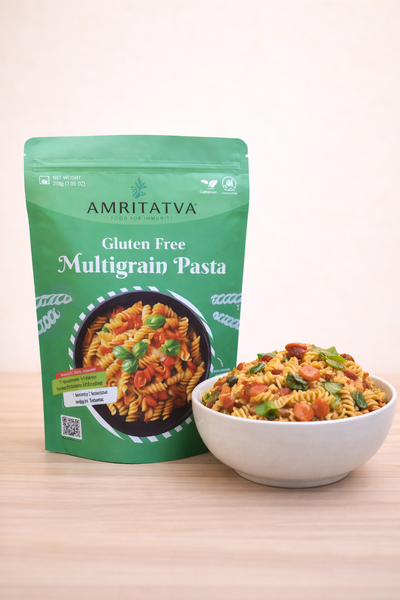
We'll be straightforward about where Amritatva sits in that range. Our Gluten-Free Pasta with All-Purpose Seasoning and Gluten-Free Pasta with Italian Seasoning are priced at ₹210 for 200g, which works out to roughly ₹1,050 per kg, above the general market range quoted above. We're not going to pretend that's cheap. It reflects a multigrain, chickpea-forward formulation (the nutrition profile discussed earlier in this guide) rather than a rice-only base, plus the seasoning included in the pack. If budget is the deciding factor, a plain rice-flour pasta will cost less; if the nutrition and blood sugar profile matter more to you, that's where the price difference is going.
Where Can You Actually Buy Gluten-Free Pasta in India?
Availability has improved but is still fragmented. You won't reliably find gluten-free pasta on a typical mainstream supermarket shelf in most Indian cities yet; it's mostly sold direct through D2C brand websites and on platforms like BigBasket and Flipkart. Estimates on the exact market size vary by research firm and scope definition, but the direction is consistent: Grand View Research puts India's gluten-free products market at $201.8 million in 2025, growing to $513.8 million by 2033 at a 12.4% CAGR, while IMARC Group's most recent outlook estimates $873.1 million in 2025, reaching $1,592.4 million by 2034 at a 6.70% CAGR (Grand View Research, IMARC Group). Whichever figure you trust, both agree the category is growing at a healthy single-to-low-double-digit rate every year, not shrinking or flat. Amritatva sells directly through our own gluten-free pasta collection, which is currently the most reliable way to get both seasoning variants in stock.
Gluten-Free Pasta and Noodles in an Indian Diet
Pasta doesn't have to mean an Italian-style meal to fit into an Indian kitchen. Gluten-free pasta works well in a masala pasta bake, a simple tomato-onion sabzi-style toss, or a cold pasta salad with chaat masala and lemon, the same way regular pasta gets adapted in most Indian households already. The cooking adjustments from earlier in this guide (more water, earlier doneness check, gentle stirring) apply whether you're making an Indian-style dish or a more traditional one.
If noodles are more your household's staple than pasta, the same gluten-free, multigrain logic applies there too; our gluten-free noodles collection uses a comparable ingredient approach for maggi-style or stir-fried preparations. For noodle-specific buying advice, including why an independent 2021 lab study found roughly 1 in 10 labeled gluten-free products in India didn't actually meet their own claim, see our buyer's guide to gluten-free noodles in India. For a full brand-by-brand comparison, including how to verify any brand's FSSAI license number yourself, see our guide to gluten-free pasta brands in India.
Frequently Asked Questions
What is the FSSAI gluten-free standard?
Under the Food Safety and Standards (Food Products Standards and Food Additives) First Amendment Regulations, 2021, FSSAI allows a "gluten-free" label in India only if the product contains less than 20 mg/kg (20 ppm) of gluten. This replaced an older two-tier system that also allowed a "low gluten" claim (20-100 mg/kg); that tier was removed, leaving one clear threshold. Compliance has been mandatory since 1 January 2022, and the 20 ppm limit matches the international Codex Alimentarius, EU, and US FDA standards.
Is all gluten-free pasta in India actually safe for celiac disease?
Only if it's tested and labeled under FSSAI's 20 ppm gluten threshold (Regulation 2.14, enforced since January 2022). Always check for an explicit "gluten-free" label backed by lab testing rather than assuming a rice- or corn-based pasta is automatically safe, since cross-contamination during milling or packing can still occur without certification.
Is gluten-free pasta good for diabetics?
Only if it's a chickpea or legume-forward blend, not a rice-only one; the "gluten-free" label itself says nothing about blood sugar impact. Chickpea-flour pasta has a glycemic index of roughly 58 versus wheat pasta's 73, and that drops further to around 33-39 when the pasta is cooked, cooled, and reheated rather than eaten fresh (PMC, 2024; MDPI, 2021). Rice-only gluten-free pasta doesn't get this benefit and can carry a GI similar to or higher than wheat pasta. This isn't a substitute for advice from your doctor or dietitian, especially if you're managing diabetes with medication.
Does gluten-free pasta taste different from regular pasta?
Yes, noticeably, though the gap has narrowed. Rice and corn-based versions taste closest to wheat pasta, while chickpea and multigrain blends have a slightly earthier, nuttier flavor. Most people adjust within a few meals, especially when the pasta is sauced well rather than eaten plain.
Is gluten-free pasta good for weight loss?
Only if it's a chickpea or legume-forward blend, not a rice-only one. Chickpea-based pasta shows a glycemic index around 58 versus wheat's 73 (PMC, 2024), which supports better satiety, but rice-only gluten-free pasta can have a similar or higher GI than wheat pasta.
How much more expensive is gluten-free pasta in India?
Roughly 50-85% more than regular wheat pasta at Indian retail, working out to about ₹120-200 per kg for gluten-free versus ₹70-130 per kg for standard wheat pasta, depending on brand and ingredient base.
Can kids eat gluten-free pasta safely?
Yes, and it can be a good source of extra protein and fiber if it's a chickpea or multigrain blend rather than rice-only. There's no medical downside to gluten-free pasta for a non-celiac child; the main consideration is taste preference and price.
The Bottom Line on Gluten-Free Pasta in India
Gluten-free pasta in India is no longer a vague, unregulated claim. It's a specific, FSSAI-tested standard (under 20 ppm gluten) backed by a market growing at a healthy single-to-low-double-digit rate every year. But the "gluten-free" label alone doesn't tell you whether a pasta is nutritionally better or blood-sugar-friendly; that comes down to the ingredient base, with chickpea and multigrain blends carrying real, peer-reviewed advantages over rice-only versions.
Cook it with a bit more water and check it slightly early, expect to pay a premium for legume-based nutrition, and read the ingredient list, not just the front label, before you decide which gluten-free pasta is right for your kitchen. If you're ready to try a multigrain, chickpea-forward option, browse Amritatva's gluten-free pasta collection, or start from the beginning with our complete gluten-free diet guide for India.
Every Amritatva product is independently tested by FSSAI-approved third-party laboratories. View our lab reports →
1 comment
Hi,
Great tips! Switching to gluten-free pasta has made a real difference for me, especially when I’m trying to make healthier food choices. I’ve also been using the discount codes from https://rolandmedicalweightloss.com/glp-1-pills-price-discount-codes/ to help save on my GLP-1 medication, and they’ve been really useful. Thanks for sharing this helpful guide!