

Short answer: dried oyster mushrooms and mushroom powder are the practical choice for most Indian kitchens, because fresh oyster mushroom isn't a pan-India, shelf-stable product you can reliably buy year-round. Drying does trade away some nutrients: crude protein drops from roughly 28.85% to 25.91% on a dry-matter basis (Tolera & Abera, Food Science & Nutrition, 2017). But that trade buys you a product that actually sits in your pantry and gets used.
Fresh mushroom isn't automatically the "purer" or cheaper option either, once you compare gram-for-gram of usable, dry-matter nutrition rather than gram-for-gram of mostly water. This guide walks through the real nutrition differences, the honest cost-per-gram math, food safety, and a simple framework for which format to buy based on how you actually cook. For the fuller science on what oyster mushrooms offer in the first place, see our complete oyster mushroom benefits guide. If you're weighing whole mushrooms against a capsule supplement instead, our mushroom powder vs. supplements comparison covers that separate question.
Key Takeaways
- Drying lowers crude protein from 28.85% to 25.91% and fiber from 12.87% to 10.41% on a dry-matter basis, but oven-drying alone can push protein down further, to around 24.99% (Tolera & Abera, 2017).
- Drying method matters more than the word "dried" itself: freeze-dried oyster mushroom retained roughly 2x the beta-glucan of hot-air-dried mushroom in one 2025 study (Tokarczyk et al., MDPI).
- Fresh oyster mushroom looks cheapest at Rs 150-500/kg, but once you account for it being ~90% water, the dry-matter-equivalent cost runs closer to Rs 1.50-5/gram, in the same range as dried and powder formats.
- A 2013 market-sample study found no regulated mycotoxins, including aflatoxins, in 34 dried mushroom samples tested via LC-MS/MS, even though toxigenic mould species were present (Ezekiel et al., International Journal of Food Microbiology, 2013).

Does Drying Actually Change the Nutrition in Oyster Mushrooms?
Yes, drying measurably lowers protein, fiber, and carbohydrate content on a dry-matter basis, though the change is a trade-off, not a collapse. Fresh oyster mushroom runs 28.85% crude protein versus 25.91% for dried, and fiber drops from 12.87% to 10.41% (Tolera & Abera, Food Science & Nutrition, Wiley, 2017). Ash content rises slightly, from 9.76% to 10.91%, as water-soluble organic matter is lost relative to minerals.
The same study found that drying method has its own effect within "dried" as a category: oven-drying specifically pulled protein down further, to around 24.99%, more than other drying approaches tested. That's a detail most buying guides skip entirely. They treat "dried" as one uniform outcome, when it isn't.
| Nutrient (dry-matter basis) | Fresh Oyster Mushroom | Dried Oyster Mushroom |
|---|---|---|
| Crude protein | 28.85% | 25.91% (oven-dried: ~24.99%) |
| Crude fiber | 12.87% | 10.41% |
| Ash | 9.76% | 10.91% |
| Carbohydrate | 48.16% | 42.14% |
Source: Tolera & Abera, Food Science & Nutrition (Wiley), 2017.
Citation capsule: Comparing fresh to dried oyster mushroom on a dry-matter basis, crude protein falls from 28.85% to 25.91% and crude fiber from 12.87% to 10.41% (Tolera & Abera, Food Science & Nutrition, Wiley, 2017). Carbohydrate drops from 48.16% to 42.14%, while ash content rises slightly from 9.76% to 10.91% as water-soluble organic matter is lost relative to minerals. Oven-drying specifically lowered protein further, to roughly 24.99%. This shows the drying method used, not just the fact of drying itself, changes the outcome. For a shopper comparing fresh and dried oyster mushroom, this means dried isn't nutritionally identical to fresh. But the loss is a modest percentage-point shift, not a dramatic one. That's why dried mushroom remains a reasonable everyday cooking choice in Indian kitchens, where fresh availability is inconsistent and irregular by season and city.
Does the Drying Method Change Beta-Glucans and Antioxidants?

Yes, drying method affects how much beta-glucan and antioxidant activity survives, sometimes by a factor of two. A 2025 study found freeze-dried oyster mushroom retained about 5.80g/100g beta-glucan on a dry-weight basis, versus roughly 2.21g/100g for hot-air-dried mushroom at equivalent inclusion levels. Freeze-drying preserved roughly double (Tokarczyk et al., Molecules, MDPI, 2025).
Amritatva's oyster mushrooms are sun-dried, not freeze-dried or hot-air-dried under lab conditions, so we can't claim our own beta-glucan retention matches either figure above without our own testing to back it. What this research does establish clearly is the broader principle: not all "dried" mushroom products are equivalent, and drying method is a real variable worth asking any brand about, not an assumption to skip past.
A separate 2024 study measured ergothioneine, an antioxidant amino acid, in fresh oyster mushroom at 6.52 ± 0.16 mg/g dry matter (Villalobos-Pezos et al., Antioxidants, MDPI, 2024). Hot-air drying at a moderate 40°C preserved it better than freeze-drying, higher-temperature hot-air drying, or microwave-vacuum drying. The same study measured overall antioxidant capacity (ORAC) at 32.54 mmol TE/100g fresh, dropping to 22.12 with 40°C hot-air drying and to 13.87 with microwave-vacuum drying. Drying reduces measurable antioxidant activity regardless of method, though moderate heat preserved the most.
Citation capsule: Drying method meaningfully changes how much beta-glucan and antioxidant capacity survives in oyster mushroom, and beta-glucan is the specific compound most closely tied to the immune-supporting effects associated with mushrooms. One 2025 study found freeze-drying retained roughly double the beta-glucan of hot-air drying (5.80g/100g versus 2.21g/100g dry-weight). A separate 2024 study found moderate 40°C hot-air drying preserved ergothioneine (an antioxidant amino acid found almost exclusively in fungi) better than freeze-drying or higher-heat methods. Even so, fresh mushroom's overall antioxidant capacity (32.54 mmol TE/100g) still measurably exceeded any dried version tested (22.12 at best). The practical lesson for shoppers: "dried" is not one uniform outcome. Drying method matters as much as the format itself, so a brand's specific drying process is a fair question to ask before assuming any two dried products on a shelf are nutritionally equal.
Do Oyster Mushrooms Contain Meaningful Vitamin D2?
Oyster mushrooms can develop meaningful vitamin D2 when exposed to UV-B light. Lab studies show a range of 27.89 to 69.00 micrograms per gram dry matter after UV-B treatment (Jiang, Zhang & Mujumdar, Trends in Food Science & Technology, 2020, citing Huang et al., 2015, and Banlangsawan & Sanoamuang, 2016). Vitamin D2 in mushrooms forms when ergosterol in the cell walls reacts to UV light, sunlight included, not just artificial UV-B lamps.
We'll say plainly what we don't know here: that 27.89-69.00 microgram range comes from controlled UV-B lamp studies, not from measurements of naturally sun-dried commercial batches like ours. Sun-drying does involve real sunlight exposure, so some vitamin D2 conversion is plausible, but we haven't tested our own product's vitamin D2 content and won't attach a number to it that isn't ours to claim.
Which Format Actually Costs Less Per Gram?

Dried oyster mushroom and mushroom powder in India run Rs 2.50 to 3.60 per gram across the brands we checked. Fresh mushroom's dry-matter-equivalent cost lands in a similar Rs 1.50-5 per gram range once its roughly 90% water content is factored in. Fresh is not automatically the cheaper option it looks like at the mandi counter.
Here's the honest breakdown, checked live in July 2026:
| Product | Pack / Price | Price per Gram |
|---|---|---|
| Amritatva Oyster Mushroom Powder | 100g / Rs 310 | Rs 3.10/g (~40 servings at 2.5g/day) |
| Amritatva Dried Oyster Mushrooms | 50g / Rs 180 | Rs 3.60/g |
| SomaShrooms Oyster Whole Dried Mushroom | 100g / Rs 250 | Rs 2.50/g |
| Urban Platter Dried Oyster Mushrooms | 100g / Rs 280 | Rs 2.80/g |
| Nourcery Dried Oyster Mushroom Powder | 80g / Rs 225 | Rs 2.81/g |
| Fresh oyster mushroom (mandi/wet market) | Rs 150-500/kg wet weight | Rs 0.15-0.50/g wet; roughly Rs 1.50-5/g once ~90% water content is converted to a dry-matter-equivalent basis |
Pricing verified directly against brand listings, July 2026. Fresh mushroom dry-matter-equivalent is an estimate, not a lab measurement.
Worth noting: Nuvedo, often mentioned alongside SomaShrooms in the functional mushroom space, doesn't sell oyster mushroom powder or dried oyster mushroom at all. Their oyster offering is a home-growing kit, and their dried-mushroom line covers shiitake and lion's mane, not oyster. If you've seen Nuvedo mentioned in an oyster mushroom comparison elsewhere, it's worth double-checking what they actually sell.
Citation capsule: Once fresh oyster mushroom's roughly 90% water content is converted to a dry-matter-equivalent cost, its real price runs approximately Rs 1.50 to 5 per gram. That's comparable to dried oyster mushroom and mushroom powder brands sold in India at Rs 2.50 to 3.60 per gram, not the far cheaper price its per-kilogram mandi rate suggests at first glance. This matters because "fresh is cheapest" is a common but misleading shortcut: it's true only if you compare wet weight to wet weight, not usable, dry-matter nutrition to usable nutrition. A kilogram of fresh mushroom priced around Rs 300 contains only about 100 grams of actual dry matter once its water content is removed, which is the real basis for a fair price comparison. Amritatva's own Dried Oyster Mushrooms (Rs 3.60/gram) and Oyster Mushroom Powder (Rs 3.10/gram) sit within the same real-world price band as fresh, once the comparison is done fairly rather than by shelf price alone.
Why Doesn't Amritatva Sell Fresh Oyster Mushrooms?
Fresh oyster mushroom is a regional, mandi-based product in India, not a pan-India, shelf-stable item you can order online with any consistency, and that's the honest reason we sell dried and powder formats instead. Availability swings hugely by city, by season, and by which local vendor happens to be growing that week.
A shelf-stable dried or powdered format solves a real logistics problem: it ships anywhere in India, keeps for months without refrigeration, and gives you a consistent product every single time you order. Fresh mushroom simply can't offer that at national scale today. No brand selling fresh oyster mushroom as an e-commerce product changes that underlying supply reality.
We'd rather say this directly than let the comparison tables above imply fresh is an equally accessible option for every reader. If you live near a mandi or a local mushroom grower and fresh is genuinely available to you, it's a fine choice nutritionally. For most of India, dried and powder are the formats that actually show up at your door.
Is Dried Mushroom Powder Safe From Mold and Contamination?
Mold presence on dried mushrooms doesn't automatically mean regulated toxin contamination. A 2013 study tested 34 dried mushroom market samples via LC-MS/MS across 320 possible metabolites, finding toxigenic mould species present but no EU-regulated mycotoxins, including aflatoxins, positively identified (Ezekiel, Sulyok, Frisvad et al., International Journal of Food Microbiology, 2013).
That study looked at Nigerian market samples, not Indian oyster mushroom specifically. Mould visibility and regulated toxin contamination turn out to be two different things, but this data doesn't say anything about our own product's safety record one way or the other. Amritatva runs its own FSSAI-approved third-party lab testing on every batch, which is the actual basis for our own safety claims, not this study.
General food-safety practice for storing dried mushroom at home: an airtight container, away from direct sunlight, under roughly 10% moisture content and 65% relative humidity. That combination typically supports a 6 to 12 month shelf life. It's standard kitchen practice, not a specific study's finding, and it applies whether you're storing dried whole mushrooms or powder.
Which Format Should You Buy for Your Kitchen?
The right format depends on how you actually cook, not on which one sounds more "natural." For daily cooking, mushroom powder is the easiest habit to build. It stirs into chai, dal, or a roti dough with no prep. For occasional use, whole dried mushrooms rehydrate well into a sabzi or biryani when you want texture and bite, not just flavour. For a specific health goal tied to beta-glucan intake, the drying method matters more than the format itself, so ask any brand how their product is dried, not just whether it's "dried."
One honest caveat on bioavailability: mushroom cell walls are built from chitin, which limits how easily your body extracts compounds like beta-glucan regardless of format. Powder's finer particle size increases surface area, but it doesn't eliminate the chitin barrier entirely. A related study on maitake mushroom, a different species, not oyster, found that finer particle size (20-30 micrometers) improved extractable beta-glucan. Treat this as a plausible related mechanism worth knowing about, not a direct oyster mushroom finding, since no comparable study on Pleurotus ostreatus powder specifically turned up in our research.
In our own kitchen, we default to powder for the daily habit and keep whole dried mushrooms on hand for weekend cooking that wants more bite: khichdi, a mushroom biryani, or a simple mustard-oil sabzi. Neither format is objectively "better"; they solve different cooking moments. For more everyday ways to use the powder specifically, the "How Can You Add Oyster Mushrooms to Everyday Indian Cooking?" section of our oyster mushroom benefits guide covers practical Indian cooking uses in full.
Frequently Asked Questions
Is dried oyster mushroom as nutritious as fresh?
Mostly yes, with a modest trade-off. Dried oyster mushroom carries slightly less protein (25.91% vs 28.85%) and fiber (10.41% vs 12.87%) than fresh on a dry-matter basis, but the difference is a percentage-point shift, not a major nutritional loss (Tolera & Abera, 2017).
Is mushroom powder or whole dried mushroom better value?
Both run in a similar Rs 2.50-3.60 per gram range in India. Powder suits daily use in chai or dal since it needs no prep; whole dried mushrooms suit occasional cooking where you want texture, like a sabzi or biryani, after rehydrating.
Why is fresh oyster mushroom hard to find in India?
Fresh oyster mushroom is grown and sold regionally through mandis and local vendors, not as a pan-India, shelf-stable e-commerce product. Availability varies hugely by city and season, which is exactly why dried and powder formats exist as reliable alternatives.
Does drying destroy the beta-glucans in oyster mushroom?
No, but the drying method affects how much survives. One 2025 study found freeze-drying retained roughly double the beta-glucan of hot-air drying at equivalent inclusion levels, showing method matters more than the simple fact of drying (Tokarczyk et al., 2025).
Is dried mushroom safe from mold and toxins?
A 2013 study of 34 dried mushroom market samples found mould species present but no regulated mycotoxins, including aflatoxins, detected via LC-MS/MS testing (Ezekiel et al., 2013). Amritatva additionally runs its own FSSAI-approved third-party lab testing on every batch as its own safety basis.
The Amritatva Difference
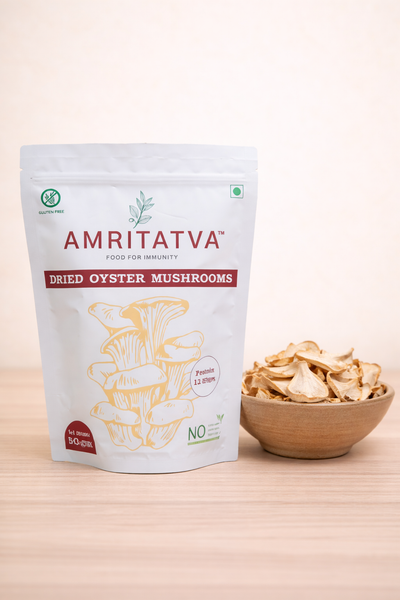
We sell dried oyster mushrooms and oyster mushroom powder, not fresh. That's because dried and powder are the formats that can actually reach a kitchen anywhere in India reliably, and we'd rather be upfront about that than pretend fresh is an equally accessible option in this comparison. Every batch of both products carries FSSAI-approved third-party lab testing, the same standard we ask readers to expect from any brand in this article's comparison tables.
As a DPIIT-recognised startup, our approach has been to publish the real numbers, nutrition, pricing, drying-method caveats included, rather than let a marketing headline stand in for the actual research. If a claim in this article isn't backed by a named, linked source, that's a gap we'd rather flag than fill with confident-sounding language.
Where to Buy
Amritatva's Dried Oyster Mushrooms and Oyster Mushroom Powder are available directly through our site, each FSSAI-tested before it ships.
- Oyster Mushroom Powder
- Dried Oyster Mushrooms
- Browse the full range: Dried Mushrooms Collection
- Browse the full range: Mushroom Powder Collection
Sources
- Tolera, K. D., & Abera, S. (2017). Nutritional quality of Oyster mushroom (Pleurotus ostreatus) as affected by osmotic pretreatments and drying methods. Food Science & Nutrition. PMC5608979
- Tokarczyk, G., et al. (2025). Beta-glucan retention in Pleurotus ostreatus across drying methods. Molecules, MDPI. PMC12693436
- Villalobos-Pezos, A., et al. (2024). Ergothioneine and antioxidant capacity in Pleurotus ostreatus under different drying methods. Antioxidants, 13(12):1581, MDPI. PMC11672878
- Jiang, Q., Zhang, M., & Mujumdar, A. S. (2020). UV-induced vitamin D2 formation in mushrooms. Trends in Food Science & Technology. PMC7508054
- Ezekiel, C. N., Sulyok, M., Frisvad, J. C., et al. (2013). Fungal and mycotoxin assessment of dried edible mushrooms. International Journal of Food Microbiology. PubMed 23454813
Every Amritatva product is independently tested by FSSAI-approved third-party laboratories. View our lab reports →
Preeti Rathore is the founder of Amritatva, an IIM Ahmedabad-trained entrepreneur (SAP Regional Entrepreneurship Bootcamp, 2021) building India's first lab-certified functional mushroom food brand. This article reflects her own research process and is for general education; it does not replace professional dietary advice.

0 comments