

Gluten intolerance is an umbrella term for conditions where the body reacts badly to gluten, a protein found in wheat, barley, and rye. In India, this mostly means celiac disease, an autoimmune condition confirmed in 1.04% of people in North India (AIIMS New Delhi study, Makharia et al., 2011). That works out to roughly 1 in every 96 people, a number far higher than most Indian doctors assumed a decade ago.
If you've just been told you might have a gluten problem, you're probably drowning in conflicting information. Some of it is useful. A lot of it is guesswork dressed up as fact. This guide sticks to what Indian research actually shows: how common gluten intolerance is here, how doctors diagnose it, and what daily life looks like once you know.
For a broader look at building a full gluten-free lifestyle in India, see our complete gluten-free diet guide for India.
Key Takeaways
- Celiac disease affects about 1.04% of people in North India, roughly 1 in 96 (AIIMS Makharia et al., 2011).
- A CMC Vellore study found celiac disease is 77 times more common in North India than South India, tracking wheat consumption, not genetics (Ramakrishna et al., 2016).
- Diagnosis starts with a tTG-IgA blood test (₹400-1,800), followed by endoscopy if positive.
- Celiac disease, gluten sensitivity, and wheat allergy are three distinct conditions with different tests.
What Is Gluten Intolerance, Exactly?
Gluten intolerance isn't one single diagnosis. It's a loose term covering three different conditions: celiac disease, non-celiac gluten sensitivity, and wheat allergy, each with its own cause and its own test. Doctors in India increasingly ask patients to be specific about which one they mean, because the treatment path differs.
Celiac disease is the best understood of the three. It's an autoimmune disorder where eating gluten triggers your immune system to attack the lining of your small intestine. Over time, this damages the villi, the tiny finger-like structures that absorb nutrients from food. Left undiagnosed, it can lead to anemia, bone thinning, and fertility problems.
Non-celiac gluten sensitivity (NCGS) is murkier. People report real symptoms after eating gluten, bloating, fatigue, brain fog, but blood tests and biopsies come back normal. There's no validated lab test for NCGS anywhere in the world. It remains a diagnosis of exclusion: doctors rule out celiac disease and wheat allergy first, and if symptoms still track with gluten, NCGS is the working label.
Global prevalence estimates for NCGS range wildly from 0.5% to 13% of the population, a spread so wide it tells you more about how poorly studied the condition is than about actual risk. No robust, India-specific NCGS prevalence study exists yet, so treat any number claiming to measure it nationally with real skepticism.
Wheat allergy is the odd one out. It's an immune reaction, but a completely different kind, involving IgE antibodies rather than the autoimmune process behind celiac disease. Reactions can happen within minutes to an hour of eating wheat, and children sometimes outgrow it entirely.
Celiac Disease vs Gluten Sensitivity vs Wheat Allergy
| Feature | Celiac Disease | Non-Celiac Gluten Sensitivity | Wheat Allergy |
|---|---|---|---|
| Mechanism | Autoimmune | Undefined | IgE-mediated (immune) |
| Onset | Weeks to years | Hours to days | Minutes to an hour |
| Diagnostic test | tTG-IgA + biopsy + HLA | None validated; diagnosis of exclusion | Skin prick or IgE blood test |
| Duration | Lifelong | May lessen over time | Can be outgrown, especially in kids |
| Gluten-free diet needed | Yes, strictly, for life | Often, to manage symptoms | Only wheat needs avoiding, not all gluten |
How Common Is Gluten Intolerance in India?
Celiac disease affects 1.04% of people in North India, according to the AIIMS New Delhi community study led by Dr. Govind Makharia, one of the most cited pieces of research on this topic in the country (Makharia et al., ~2011). Seroprevalence, meaning people who tested positive on antibody screening, was even higher at 1.44%.
Here's what makes the Indian data genuinely interesting: celiac disease isn't evenly spread across the country. A large CMC Vellore study covering 23,331 people across three regions found celiac autoantibody prevalence of 1.23% in North India, 0.87% in Northeast India, and just 0.10% in South India (Ramakrishna et al., American Journal of Gastroenterology, January 2016). Confirmed disease prevalence followed the same pattern: 8.53 per 1,000 in the North versus 0.11 per 1,000 in the South, a roughly 77-fold difference.
| Region | Confirmed celiac prevalence (per 1,000) | Average daily wheat intake |
|---|---|---|
| North India | 8.53 | 455 g/day |
| Northeast India | 4.66 | 37 g/day |
| South India | 0.11 | 25 g/day |
Source: Ramakrishna et al., American Journal of Gastroenterology, 2016, n=23,331
Why the North-South Gap Exists
Why such a massive gap? It surprises most people to learn this isn't about genetics at all. It's about wheat. The same CMC Vellore study measured average daily wheat intake at 455 grams in North India, compared to just 37 grams in the Northeast and 25 grams in the South, where rice dominates the plate. More wheat exposure over a lifetime means more opportunity for a genetically susceptible person's immune system to react.
This matters if you live in Chennai or Kochi and just got a celiac diagnosis. You're statistically rarer than someone in Delhi or Punjab with the same condition, which is partly why South Indian doctors sometimes take longer to consider celiac disease as a possibility. Rice-based regional diets simply haven't put South Indian populations under the same wheat exposure.
Citation capsule: Celiac disease prevalence varies nearly 80-fold across India, from 8.53 per 1,000 people in North India to just 0.11 per 1,000 in South India, a gap researchers link directly to wheat consumption (455g/day in the North vs 25g/day in the South), not genetic differences (Ramakrishna et al., 2016).
What Are the Signs of Gluten Intolerance?
Classic celiac disease symptoms include chronic diarrhea, bloating, and unexplained weight loss, but Indian gastroenterologists increasingly see "atypical" presentations instead, iron-deficiency anemia that won't respond to supplements, short stature in children, or unexplained infertility. Digestive symptoms alone don't tell the full story anymore.
Some patients have no gut symptoms whatsoever. Their anemia doesn't budge no matter how many iron tablets they take. Their child isn't growing at the expected rate for their age. A woman struggles to conceive for months with no other explanation. Each of these has led to a celiac diagnosis after doctors finally tested for it.
Non-celiac gluten sensitivity looks different again. Symptoms tend to arrive faster, sometimes within hours of a wheat-heavy meal, and usually include bloating, brain fog, joint pain, or fatigue. Because there's no biopsy damage and no positive antibody test, NCGS is confirmed only when symptoms consistently improve on a gluten-free diet and return when gluten is reintroduced.
Wheat allergy symptoms show up fastest of all: hives, swelling, a runny nose, or in rare severe cases, difficulty breathing, usually within an hour of exposure. This is the one presentation where doctors won't wait around for a slow diagnostic process. It needs an allergist and often an epinephrine plan if reactions have been severe.
How Is Gluten Intolerance Diagnosed in India?
Diagnosis follows three steps: a tTG-IgA blood test first (₹400-1,800), an endoscopy with duodenal biopsy if that's positive (₹2,000-25,000 depending on hospital), and sometimes an HLA-DQ2/DQ8 genetic test (₹6,000-8,000) for unclear cases. Each step rules something in or out. None works well alone.
Step 1: The tTG-IgA Blood Test
This is the first-line screening test, and it's the one your doctor will likely order first. It measures antibodies your immune system produces in response to gluten exposure, and importantly, you need to still be eating gluten when you take it. Going gluten-free beforehand can produce a false negative. Costs in India run from roughly ₹1,100 at Redcliffe Labs to around ₹1,650 at Metropolis Mumbai, with Orange Health Bangalore pricing it near ₹1,309.
Step 2: Endoscopy With Duodenal Biopsy
A positive blood test typically leads to an upper GI endoscopy, where a gastroenterologist takes small tissue samples from the duodenum to check for villous atrophy, the flattening of the intestinal lining that confirms celiac disease. Public hospitals in India charge roughly ₹2,000-6,000 for the procedure; private hospitals range from ₹10,000-25,000, plus another ₹1,000-5,000 for pathology analysis of the biopsy sample, per Medicover Hospitals' cost guide.
Here's a detail that gets skipped often: this test also needs to happen while you're still eating gluten. Stop too early and the intestinal lining may have already started healing, hiding the damage doctors are looking for.
Indian gastroenterology literature flags something worth knowing before you get a biopsy result: villous atrophy isn't unique to celiac disease in India. Tropical sprue, intestinal infections, and malnutrition-related enteropathy can all damage the gut lining in similar ways. A biopsy showing damage without a positive blood test result first risks a wrong diagnosis, which is exactly why doctors want both pieces of evidence, not just one.
Step 3: HLA-DQ2/DQ8 Genetic Testing
This test doesn't diagnose celiac disease. It rules it out. Around 90-95% of celiac patients carry the HLA-DQ2 gene, with most of the remainder carrying HLA-DQ8, according to test documentation from Mayo Clinic Labs and Quest Diagnostics. But 20-30% of the general population carries these same genes without ever developing celiac disease.
That means a positive HLA result confirms nothing on its own. A negative result, however, is genuinely useful. It makes celiac disease highly unlikely, which is why doctors reach for this test mainly in ambiguous cases, or when screening first-degree relatives of someone already diagnosed. It typically costs ₹6,000-8,000 in India (Redcliffe Labs ₹6,000, DNA Labs India ₹8,000).
Citation capsule: Diagnosing celiac disease in India follows three steps: a tTG-IgA blood test (₹400-1,800) while still eating gluten, an endoscopy with biopsy (₹2,000-25,000) to confirm intestinal damage, and an optional HLA-DQ2/DQ8 genetic test (₹6,000-8,000) that rules the disease out rather than confirming it, since 20-30% of the general population carries these genes harmlessly.
Which Doctor Should You See?
A gastroenterologist manages the full diagnostic process and confirms celiac disease through blood work and endoscopy. Once you have a confirmed diagnosis, a dietitian typically takes over to help you rebuild your diet safely, since a strict, lifelong gluten-free diet is the only treatment that currently exists for celiac disease.

How Do You Live With Gluten Intolerance in India?
Managing gluten intolerance in India means learning to read ingredient labels carefully, since wheat hides in unexpected places: asafoetida (hing) often contains wheat flour as a carrier, soy sauce is usually wheat-based, and street food batters routinely mix wheat with besan. Awareness of these hidden sources matters more than avoiding obvious things like roti and naan.
The good news is that Indian cooking already leans on naturally gluten-free staples. Rice, besan, ragi, jowar, bajra, and moong dal have been kitchen regulars for generations, long before "gluten-free" became a supermarket label. Dosa, idli, and khichdi can all be entirely gluten-free if you check the batter and spice mixes for contamination. For the full categorized list, including hidden-gluten risks in hing, namkeen, and soy sauce, see our complete list of naturally gluten-free Indian foods.
Eating out is where things get harder. Shared frying oil, common tawas, and cross-contact in home kitchens during joint family meals are real risks that don't show up on a menu. Many newly diagnosed patients find that cooking at home, at least initially, feels safer than navigating restaurant kitchens while they're still learning what to watch for.
One pattern we've noticed while talking to newly diagnosed customers: the hardest adjustment usually isn't the food itself, it's social pressure at family functions where refusing food is read as rudeness rather than a medical need. Carrying a small explanation card or simply looping in the host beforehand tends to help more than people expect.
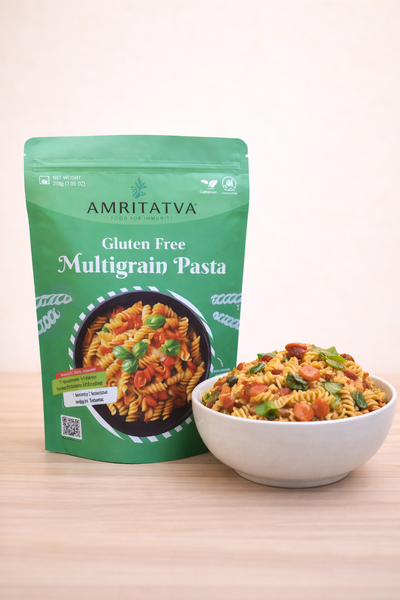
This is also where reliable substitutes matter. Amritatva makes FSSAI-certified multigrain gluten-free pasta and noodles specifically for this gap, so a diagnosis doesn't mean giving up familiar meal formats entirely. Every batch is independently verified through third-party lab testing, so "gluten-free" on the label isn't just a claim.
Frequently Asked Questions
Is gluten intolerance the same as celiac disease in India?
No. Celiac disease is one specific autoimmune form of gluten intolerance, confirmed in 1.04% of North Indians (AIIMS Makharia et al., 2011). Gluten intolerance also covers non-celiac gluten sensitivity and wheat allergy, which have different causes, tests, and long-term outlooks.
Can gluten intolerance develop later in life in India?
Yes. Celiac disease can appear at any age, and Indian studies show it's often missed for years because it's still assumed to be a childhood or Western condition. Regional wheat intake, not age, is a stronger predictor, with North Indians eating an average of 455g of wheat daily versus 25g in the South (Ramakrishna et al., 2016).
How much does celiac disease testing cost in India?
A first-line tTG-IgA blood test costs roughly ₹400-1,800 depending on the lab. If positive, an endoscopy with biopsy adds another ₹2,000-25,000 depending on whether you use a public or private hospital, plus ₹1,000-5,000 for pathology.
Should I stop eating gluten before getting tested?
No. Both the tTG-IgA blood test and the endoscopy biopsy require you to keep eating gluten beforehand. Stopping early can heal the intestinal lining or lower antibody levels enough to produce a false negative, delaying an accurate diagnosis.
Key Takeaways
Gluten intolerance in India is more common in the north and more nuanced than most people realize. Celiac disease affects roughly 1 in 96 people in North India, but the same condition is nearly 80 times rarer in the South, a gap driven by wheat consumption, not genetics (Ramakrishna et al., 2016).
If you suspect gluten intolerance, start with a tTG-IgA blood test while still eating gluten, and see a gastroenterologist before making any dietary changes. A confirmed diagnosis, not guesswork, should drive a lifelong gluten-free diet.
For a broader look at building a full gluten-free lifestyle in India, from grocery shopping to eating out safely, read our complete gluten-free diet guide for India.
Every Amritatva product is independently tested by FSSAI-approved third-party laboratories. View our lab reports →


0 comments