

Key Takeaways
- Oyster mushrooms are the highest known dietary source of ergothioneine — an antioxidant the human body cannot synthesise — confirmed in a 2024 paper in Bioactive Compounds in Health and Disease.
- A 2024 Frontiers in Nutrition study confirmed mushroom beta-glucans drive "trained immunity," creating a durable shift in immune cell readiness rather than just temporary stimulation.
- Sun-dried oyster mushrooms provide 10–450 IU of Vitamin D2 per 100g — directly addressing India's 70–90% Vitamin D deficiency rate (PMC, NIH, 2024) through food rather than supplements.
- At 33 kcal and 3.3g protein per 100g with 2.3g dietary fibre, oyster mushrooms are one of the few foods that are simultaneously high-protein, high-fibre, and very low calorie (USDA FoodData Central).
Pick up a dried oyster mushroom. It looks unremarkable — pale, papery, weightless. Nothing about it signals what it contains: one of the food world's densest concentrations of beta-glucans, ergothioneine, Vitamin D precursors, and B vitamins in a form that survives cooking, dissolves into any dish, and costs a fraction of what a comparable supplement stack would. The gap between what oyster mushrooms do nutritionally and how seriously most Indian kitchens take them is one of the more interesting disconnects in modern food culture.
What Makes Oyster Mushrooms Genuinely Functional
A functional food, by FSSAI's working definition, is one that provides health benefits beyond basic nutrition — through bioactive compounds with a demonstrated mechanism of action. Oyster mushrooms meet this standard several times over. Their beta-glucan content activates Dectin-1 receptors on macrophages and Natural Killer cells, triggering an immune cascade confirmed in peer-reviewed research across human and in vitro models. Their ergothioneine content, confirmed as the highest of any food by a 2024 Bioactive Compounds paper, protects tissues under oxidative stress. Their ergosterol converts to Vitamin D2 under UV exposure. Each of these operates through a separate, well-understood pathway — not vague "wellness support," but specific biological mechanisms backed by decades of research.
Beta-Glucans: Your Immune System's Training Partner
Not all immune support is equal. Some compounds stimulate the immune system temporarily — a short spike in activity that subsides. Oyster mushroom beta-glucans do something more lasting. A 2024 study in Frontiers in Nutrition found they drive "trained immunity" — an epigenetic reprogramming of monocytes and macrophages that keeps them in a state of heightened readiness for weeks after exposure. Think of it as immune conditioning rather than immune stimulation. Regular consumption maintains that conditioning.
Vitamin D From a Plant: The Case for Sun-Dried Oyster Mushrooms
India has a paradox: one of the sunniest countries on earth, with 70–90% of its population Vitamin D deficient (PMC, 2024). Urban air pollution, indoor work, sun-avoidance behaviour, and darker skin tones all contribute. Oyster mushrooms exposed to UV during sun-drying convert ergosterol to ergocalciferol (Vitamin D2) — a process confirmed by the USDA and Journal of Food Composition and Analysis. The yield varies with sun exposure intensity, but ranges from 10 to 450 IU per 100g. For vegetarians without dairy, this is one of the very few reliable dietary Vitamin D sources available in India.
Ergothioneine: The Antioxidant That Goes Where Others Can't
Ergothioneine is unusual among antioxidants. Unlike Vitamin C or E, which circulate in blood and act broadly, ergothioneine is actively transported into specific tissues under oxidative stress — the liver, kidneys, bone marrow, eyes, and brain. It accumulates where oxidative damage is greatest, acting as a targeted defender. The human body has a dedicated transporter protein for it (OCTN1), suggesting evolutionary importance. We can't make it in meaningful quantities; we have to eat it. Oyster mushrooms are the richest dietary source by a significant margin, per 2024 Bioactive Compounds research.
The Micronutrient Profile That Fills Indian Dietary Gaps
Per USDA FoodData Central, 100g of raw oyster mushrooms contains: copper (0.24mg — 27% DV, critical for iron metabolism and immune cell production), selenium (2.6µg — scarce in Indian agricultural soils), zinc (0.77mg), riboflavin B2 (0.35mg — 27% DV), niacin B3 (4.96mg — 31% DV), and pantothenic acid B5 (1.29mg — 26% DV). None of these receive the attention that protein and calories do in Indian nutrition conversations — but their collective absence lowers immune function, energy metabolism, and skin and hair health in ways that show up slowly over years.
How to Use Oyster Mushrooms Every Day Without Changing Your Cuisine
- In dal: Add 10–15g of rehydrated sun-dried oyster mushrooms to any dal recipe — they absorb the spice profile and become invisible in texture while delivering full nutritional benefit.
- As a seasoning: Ground dried oyster mushrooms make a natural umami powder that deepens flavour in rice dishes, soups, and curries without MSG.
- In sabzi: Toss rehydrated mushrooms with vegetables — they cook down to the same texture as paneer in dry preparations.
- In soups and broths: A 10g addition to any broth provides beta-glucans, B vitamins, and Vitamin D at cooking temperature — all bioactively stable at 100°C.
Try This Product
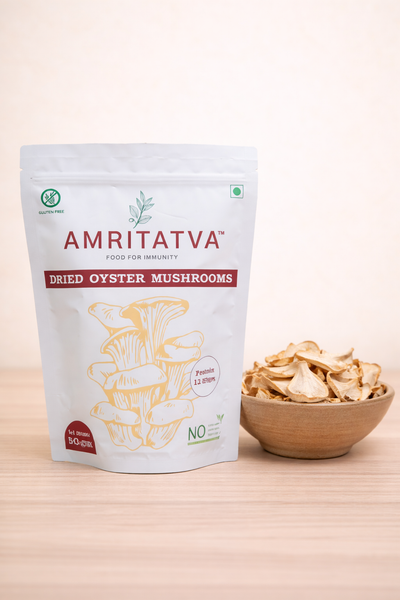
Amritatva Dried Oyster Mushrooms
Sun-dried, hand-sorted. No chemicals. Rehydrates in minutes.
Shop NowFrequently Asked Questions
Are oyster mushrooms safe to eat every day?
Yes. Oyster mushrooms (Pleurotus ostreatus) are a widely consumed culinary mushroom with a well-established safety profile. No adverse effects have been reported at typical dietary doses across any age group. They're classified as GRAS (Generally Recognised As Safe) by the US FDA and approved as food under FSSAI in India.
What is the difference between fresh and dried oyster mushrooms?
Dried oyster mushrooms are more nutritionally concentrated (water removed), have longer shelf life without refrigeration, and contain significantly more Vitamin D2 if sun-dried. Fresh mushrooms have a higher water content and slightly different texture but comparable beta-glucan and B-vitamin content.
Can oyster mushrooms help with weight management?
Oyster mushrooms provide 33 kcal per 100g with 3.3g protein and 2.3g fibre — a combination that creates satiety without caloric cost. The dietary fibre slows gastric emptying, and the protein supports muscle maintenance during weight loss.
Do I need to do anything special to prepare dried oyster mushrooms?
Soak dried oyster mushrooms in warm water for 15–20 minutes until fully rehydrated. The soaking water contains water-soluble nutrients and flavour — use it as a broth base rather than discarding it. After rehydration, mushrooms can be sliced and used exactly as you would fresh mushrooms in any recipe.


0 comments