

Key Takeaways
- 70–90% of Indians are Vitamin D deficient — oyster mushrooms contain ergosterol, which the body converts to Vitamin D2, making them one of the few plant-based sources available in Indian diets (National Institutes of Health, PMC, 2024).
- Oyster mushroom beta-glucans drive "trained immunity" — priming immune cells to respond faster on re-exposure to pathogens, per a 2024 study in Frontiers in Nutrition.
- Shiitake mushrooms contain lentinan, a beta-glucan compound with over 40 years of peer-reviewed immune research behind it, including activation of Natural Killer cells.
- Sun-drying mushrooms multiplies their Vitamin D content up to 100-fold compared to fresh, indoor-grown mushrooms (Journal of Food Composition and Analysis).
Between 70% and 90% of Indians are Vitamin D deficient, according to studies published by the National Institutes of Health (PMC, 2024) — a figure that holds across both urban and rural populations. Most people reach for dairy or sunlight as a fix. But there's a food that has been part of Indian cooking for centuries, is naturally gluten-free, and addresses several nutritional gaps in one go: the mushroom.
Oyster and shiitake mushrooms aren't just flavourful. They're among the most nutrient-dense functional foods accessible to Indian households — and modern nutrition science backs that up in detail.
1. One of the Very Few Plant Sources of Vitamin D
Research published in PMC (National Institutes of Health, 2024) confirms 70–90% of Indians are Vitamin D deficient — with no meaningful gap between urban and rural populations. Oyster mushrooms contain ergosterol, a compound that converts to Vitamin D2 when exposed to UV light. Sun-dried oyster mushrooms can deliver between 10 and 450 IU of Vitamin D per 100g depending on sun exposure during drying, per USDA FoodData Central data. For vegetarians and vegans who avoid dairy, dried oyster mushrooms are one of the very few viable plant Vitamin D sources in the Indian pantry — and far cheaper than supplements.
2. Beta-Glucans That Train Your Immune System
A 2024 study in Frontiers in Nutrition found that mushroom beta-glucans drive "trained immunity" — they reprogram white blood cells to mount a faster, stronger response the next time a pathogen appears. This is a step beyond simple immune stimulation. Oyster mushrooms are particularly rich in pleuran, a specific beta-glucan studied in both laboratory and human trials for immune modulation. When you eat oyster mushrooms regularly, you give your immune system repeated practice runs — so it's better prepared when it counts.
3. Shiitake's Lentinan: Four Decades of Immune Research
Lentinan is a beta-glucan from shiitake mushrooms that has been in clinical research since the 1970s. Studies in PMC confirm it activates macrophages, enhances Natural Killer cell activity, and promotes interferon production — the signalling proteins that coordinate immune response. Japan has used pharmaceutical-grade lentinan as an adjunct in certain oncology protocols. For everyday use, regular consumption of dried shiitake mushrooms provides a consistent, low-dose intake of this well-studied compound, supporting immune resilience through food rather than supplementation.
4. Micronutrients That Most Indian Vegetarian Diets Lack
Beyond Vitamin D, oyster and shiitake mushrooms provide micronutrients that are consistently low in Indian vegetarian diets. Per USDA FoodData Central: oyster mushrooms contain copper (0.24mg per 100g — 27% of daily value), selenium (2.6µg — an antioxidant mineral scarce in Indian soils), and zinc (0.77mg, essential for wound healing and immune cell production). Shiitake add B vitamins — riboflavin, niacin, and pantothenic acid — critical for energy metabolism. None of these make nutrition headlines, but their quiet absence in Indian diets lowers immunity, energy, and cognitive performance over time.
5. A Natural Prebiotic for Gut-Based Immunity
A 2025 review in ScienceDirect confirmed that mushroom beta-glucans act as prebiotics, feeding beneficial gut bacteria including Lactobacillus and Bifidobacterium. This matters because 70–80% of the immune system is housed in gut-associated lymphoid tissue (GALT) — what happens in your gut directly shapes immune outcomes. Indian diets high in refined grains tend to reduce microbiome diversity over time. Adding dried mushrooms — even in small quantities as seasoning or in broth — is one of the most efficient ways to introduce prebiotic fibre and umami flavour without changing the cuisine.
6. Ergothioneine: The Antioxidant Your Body Can't Make
Oyster and shiitake mushrooms are the highest known dietary source of ergothioneine, an antioxidant the human body cannot synthesise in meaningful quantities on its own. A 2024 paper in Bioactive Compounds in Health and Disease noted that ergothioneine accumulates specifically in tissues under oxidative stress — the liver, kidneys, and bone marrow — and appears to protect them during chronic inflammation. Consistent mushroom intake won't reverse disease, but it creates a biochemical buffer that's hard to get elsewhere.
7. High Nutrition, Low Calories
Oyster mushrooms provide approximately 33 kcal per 100g with 3.3g protein and 2.3g dietary fibre (USDA FoodData Central, 2024). Shiitake come in at 34 kcal per 100g with 2.2g protein and 2.5g fibre. Sun-dried mushrooms are volume-small but nutrient-dense: a 10g handful added to dal or sabzi delivers real nutritional value without changing the dish's taste, cost, or complexity.
How to Add Oyster & Shiitake to Your Daily Indian Meals
The most practical route for Indian households is through dried formats. Sun-dried oyster and shiitake mushrooms can be:
- Rehydrated and folded into dal, sabzi, or rice dishes
- Ground into a seasoning powder and mixed into curries, soups, or chutneys
- Used in place of meat-based umami in broths and gravies
- Steeped as a light, nutrient-dense hot tea
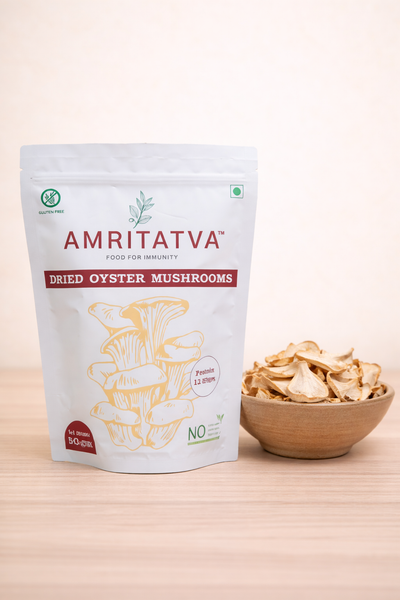
Amritatva's sun-dried oyster and shiitake mushrooms are FSSAI-certified (Lic. 22222046000640), dried without chemicals, and free from preservatives.
Try This Product
Amritatva Dried Oyster Mushrooms
Sun-dried, hand-sorted. No chemicals. Rehydrates in minutes.
Shop NowFrequently Asked Questions
Are oyster and shiitake mushrooms good for Indians specifically?
Yes. Given that 70–90% of Indians are Vitamin D deficient and vegetarian diets often lack selenium, zinc, and B vitamins, these mushrooms address multiple nutritional gaps in the Indian diet. They're naturally gluten-free and suit all religious dietary requirements.
Can mushrooms replace Vitamin D supplements?
Sun-dried oyster mushrooms can contribute up to 450 IU of Vitamin D per 100g — a meaningful dietary contribution — but they won't fully replace supplementation if you're clinically deficient.
What's the difference between dried and fresh mushrooms?
Sun-drying multiplies Vitamin D content up to 100-fold compared to fresh, indoor-grown mushrooms because UV exposure converts ergosterol to Vitamin D2. Dried mushrooms also last months without refrigeration, are more cost-effective, and concentrate nutrients by removing water weight.
How much should I eat to see benefits?
Research suggests 5–10g of dried mushrooms daily — roughly 50–100g rehydrated — provides a meaningful intake of beta-glucans, B vitamins, and Vitamin D. That's the equivalent of a small handful added to your dal or soup once a day.


0 comments