

Can small food changes really change family eating habits?
Yes—but usually not because of one “clean eating” switch. Sustainable family nutrition is more about building a household routine around adequacy, balance, moderation and variety than following a perfect food list. WHO recommends a varied diet containing foods such as vegetables, fruits, pulses, whole grains, nuts and appropriate protein sources, while limiting excessive free sugars, sodium and unhealthy fats.
For an Indian family, this does not necessarily mean replacing every familiar food. It can mean making small, realistic adjustments: cooking at home more often, adding vegetables or pulses to familiar meals, keeping fruit available for snacks, reading ingredient labels and making water the everyday drink.
The most useful transformation may therefore be less about “clean eating” and more about creating a home environment where balanced choices become easier.
Why is changing the whole family's eating routine difficult?
Food habits are connected to much more than nutrition.
They are connected to time, convenience, taste, family preferences, work schedules, school routines and availability.
This is particularly relevant in Indian households, where one meal may need to work for children, parents and grandparents at the same time.
WHO India notes that changing lifestyles and greater availability of highly processed convenience foods have contributed to changes in dietary patterns. At the same time, healthy diets need to reflect local foods, cultural habits and individual needs.
That means a realistic family approach is usually more useful than a rigid list of “allowed” and “forbidden” foods.
What does a healthier family eating pattern actually look like?
A healthier routine can start with the overall pattern, rather than focusing on individual foods.
| Instead of focusing only on… | Try focusing on… |
|---|---|
| Removing every packaged food | Reading labels and choosing foods thoughtfully |
| Completely eliminating treats | Keeping treats occasional and balanced |
| One “superfood” | Variety across food groups |
| Strict diets | Consistent everyday meals |
| Perfect meal plans | Practical meals that fit family routines |
| Weight loss as the only goal | Nutrition, energy needs and overall wellbeing |
WHO's current healthy-diet guidance describes four useful principles: adequacy, balance, moderation and diversity.
That gives families a much more practical framework than simply asking whether a food is “clean.”
What is one of the easiest changes a family can make?
Start by changing what is readily available at home.
If fruit is washed and ready to eat, it becomes an easier snack.
If roasted chana, nuts or seeds are available, they can become convenient alternatives to frequently choosing packaged snack foods.
If vegetables are already prepared for cooking, adding them to dal, poha, upma, pulao or a regular sabzi becomes easier.
This is not about banning other foods. It is about changing the food environment so that nutritious choices require less effort.
Research on family-based healthy-eating interventions suggests that the home environment is an important setting for influencing children's eating behaviour, although the evidence does not point to one universally successful strategy.
Can cooking at home make healthy eating easier?
Home cooking can give families greater control over ingredients, portions and preparation methods.
For example, a typical Indian weekday meal can be built around:
- Dal or another pulse
- Rice, roti or millet
- One or two vegetables
- Curd or an appropriate plant-based alternative
- Salad or seasonal fruit
- Water as the regular beverage
But “homemade” does not automatically mean healthy. A homemade dish can still contain substantial amounts of sugar, salt or fat.
The goal is therefore not simply “eat homemade.”
It is “build balanced meals with a variety of foods.”
What happens when children are included instead of forced?
Children are part of the family's food environment, so changing their meals separately can be difficult.
Instead of saying:
“You have to eat this because it is healthy.”
families can make healthier foods more familiar and enjoyable.
For example:
- Add vegetables to familiar dishes.
- Offer fruit alongside breakfast.
- Let children help wash or arrange ingredients.
- Try different colours and textures.
- Introduce new foods repeatedly without forcing a child to finish them.
- Keep family meals relaxed rather than turning every meal into a nutrition lesson.
Research on family eating environments supports the importance of parental involvement, although individual responses vary and there is no single formula that works for every child.
Can family meals influence eating habits?
There is evidence of an association between more frequent family meals and favourable dietary patterns in children and adolescents, including greater consumption of fruits, vegetables and some healthful nutrients. However, much of this evidence is observational, so it does not prove that family meals themselves cause these outcomes.
In practical terms, a family meal can create an opportunity to:
- Eat without rushing.
- Introduce different foods.
- Observe parents' eating habits.
- Talk about food without labelling everything “good” or “bad.”
- Build a more regular eating routine.
Even a few shared meals each week can be a realistic starting point for a busy family.
Does healthier eating automatically improve digestion, energy and sleep?
This is where nutrition content often becomes too promotional.
A healthier dietary pattern can support overall nutritional adequacy and health, but it would be inaccurate to promise that every family will experience better digestion, more energy or improved sleep within a few weeks.
For example, research has found an association between healthier dietary patterns and better sleep quality, but a systematic review noted that much of the available research was observational and could not establish a causal relationship.
Similarly, digestion can be affected by many factors, including the type and amount of food consumed, fibre intake, hydration, individual tolerance and underlying health conditions.
So the better message is:
Healthy eating supports the foundations of wellbeing—but individual results vary.
How can an Indian family make healthier eating practical?
Rather than redesigning the entire kitchen, try one change at a time.
Week 1: Improve the everyday beverage routine
Keep water easily available and reduce frequent consumption of sugary drinks.
Week 2: Add one more fruit or vegetable
Add seasonal fruit to breakfast or a vegetable to lunch/dinner.
Week 3: Improve one snack
Try roasted chana, fruit, nuts, seeds, homemade snacks or another suitable option.
Week 4: Plan a few more home meals
Prepare simple dishes that can work for the entire family.
The objective is not to complete a “30-day clean eating challenge.”
It is to create habits that can still work when someone has a busy workday, school exams, travel or a family celebration.
What does “balance instead of perfection” really mean?
A family can eat nutritious meals most of the time and still enjoy birthday cake, festive foods, restaurant meals or favourite snacks.
Healthy eating does not require every meal to be nutritionally perfect.
WHO's principles of adequacy, balance, moderation and diversity are much more useful than the idea that food must be completely “clean.”
For an Indian family, this could mean enjoying:
Dal + rice + sabzi + salad
on one day,
Millet khichdi + vegetables + curd
on another,
and a family celebration meal on the weekend.
The pattern across days matters more than making one meal perfect.
How can Amritatva fit into a family's everyday food routine?
At Amritatva, our approach is built around making vegan and gluten-free food options practical for everyday Indian households.
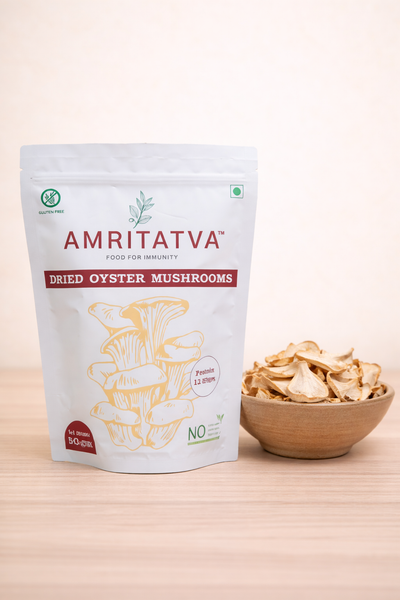
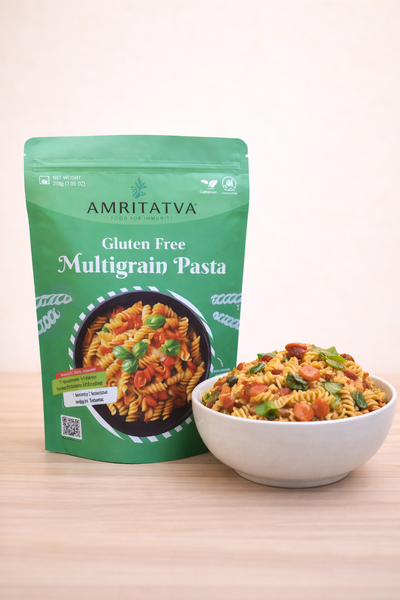
Products such as our sattu protein mix, gluten-free pasta and noodles, mushroom powder and seasonings can be used as convenient ingredients within a varied diet.
For example:
- Sattu can become a quick breakfast or snack.
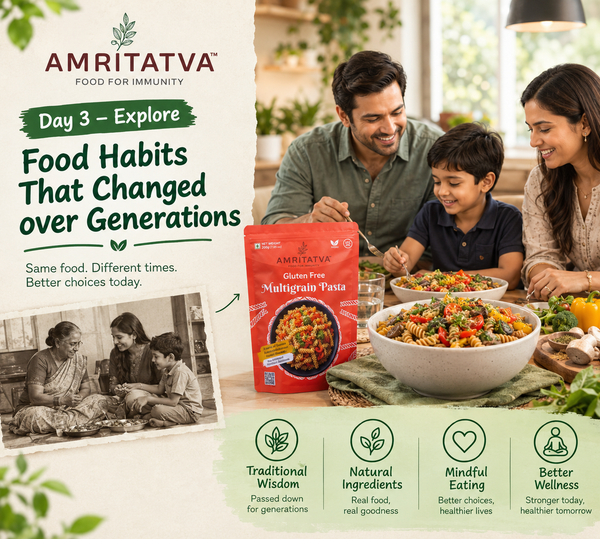
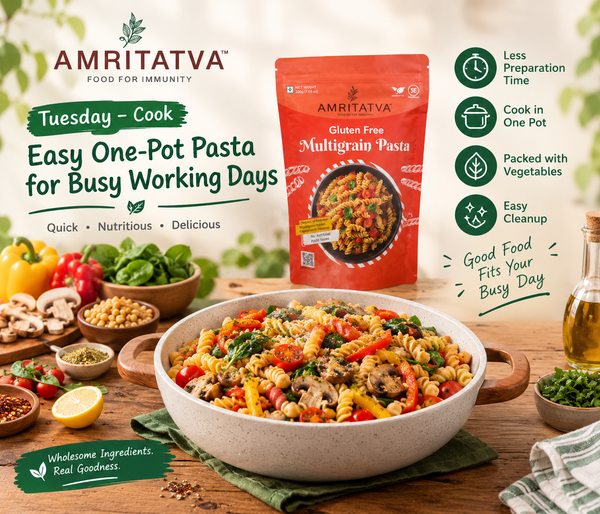
- Gluten-free pasta can be combined with vegetables and a suitable protein source for a weekday meal.
- Mushroom powder can be incorporated into selected recipes.
- Seasonings can add flavour to everyday dishes.
The important part is that no single Amritatva product—or any individual food—needs to carry the entire burden of “healthy eating.”
The goal is to make balanced food choices easier to fit into real family life.
What is the biggest lesson from a family food transformation?
It is rarely about making the biggest change.
It is about making the change repeatable.
A family that moves from:
“We need to completely change our diet.”
to:
“Let's make one better choice at a time.”
has a more practical starting point.
That might mean an extra serving of vegetables, a more balanced breakfast, fewer sugary drinks, more home-prepared meals or simply eating together without screens a few times a week.
Small changes do not guarantee dramatic results.
But they can become habits—and habits are easier to maintain when they fit the family's real life.
FAQ
What is the easiest way to start healthy eating as a family?
Start with one shared habit rather than changing everything at once. You could begin by adding a fruit or vegetable to one meal each day, replacing frequent sugary drinks with water, or planning a few more home-prepared meals each week. Once the first change becomes routine, add another. This makes healthy eating feel more manageable and less restrictive.
Does clean eating mean avoiding all packaged foods?
No. “Clean eating” does not have one universally agreed scientific definition, and packaged food is not automatically unhealthy. Some packaged foods can be nutritious and convenient. A more useful approach is to check the ingredient list and nutrition information, consider the food's role in the overall diet, and limit foods that are frequently high in free sugars, sodium or unhealthy fats.
How can I get children to eat healthier food?
Children generally benefit from repeated exposure to a variety of foods without excessive pressure. Parents can model balanced eating, involve children in age-appropriate food preparation and make nutritious foods easy to access. A child may need multiple exposures to become comfortable with a new food. Individual preferences also vary, so forcing food is not a reliable long-term strategy.
Can healthy eating improve digestion?
A balanced diet containing appropriate amounts of fibre, fluids and a variety of foods can support normal digestive health, but there is no guarantee that changing to a “clean” diet will immediately improve digestion. Individual tolerance matters, and increasing fibre very quickly can itself cause digestive discomfort for some people. Persistent digestive symptoms should be discussed with a qualified healthcare professional.
Can changing diet improve sleep?
Research suggests that healthier dietary patterns are associated with better sleep quality, but the evidence does not establish that changing diet alone will improve sleep for everyone. Sleep is influenced by multiple factors, including sleep schedule, stress, physical activity and health conditions. A balanced diet can be one part of an overall healthy lifestyle rather than a guaranteed sleep solution.
How can busy Indian families eat healthier without spending hours cooking?
Keep the approach simple. Batch-cook dal or legumes, wash and portion fruit and vegetables, keep basic ingredients available, and use versatile foods that work across several meals. Leftover vegetables can go into paratha, poha or rice; cooked dal can become a base for another meal. The objective is not elaborate cooking—it is making balanced choices easier on busy days.
A family's food habits do not need to change overnight.
They can evolve through small, repeatable choices—one breakfast, one snack, one grocery decision and one family meal at a time.
Healthy eating is not about creating a perfect household.
It is about creating a household where balanced choices become easier, familiar and sustainable.


0 comments