

Key Takeaways
- Out of 1.7 lakh food samples tested by FSSAI in 2024, over 33,000 were found non-compliant or adulterated — roughly 1 in 5 products on the Indian market carries a safety or labelling violation.
- India's plant-based food market is projected to grow at 12.7% CAGR through 2030 (IMARC Group, 2024), driven by consumers who are increasingly choosing food based on transparency, not just taste or price.
- Conscious consumerism — choosing products based on origin, process, and impact rather than branding — is the fastest-growing purchasing behaviour in urban India's food market.
- The clean-label movement is not idealism — it is a rational response to documented failures in the food system, backed by FSSAI data showing endemic compliance problems.
Most food conversations start with taste. Some start with price. The more honest conversation starts with a question most of us were never taught to ask: what's actually in this, and how did it get here? The answer, for much of what fills Indian supermarket shelves, is more complicated than the front-of-pack design suggests. The gap between what food brands communicate and what food systems actually do is wide — and it's closing, slowly, because consumers are beginning to look for it.
What the Data Actually Shows About Indian Food Safety
FSSAI's 2024 surveillance data is not reassuring. Of 1.7 lakh food samples tested across India, over 33,000 were found to be non-compliant, adulterated, or carrying false claims — a failure rate of roughly 20%. These aren't fringe products. They include packaged snacks, beverages, spices, and dairy products sold in mainstream retail. The FSSAI received over 7,700 food adulteration complaints in 2024–25 — nearly double the 4,330 filed in 2022–23 (NewsGram, 2026). Consumer vigilance is rising. The system's record gives them reason to be vigilant.
The Gap Between Branding and Production
Food brands have become extraordinarily skilled at visual shorthand. Green packaging, farm imagery, words like "natural," "traditional," and "pure" carry emotional weight that regulatory language doesn't. "Nature-identical flavouring" means a synthetic compound chemically identical to a natural one — but manufactured in a laboratory. "Permitted food colour" covers 32 synthetic dyes that FSSAI allows but several European countries have restricted. "Edible starch" often means modified maida. None of these disclosures are dishonest in a legal sense. But they rely on most consumers not reading carefully enough to understand what they mean. That reliance is the problem.
What Conscious Consumerism Actually Looks Like
The shift toward conscious consumption isn't a fringe position. Urban Indian consumers — particularly millennials and Gen Z — are reporting higher levels of ingredient scrutiny, brand research, and willingness to pay a premium for verified transparency. A 2024 Nielsen India report found 63% of urban consumers checking ingredient labels before purchase — up from 41% in 2020. The questions have changed: not just "what does this taste like?" but "who made this, how, and what's actually in it?" Brands that can answer those questions clearly are gaining a durable competitive advantage. Brands that can't are being called out in ways that packaging design can no longer obscure.
The Case for Plant-Based Food Systems
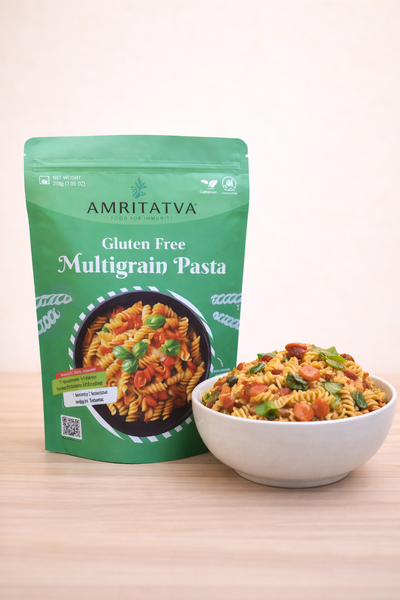
Plant-based food systems — built on millets, legumes, mushrooms, and other whole crops — have several advantages beyond individual nutrition. They require fewer resources per kilogram of output than animal-based systems. They align with India's agricultural heritage — millet cultivation, for example, predates wheat by thousands of years and is suited to drier Indian climates. And they are inherently more transparent: a product with five ingredients derived from named whole crops has a shorter, more traceable supply chain than one with 22 ingredients including synthetic additives. Shorter supply chains mean fewer points of adulteration. The food system transparency problem and the plant-based nutrition conversation are connected. Our Gluten-Free Pasta with All-Purpose Seasoning is built exactly on this principle — whole-food ingredients, short supply chain, nothing to hide.
The Future of Food Is Built on Honesty
Every food choice is a signal. At scale, purchasing decisions shape which food systems receive investment and which ones don't. When consumers choose brands that list every ingredient in plain language, that have verifiable FSSAI licences, and that don't hide behind vague additive categories, they're creating the conditions for a more honest food market. Amritatva's FSSAI Licence 22222046000640 is verifiable on the official government portal. Every product's ingredient list is written in language a consumer can understand without a chemistry degree. That's not a marketing position. It's a minimum standard — and one that more of the Indian food industry should be held to. Our All-Purpose Seasoning reflects that commitment: recognisable ingredients, no hidden additives, complete transparency on the label.
Try This Product
Gluten-Free Pasta + All-Purpose Seasoning
Clean-label combo — whole ingredients, nothing hidden.
Shop Now →Frequently Asked Questions
How can I verify if an Indian food product is FSSAI certified?
Every FSSAI-licensed product must carry a 14-digit licence number on its packaging. You can verify any number at fssai.gov.in. If the number doesn't appear in the FSSAI database, the certification claim is false. Absence of a number on a packaged food product means it's unlicensed — a red flag regardless of how it's marketed.
What does "no preservatives" actually mean on Indian food labels?
Under FSSAI Labelling Regulations, "no added preservatives" means no synthetic compounds classified as preservatives (like sodium benzoate or potassium sorbate) were added. A product can legally carry this claim while containing pH adjusters, water activity suppressants, and humectants that perform preservation functions under different chemical classifications. The cleaner test is ingredient list length and recognisability.
Is plant-based food automatically more sustainable?
Not automatically. Highly processed plant-based products with long ingredient lists can have significant environmental footprints from processing, packaging, and supply chains. The most sustainable plant-based eating is built on whole crops with short supply chains — local millets, seasonal vegetables, legumes, and minimally processed ingredients.
What makes a brand genuinely transparent?
Genuine transparency means: full ingredient lists in plain language (no catch-all terms), verifiable regulatory certifications (FSSAI number, not just claims), honest nutrition information without manipulated serving sizes, and sourcing information that's specific enough to verify. Logos and claims aren't transparency — information that can be checked is.

0 comments