

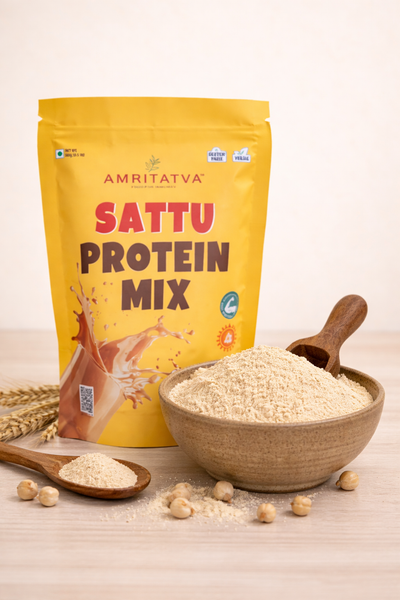
Finding a homemade snack that children will actually enjoy doesn't have to mean complicated cooking. These No-Bake Sattu Energy Balls combine roasted gram flour, dates and nuts into small, naturally sweet bites that can be prepared without an oven.
Sattu is traditionally made from roasted gram and is a familiar ingredient in many Indian households. It can be used in drinks, parathas, laddoos and other everyday preparations.
This recipe uses dates for sweetness and a small amount of ghee to bring the mixture together. You can also adjust the texture and ingredients according to your child's age and preferences.
The recipe is simple enough to prepare with children too—especially when they get to help mix and shape the little balls.
Why make a homemade sattu snack?
Homemade snacks give parents more control over the ingredients and the amount of added sugar used.
That doesn't mean every homemade snack is automatically healthier than every packaged snack. What matters is the overall ingredient list, portion size and how the food fits into the child's wider diet.
WHO recommends that children's diets include a variety of nutritious foods and that free-sugar intake be limited. Dietary habits developed during childhood can also continue into later life.
Sattu can be one convenient ingredient within that broader variety.
What do you need for these sattu energy balls?
Ingredients
- 1 cup sattu (roasted gram flour)
- 8–10 soft dates, preferably seedless
- 2 tablespoons finely chopped nuts
- 1 tablespoon ghee
- ¼–½ teaspoon cardamom powder
- 1 tablespoon jaggery powder — optional
- 1–2 teaspoons water or milk, only if needed to adjust consistency
Optional additions
Depending on your child's age and preferences, you can add:
- Finely ground seeds
- Unsweetened desiccated coconut
- Raisins
- A small amount of unsweetened peanut or nut butter
You don't need to add everything. The basic combination of sattu and dates is enough to make the recipe.
Tip: Since dates already provide sweetness, taste the mixture before adding jaggery.
How do you make no-bake sattu energy balls?
Step 1: Prepare the dates
If your dates are firm or dry, soak them briefly in warm water until they soften. Drain well.
Blend or mash them into a thick paste.
Step 2: Combine the dry ingredients
Add the sattu, finely chopped or ground nuts and cardamom powder to a mixing bowl.
Mix well.
Step 3: Add the dates
Add the date paste and ghee.
Start mixing with a spoon or clean hands until the mixture begins to come together.
Step 4: Adjust the texture
If the mixture feels too dry, add a little water or milk—one teaspoon at a time.
If it feels too sticky, add a little more sattu.
The finished mixture should be soft enough to shape but not wet.
Step 5: Shape the balls
Take small portions and roll them into bite-sized balls.
For younger children, make them smaller and ensure the texture is appropriate for their chewing ability.
Step 6: Chill
Place the balls in the refrigerator for around 15–20 minutes before serving.
Store leftovers in an airtight container in the refrigerator.
Can children help make this recipe?
Absolutely.
This is one of the advantages of a no-bake recipe.
Older children can help:
- Measure the ingredients
- Mix the dry ingredients
- Mash the dates
- Roll the mixture into balls
- Sprinkle coconut or another suitable coating
Simple food preparation can also help children become familiar with ingredients and participate in family meals.
For younger children, adults should handle blending, chopping and any ingredients that present a choking risk.
What makes sattu useful in an everyday Indian kitchen?
Sattu is roasted gram flour and is a traditional Indian ingredient used in several regional preparations.
It can be mixed into drinks, used in stuffed parathas, added to savoury preparations or turned into simple snacks like these energy balls.
Its biggest practical advantage is versatility.
Instead of treating sattu as a special “superfood,” think of it as one familiar ingredient that can contribute to a varied diet.
WHO's current healthy-diet guidance emphasises variety, adequacy, balance and moderation, with pulses such as chickpeas included among nutritious carbohydrate and plant-food sources.
Should you add jaggery when dates are already being used?
Not necessarily.
Dates provide sweetness, so you can first make the mixture without jaggery and taste it.
If your child prefers a sweeter snack, a small amount of jaggery can be added.
The idea is not to make the snack “sugar-free.” Dates and jaggery both contribute sugars. Rather, the recipe gives you control over how much additional sweetener you use.
WHO recommends limiting free sugars throughout life, including during childhood.
Can you add nuts and seeds?
Yes, provided they are appropriate for your child's age and chewing ability.
For young children, whole nuts and seeds can be choking hazards. The American Academy of Pediatrics advises modifying high-risk foods and avoiding whole nuts for young children. Nut butter should also be spread thinly rather than offered in thick, sticky portions.
For a younger child, use finely ground nuts or another age-appropriate form, and always consider the child's individual development.
If your child has a known food allergy, leave out the relevant allergen and follow your healthcare professional's advice.
How can you make different versions?
The basic recipe can easily become several different snacks.
Coconut Sattu Balls
Add 1–2 tablespoons of unsweetened desiccated coconut to the mixture.
Peanut Sattu Balls
Add a small amount of smooth peanut butter if peanuts are suitable for your child.
Seed Sattu Balls
Use finely ground seeds rather than whole seeds for younger children where appropriate.
Cardamom Sattu Balls
Keep the recipe simple with extra cardamom for a familiar Indian flavour.
Cocoa Sattu Balls
For an occasional chocolate-flavoured variation, add a small amount of unsweetened cocoa powder and adjust the mixture as needed.
The goal isn't to create a different “health benefit” for every version. You're simply changing flavour and texture to make a familiar ingredient more enjoyable.
When can you serve these sattu balls?
These can work as a small homemade snack during:
- School tiffin
- After-school snack time
- Weekend cooking
- Family tea-time
- A convenient homemade bite between meals
Portion size should depend on the child's age, appetite and overall meals.
A snack should complement a child's meals—not replace a varied diet.
Sattu Energy Balls vs a packaged sweet snack
| Homemade Sattu Energy Balls | Packaged Sweet Snack |
|---|---|
| Ingredients can be selected at home | Ingredients vary by product |
| Sweetness can be adjusted | Sugar level depends on the product |
| Can be made in small batches | Convenient and ready to eat |
| Sattu, dates and nuts can be included | Nutritional composition varies |
| Texture can be adapted for the child | Texture may not be suitable for every age |
This isn't a claim that every packaged snack is unhealthy or that every homemade snack is automatically better. Reading the label and considering the overall diet still matters.
How does this fit into a balanced diet for children?
One snack doesn't determine whether a child's diet is healthy.
Children need a variety of foods across the day, including appropriate sources of carbohydrates, protein, fats, vitamins, minerals and fibre.
WHO describes a healthy diet around four principles: adequacy, balance, moderation and diversity. For children, dietary needs also vary with age and development.
So, enjoy these sattu balls as one homemade snack option, alongside regular meals containing vegetables, fruits, pulses, grains and other suitable foods.
Why keep traditional recipes simple?
Indian kitchens already have many versatile ingredients that can be adapted to modern routines.
Sattu is one example.
It doesn't need an elaborate recipe or a long list of ingredients. A few familiar foods can become a practical snack with minimal preparation.
For busy parents, that simplicity can be valuable.
And for children, familiar flavours and hands-on preparation can make homemade food more approachable.
FAQs
1. Are sattu energy balls healthy for kids?
Sattu energy balls can be a convenient homemade snack, but no single food should be described as universally “healthy” for every child. This recipe combines sattu, dates and nuts, while the overall nutritional value depends on the ingredients and portion size. Children still need a varied diet with different food groups across the day.
2. Can I make sattu energy balls without jaggery?
Yes. In fact, dates already provide sweetness, so jaggery is optional in this recipe. Make the mixture first with sattu, dates, nuts, ghee and cardamom, then taste it before deciding whether additional jaggery is necessary. Reducing added sweeteners can be a practical way to keep homemade snacks less sweet.
3. Can I give sattu energy balls to toddlers?
The recipe needs to be adapted for younger children. Whole nuts and seeds can be choking hazards, so they should not simply be mixed into balls for a young child. Use age-appropriate textures and finely ground ingredients where suitable. If you are unsure about whether a particular food or texture is appropriate, consult your child's paediatrician.
4. How long can homemade sattu energy balls be stored?
Because the recipe contains dates and other ingredients that can affect shelf life, store the finished balls in an airtight container in the refrigerator rather than assuming they are shelf-stable. Make a small batch, keep them chilled and check their appearance, smell and texture before serving. Storage time can also vary depending on the ingredients and preparation conditions.
5. Can I use sattu instead of protein powder for kids?
Sattu is roasted gram flour and can be part of a child's varied diet, but it should not automatically be treated as a replacement for a specially formulated protein supplement. Children's nutritional needs depend on age, growth and overall diet. For a child with specific nutritional requirements, speak with a paediatrician or registered dietitian rather than relying on one ingredient.
6. Can I add peanut butter to these energy balls?
Yes, if peanuts are appropriate for your child and there is no relevant allergy. For younger children, avoid giving thick spoonfuls or large sticky portions of peanut butter because they can be a choking risk. A small amount mixed thoroughly into the recipe or spread thinly in an appropriate food form is safer than a thick lump.
0 comments