

How Amritatva Ensures Quality From Farm to Fork
When you buy a packaged food, quality is something you should be able to understand—not simply assume. It involves more than attractive packaging or words such as natural, healthy or clean. It starts with the ingredients, continues through processing and testing, and ends with how the food is packed, stored and communicated to the consumer.
At Amritatva, this approach is reflected in the journey from mushroom cultivation and ingredient sourcing to processing, third-party testing, packaging and delivery. The brand currently makes mushroom-based foods, gluten-free pasta and noodles, sattu products and seasonings, with its products made in Jaipur. Amritatva states that its products carry FSSAI licence number 22222046000640 and that products are third-party tested for purity and safety before reaching customers.
So, what does “farm to fork” actually look like for a food brand?
What does “farm to fork” mean for a packaged food brand?
“Farm to fork” is often used to describe the journey of food from its source to the person eating it.
For a packaged food business, that journey can involve several stages:
Sourcing → Cultivation → Ingredient handling → Processing → Quality checks → Packaging → Storage → Delivery → Consumer
Not every product follows exactly the same route. Some ingredients may come from the brand's own cultivation, while others are sourced from farmers or ingredient suppliers.
For Amritatva, mushrooms are an important part of this journey. The brand describes cultivating oyster mushrooms at its Jaipur farm and also sourcing mushrooms from local farmers. Its website currently states that more than 300 kg have been sourced from farmers.
The important point is that quality is not created at only one stage. Each stage contributes to the final product.
How does ingredient sourcing affect food quality?
The first question is simple: What is actually going into the product?
Ingredient sourcing affects consistency, quality and the characteristics of the finished food. For a brand working with mushrooms, grains, millets, spices and other food ingredients, maintaining a reliable supply of suitable raw materials is an important part of production.
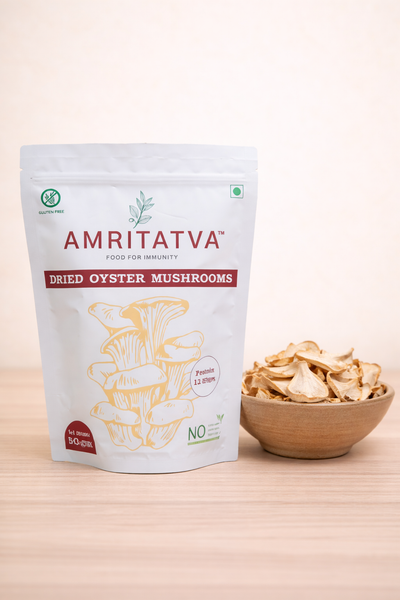
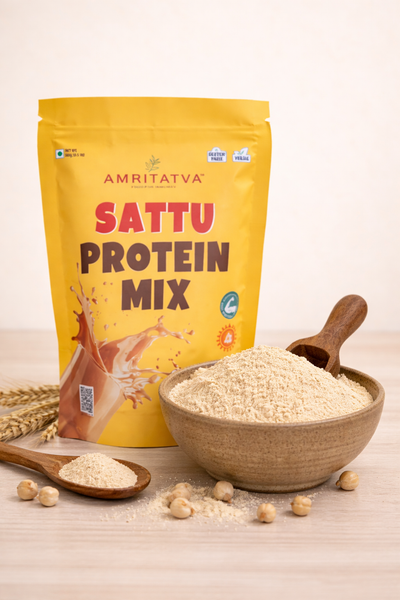
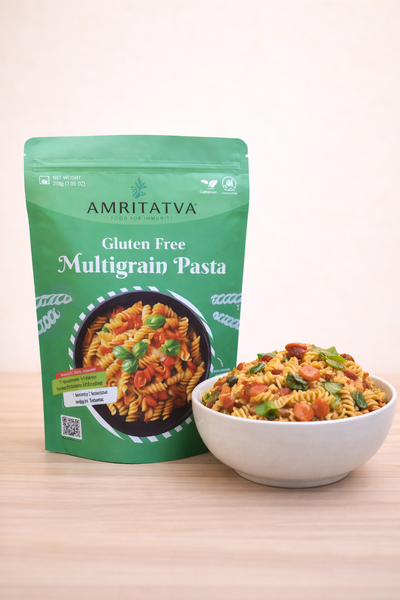
Amritatva's product range includes oyster mushrooms, shiitake mushrooms, mushroom powder, sattu, seasonings and gluten-free pasta and noodles. The brand says its mushroom products are sourced from Indian farms, while its own farm in Jaipur is used for oyster mushroom cultivation.
This is also why ingredient transparency matters.
A consumer should be able to look at the ingredient list and understand what the product contains rather than having to rely entirely on marketing language.
A useful way to look at food quality
| Stage | What to look for | Why it matters |
|---|---|---|
| Ingredient sourcing | Clearly identified ingredients and suppliers | Supports consistency and traceability |
| Processing | Appropriate handling and hygiene | Helps maintain food safety |
| Quality testing | Relevant testing for the product | Helps verify specified quality parameters |
| Packaging | Food-grade, suitable packaging | Protects the product during storage and transport |
| Labelling | Ingredients, nutrition and required information | Helps consumers make informed choices |
| Storage & delivery | Appropriate handling conditions | Helps preserve product integrity |
What happens after ingredients reach the production stage?
Good ingredients alone do not guarantee a good packaged food.
How ingredients are handled, processed and packed also matters.
Food businesses need appropriate hygiene and food-safety practices throughout production. FSSAI's packaging regulations, for example, specify requirements around food-contact packaging, suitability for the product and storage conditions, as well as clean, hygienic and tamper-proof packaging.
For Amritatva, processing is particularly relevant because the product range includes different types of foods.
Mushrooms may be dried or processed into powder. Other ingredients are combined to make sattu, pasta, noodles or seasoning blends. Each product therefore has its own formulation, processing and packaging requirements.
This is why “quality” should not be treated as one single test.
It is a process.
Why does third-party testing matter?
A label tells consumers what a product is intended to contain and the claims a brand is making. Testing provides another layer of information.
Amritatva states that its products are independently tested by a third-party laboratory and that the FSSAI licence number is provided on its packaging.
The exact parameters tested can vary according to the product and the purpose of testing. Food businesses operate within India's food-safety regulatory framework, which includes standards for food products, contaminants, packaging and labelling.
For consumers, this creates a useful habit:
Don't just ask what a product claims. Ask what can actually be verified.
For example:
- Is the FSSAI licence information available?
- Is the ingredient list clear?
- Are relevant nutrition details provided?
- Can applicable testing information be shared?
- Are storage instructions clearly mentioned?
- Are dietary claims such as gluten-free or vegan supported appropriately?
This approach is useful for any food brand—not just Amritatva.
How does packaging become part of quality?
Packaging is sometimes treated as a marketing decision, but it also has a food-safety role.
The package has to protect the product through storage, transportation and handling. FSSAI's packaging regulations require food-contact packaging to be food grade and suitable for the food, storage conditions and transportation conditions. They also specify that food products should be packed in clean, hygienic and tamper-proof containers.
For a dry food such as mushroom powder, dried mushrooms, sattu or seasoning, protecting the product from unsuitable exposure during storage and transportation is particularly relevant.
That means packaging design should answer two questions:
Does it look good?
and
Does it do its job?
The second question comes first.
Why is transparency important to Amritatva?
Food labels are ultimately a communication tool between a brand and the person buying the product.
Amritatva's stated approach is built around clear ingredient communication and its positioning around products made without maida, MSG and preservatives. Its website also provides product-specific information, FSSAI details and dietary information across its range.
But transparency also means being careful about what a brand doesn't claim.
For example:
Gluten-free does not automatically mean healthier.
Vegan does not automatically mean nutritionally complete.
Clean label does not have one universally agreed definition.
The more useful approach is to look at the complete product: ingredients, nutrition information, dietary suitability, preparation, serving size and the consumer's own needs.
That is also why Amritatva's recent product communication focuses increasingly on explaining ingredients and product composition rather than simply using broad health language.
How can consumers follow a “farm to fork” mindset at home?
You do not need to know every detail of a company's manufacturing process to become a more informed food buyer.
A few simple habits can help.
1. Read the ingredient list
Look beyond the front of the pack. Check what is actually listed in the product.
2. Check the nutrition information
Look at serving size, protein, carbohydrates, fibre, fat, sodium and other nutrients relevant to your diet.
3. Understand dietary claims
If a product says gluten-free, vegan or another specific dietary claim, understand what that claim means and whether it is relevant to your needs.
4. Look for traceability information
FSSAI details, manufacturer information, batch information, dates and storage instructions are useful parts of a packaged food label.
5. Ask questions
If a brand makes a specific quality or dietary claim, it is reasonable to ask how that claim is supported.
How does this approach fit into an Indian kitchen?
Food quality becomes most meaningful when it works with the way people actually eat.
A family may use mushroom powder in dal or sabzi. Sattu can become part of a breakfast or snack. Gluten-free pasta or noodles can be prepared with vegetables and familiar Indian spices. Seasonings can be used in everyday sabzi, roasted vegetables, marinades or fusion meals.
This is the thinking behind Amritatva's product range: food products designed to fit into familiar meals rather than requiring an entirely separate eating routine. The brand currently offers mushroom products, sattu, seasonings and gluten-free pasta and noodles.
The goal is not to tell people that one ingredient or one product is the answer to healthy eating.
It is to make food choices easier to understand.
What does “quality” ultimately mean at Amritatva?
Quality is not one dramatic moment at the end of production.
It is the accumulation of many small decisions:
Where ingredients come from.
How they are handled.
How products are processed.
What gets tested.
How food is packaged.
What information reaches the consumer.
That is the real meaning behind a farm-to-fork approach.
For Amritatva, the journey begins with mushrooms and other ingredients and continues through processing, testing, packaging and finally the Indian kitchen.
And perhaps the most useful lesson for any food business is this:
Trust is not created by saying more. It is created by making more of the food journey understandable.
FAQ
1. What does farm to fork mean in the food industry?
Farm to fork describes the journey food takes from its source to the consumer. For packaged foods, this can include cultivation or sourcing, ingredient handling, processing, quality checks, packaging, storage, transportation and delivery. The exact journey differs by product because different ingredients and manufacturing processes require different controls.
2. How does Amritatva check the quality of its products?
Amritatva states that its products are third-party tested for purity and safety before reaching customers and that its FSSAI licence number is 22222046000640. The exact testing parameters can vary by product, so consumers should refer to the relevant product information or request applicable documentation when they need details about a specific quality parameter.
3. Where does Amritatva source its mushrooms?
Amritatva states that oyster mushrooms are cultivated at its farm in Jaipur and that mushrooms are also sourced from local Indian farmers. Its website currently states that more than 300 kg have been sourced from farmers. The sourcing route can differ depending on the particular mushroom product.
4. Why is food packaging important for quality?
Packaging helps protect food during storage, handling and transportation. FSSAI regulations specify that food-contact packaging should be food grade and suitable for the product and its storage and transportation conditions. Food should also be packed in clean, hygienic and tamper-proof packaging.
5. How can consumers check whether a food brand is transparent?
Start with the label. Look for the ingredient list, nutrition information, manufacturer details, FSSAI information, batch/date information, storage instructions and applicable dietary claims. If a claim is important to your dietary needs, ask the brand what documentation or testing supports it. This is generally more useful than relying only on words such as “healthy” or “natural.”
0 comments