

Every packaged food begins with a series of choices.
Which ingredients should be used?
How should they be processed?
How should the product be stored?
What information should the consumer see on the label?
At Amritatva, one part of our philosophy is to avoid unnecessary preservatives where the product formulation allows us to do so.
This is not about suggesting that every preservative is harmful.
Preservatives have legitimate technological purposes in food manufacturing, including helping control spoilage and extending shelf life.
The more useful question is whether an ingredient has a clear role in a particular product.
What are preservatives?
Preservatives are ingredients used in foods to help maintain safety, quality or shelf life.
Different preservatives have different functions and regulatory requirements.
That is why consumers should look at the actual ingredient list rather than assuming that the word “preservative” automatically tells them whether a product is good or bad.
Why do some brands try to avoid unnecessary additives?
For some products, a simpler formulation may align better with the brand's intended food philosophy.
This can make the ingredient list easier to understand.
But simpler does not automatically mean healthier, and a shorter ingredient list is not a guarantee of superior nutrition.
Transparency is more important than marketing language.
What does ingredient transparency mean?
It means telling consumers what is actually in the product.
The ingredient list should be clear.
The nutrition information should be available.
Relevant dietary declarations should be easy to understand.
And food claims should reflect the actual product.
Why is processing important?
Preservative decisions cannot be separated from processing and packaging.
A product made with careful moisture control, appropriate packaging and responsible processing may have different requirements from a fresh product or one with a different shelf-life target.
Food manufacturing is a system.
One ingredient never tells the whole story.
Can food be preservative-free and still have a long shelf life?
Sometimes.
The answer depends on the product, packaging, moisture, processing conditions and storage requirements.
That is why “preservative-free” should not be treated as a universal technical category.
What should consumers check on packaged foods?
Look at the ingredient list.
Check nutrition information.
Read storage instructions.
Check the use-by or best-before information.
And consider whether the product fits your dietary requirements.
Why does this matter at Amritatva?
We are building food products for real kitchens.
That means we care about the ingredients, the process and the information communicated to consumers.
The aim is not to make products sound perfect.
It is to make them understandable.
Does “clean label” have one fixed definition?
No.
“Clean label” is widely used in food marketing but does not have one universally agreed definition.
That is why consumers should rely on the actual ingredient list and product information.
Frequently Asked Questions
Are preservatives always harmful?
No. Preservatives can have legitimate food-safety and shelf-life functions. The specific ingredient and its permitted use matter.
Does preservative-free automatically mean healthy?
No. Nutrition depends on the full product formulation, not one ingredient category.
Why should I read the ingredient list?
It helps you understand what the product actually contains and whether it fits your dietary preferences or restrictions.
What does Amritatva mean by “unnecessary preservatives”?
It means that where our formulation and processing allow, we prefer not to rely on preservatives that are not needed for the specific product. The actual claim should always match the product's formulation and label.
Food choices begin with trust
Trust is not created by saying that a product is perfect.
It is created when the label, formulation and communication are honest.
At Amritatva, we believe that is the standard worth working toward.
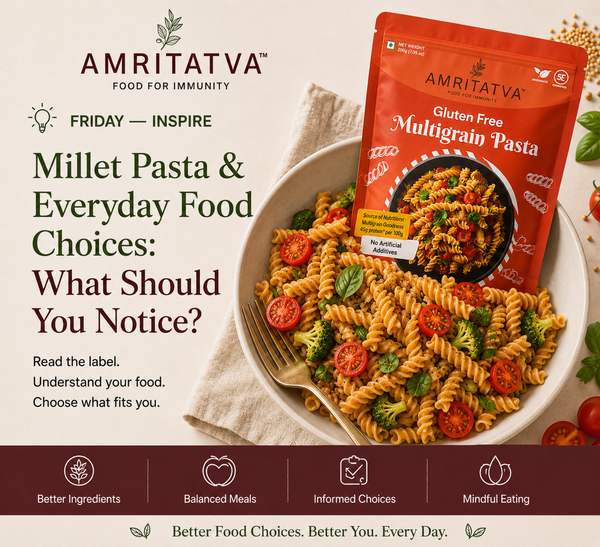
Know your ingredients. Read your label. Choose with confidence.
LinkedIn Post
Why do ingredient lists matter?
Because food is easier to trust when consumers can understand what they are buying.
At Amritatva, we aim to avoid unnecessary preservatives where our product formulation allows it.
But we also believe in something equally important: no ingredient should be labelled “bad” without context.
Good food communication should be about clarity, transparency and accurate labelling.
Simple information builds stronger trust.
0 comments