

What makes Amritatva Oyster Mushroom Powder different?
The biggest difference is not a complicated wellness promise. It is what is actually in the product—and what is not.
Amritatva Oyster Mushroom Powder is made from 100% dried oyster mushroom fruiting bodies (Pleurotus ostreatus), according to the current product information. The product is described as containing no fillers, grain powder, artificial colours, flavours or preservatives.
That makes the product story much more straightforward.
Instead of positioning mushroom powder as a miracle supplement or promising a particular health outcome, the focus is on ingredient identity, formulation transparency, testing and practical everyday use.
And that is an important distinction in a market where consumers increasingly want to understand what is actually inside the products they buy.
What exactly is in Amritatva Oyster Mushroom Powder?
The ingredient itself is simple:
Oyster mushroom — Pleurotus ostreatus.
Amritatva states that the powder is made from the mushroom's fruiting body, rather than mycelium grown on grain. The product page also states that there is no grain powder or filler added to the formulation.
The current product information identifies naturally occurring components of oyster mushrooms including beta-glucans, ergothioneine, B vitamins and amino acids. However, the presence of a nutrient or bioactive compound should not automatically be interpreted as proof that the finished product prevents or treats a disease.
That distinction matters.
Nutrition information tells you what a food contains. Clinical evidence is needed to establish what a specific product can actually do in humans.
Why does the fruiting body matter?
Mushrooms have different structural components, and mushroom products can be made in different ways.
Amritatva specifically chooses the fruiting body of the oyster mushroom for this powder. According to the brand's product information, the powder is not made from mycelium biomass grown on grain.
For a consumer, this creates a very simple label-reading question:
What is the actual mushroom material in the product?
This is more useful than judging a mushroom product simply by the number of wellness claims printed on its front label.
What makes a mushroom powder a food ingredient rather than just another supplement?
One interesting part of Amritatva's approach is how the mushroom powder can be incorporated into food.
The product is a powder rather than a capsule, so it can become part of familiar meals.
For example, it can be added to:
- Dal
- Soups
- Rice dishes
- Khichdi
- Vegetable preparations
- Sauces
- Smoothies
- Sattu-based drinks
Amritatva's mushroom powder collection specifically describes it as a food ingredient that can be added to dal, rice, soup or smoothies.
This fits the broader Amritatva philosophy: use food ingredients within the meals you already cook instead of creating a complicated routine around multiple supplements.
Does mushroom powder automatically mean “immunity boosting”?
This is where careful language matters.
Mushrooms contain compounds such as beta-glucans that are actively studied for their biological effects. But it would be an overstatement to say that simply consuming oyster mushroom powder will universally “boost immunity” or prevent illness.
The current Amritatva product page uses “immunity-boosting” marketing language, but the more evidence-first way to communicate the product is to describe its nutritional composition and naturally occurring compounds rather than promise a specific immune outcome.
WHO's current healthy-diet guidance similarly emphasizes overall dietary adequacy, balance, moderation and diversity rather than relying on one “superfood” to provide health protection.
So the better message is:
Mushroom powder can be one useful ingredient within a varied diet—not a replacement for one.
How is Amritatva different from a mushroom “miracle product”?
A useful way to compare products is to look beyond the marketing headline.
| What to check | What consumers can ask |
|---|---|
| Mushroom identity | Which mushroom species is used? |
| Mushroom part | Fruiting body, mycelium or another material? |
| Ingredients | Is the ingredient list clear? |
| Fillers | Are additional starches or fillers used? |
| Testing | Is independent testing available? |
| Claims | Are health claims supported by evidence? |
| Food use | Can it realistically fit into everyday meals? |
| Traceability | Can the brand explain where and how it is produced? |
For Amritatva Oyster Mushroom Powder, the current product information identifies Pleurotus ostreatus fruiting body, states that there are no fillers or grain powder added.
That is a much stronger and more transparent differentiator than simply saying a product is “premium.”
What does third-party testing add to the product story?
A product label and a laboratory report serve different purposes.
The label communicates the ingredients, nutritional information and other required information to consumers.
For consumers, the principle is simple:
Don't judge a food product only by what its marketing says. Look for information that can be checked.
Why does a short ingredient list matter?
A short ingredient list is not automatically proof that a product is healthier.
But a clear ingredient list makes it easier for consumers to understand what they are buying.
Amritatva's current mushroom powder is presented as a single-ingredient mushroom product, rather than a mixture of mushroom material, flavouring agents and multiple processing aids.
This is particularly useful for consumers who need to pay attention to ingredients because of dietary preferences or restrictions.
And it reflects an important principle of clean-label communication:
Say what the food contains clearly, rather than making consumers decode the product.
How can you use oyster mushroom powder in an Indian kitchen?
This is where the product becomes practical.
You do not need to create a completely new meal around mushroom powder.
Add it to dal
Stir a small amount into cooked dal after preparation and adjust according to taste.
Add it to khichdi
Mix it into vegetable or millet khichdi for an additional mushroom-based ingredient.
Add it to soup
Mushroom powder naturally contributes an earthy, savoury flavour that can work well in soups.
Add it to rice dishes
A small amount can be incorporated into pulao or other savoury rice preparations.
Add it to sattu
For people who already use sattu, mushroom powder can be incorporated into a savoury sattu drink or meal according to the product's suggested use.
Use it in everyday cooking
The most practical approach is often the simplest: use it as an ingredient in food you already enjoy.
This is one reason we think about mushroom powder as a pantry ingredient rather than something that needs a separate “wellness ritual.”
Is mushroom powder a replacement for a balanced diet?
No.
A mushroom product can contribute specific nutrients and naturally occurring compounds, but it cannot replace the diversity of a balanced diet.
WHO's 2026 healthy-diet guidance recommends a varied dietary pattern based on adequacy, balance, moderation and diversity, with minimally processed and unprocessed foods forming the foundation.
So mushroom powder can have a place alongside foods such as:
- Pulses and legumes
- Vegetables
- Fruits
- Whole grains
- Nuts and seeds
- Other appropriate protein sources
The goal is not to make one ingredient responsible for your entire nutritional routine.
Why does Amritatva focus on food rather than complicated wellness routines?
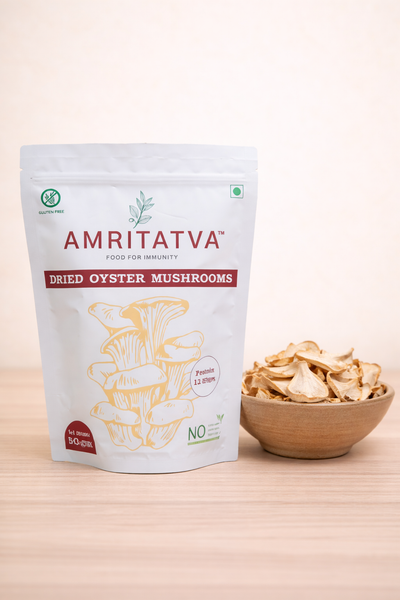
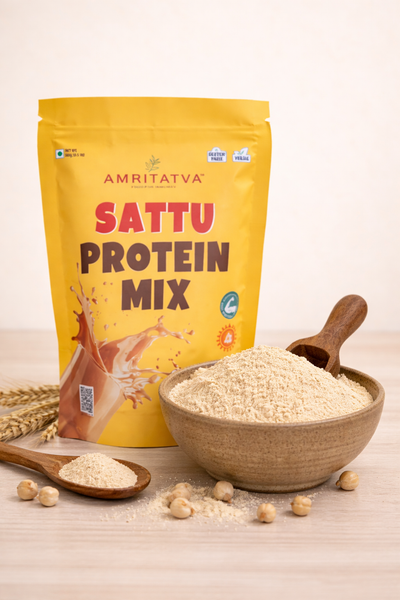
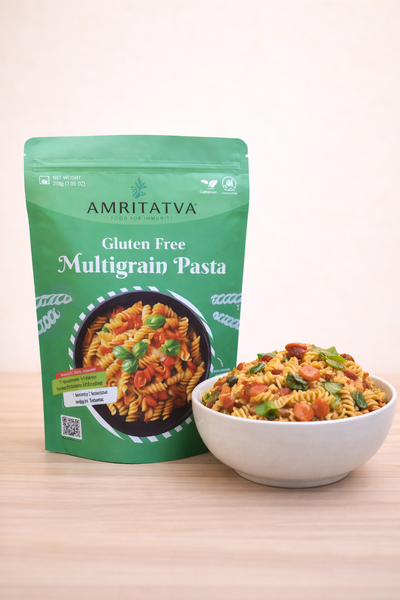
Amritatva's current product range is built around incorporating oyster mushrooms into familiar foods—including mushroom powder, dried mushrooms, pasta, noodles, sattu and seasonings.
That approach is intentional.
For an Indian household, a food ingredient has an advantage when it can move naturally from the pantry into dal, rice, khichdi, vegetables, soups or other familiar meals.
There is no need to turn every nutritious ingredient into a dramatic wellness trend.
Sometimes the more useful question is simply:
Can I actually use this regularly?
What should consumers look for when buying mushroom products?
Before buying any mushroom powder or mushroom-based wellness product, consider asking:
1. What mushroom species is used?
The species should be clearly identified.
2. Which part of the mushroom is used?
Look for clear information about fruiting body, mycelium or other components.
3. What else is in the product?
Read the complete ingredient list rather than relying only on the front label.
4. Are the important claims measurable?
If a product highlights a specific compound or nutrient, look for appropriate testing information.
5. Is the product suitable for your dietary requirements?
Check the actual label .
6. Can the product fit into normal meals?
A product that fits your routine is more practical than one that requires an elaborate daily ritual.
What is the real difference behind the Amritatva mushroom powder?
The strongest product story is not:
“This mushroom will transform your health.”
It is:
“Here is the ingredient. Here is how we formulate it. Here is what we test. Here is how you can use it.”
Amritatva's Oyster Mushroom Powder is made from 100% oyster mushroom fruiting body, with the brand stating no fillers or grain powder and third-party testing for specified parameters. It is produced in India and positioned as a food ingredient for everyday use.
That is the kind of product transparency we want to build around.
Because when it comes to food, trust should come from what you can understand and verify—not from how impressive the promise sounds.
FAQs
1. What is Amritatva Oyster Mushroom Powder made from?
Amritatva states that its Oyster Mushroom Powder is made from 100% dried oyster mushroom fruiting bodies, specifically Pleurotus ostreatus. The current product information says it contains no fillers or grain powder. It also describes the powder as vegan and gluten-free. Consumers should always check the current product label for the most up-to-date ingredient.
2. Is oyster mushroom powder the same as a mushroom supplement?
Not necessarily. Mushroom products can differ considerably in their ingredients, mushroom species, processing and intended use. Amritatva positions its Oyster Mushroom Powder as a food ingredient that can be incorporated into everyday meals such as dal, rice, soups and smoothies. It is therefore better to evaluate the actual formulation and label rather than assuming all mushroom powders or supplements are equivalent.
3. Does oyster mushroom powder boost immunity?
Oyster mushrooms contain naturally occurring compounds such as beta-glucans that are being studied for their biological effects. However, it is not appropriate to treat ordinary mushroom powder as a guaranteed immune-boosting or disease-preventing product. A varied diet, adequate nutrition, physical activity and other lifestyle factors contribute to overall health. Amritatva's product story is strongest when focused on its ingredients and testing rather than guaranteed health outcomes.
4. How can I use oyster mushroom powder in Indian cooking?
You can use mushroom powder as a savoury ingredient in familiar foods. It can be mixed into dal, soups, khichdi, rice preparations, vegetables or other dishes where an earthy umami flavour works well. Amritatva also describes its powder as suitable for use in smoothies and other everyday foods. Start with the amount recommended on the current product packaging and adjust according to taste.
5. What is the difference between mushroom fruiting body and mycelium?
The fruiting body is the visible mushroom structure, while mycelium is the network of fungal filaments from which mushrooms develop. Mushroom products can be made from either or from combinations of different materials. Amritatva specifically states that its Oyster Mushroom Powder uses the fruiting body and does not contain mycelium biomass or grain substrate residue.
6. Is mushroom powder a substitute for other nutritious foods?
No. Mushroom powder can be one ingredient within a varied diet, but it should not be treated as a replacement for vegetables, fruits, pulses, whole grains or other appropriate foods. WHO's healthy-diet guidance emphasizes dietary diversity, balance, moderation and adequacy rather than relying on one food to provide all nutritional needs.


0 comments